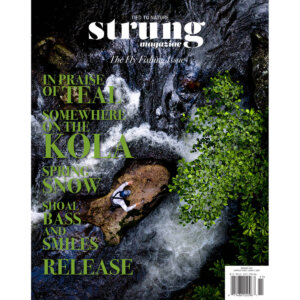
STRUNG Dispatch: from print magazine to digital newsletter

STRUNG Dispatch: from print magazine to digital newsletter

Find Us On Social

To our loyal readers and print subscribers – we sent an email June 14, 2025 explaining our decision to shutter our print operation with the Winter 2024 issue. We have received some emails and questions about this and it is apparent that not everyone received our email. The letter is below.

Suffice to say that we had to shutter our print operation as we just could not keep up with the rising cost of print. All paid subscriptions (both personal and gift) will be fulfilled by the Virginia Sportsman. It’s a great outdoor magazine that ventures far beyond the state lines, and features great writing on hunting, fishing, and outdoor culture.

The good news is that not only will you have another great magazine to read, but we aren’t going anywhere. We had to adapt, and that adaptation is Strung Dispatch. We will be sending a high quality email newsletter once a month, with a mix of hunting and angling pieces. It is totally free. No fluff, no artificial intelligence, just good outdoor writing, photography, recipes, gear reviews when we find them worthwhile, occasional gear giveaways, all within your email inbox, once a month. If you liked our print magazine, we suspect you’ll like the Dispatch. Sign up simply requires a valid email address. That’s it.

*******

June 14, 2025

Dear Subscriber,

Strung Sporting Journal has striven to be an independent and unique voice among hunting and fishing magazines since its inception. Thanks to the work of many talented and creative contributors, as well as your fidelity and support, we think we’ve succeeded beyond our wildest dreams in publishing a quality outdoor journal that’s unlike any other.

The bad news. Success in delivering an outstanding product unfortunately hasn’t translated to business success for the magazine. So with great disappointment, it’s our sad duty to inform you that Strung Sporting Journal will cease print publication effective with our Winter 2024 issue.  

The good news.  Although Strung Sporting Journal will no longer be in print, we will continue publishing the types of stories and images that have inspired and entertained readers through our free digital monthly newsletter Strung Dispatch. Our commitment to publish the content you’ve come to expect remains resolute – only the medium is changing. Sign up is quick, free, and easy at this provided link.  We hope you’ll continue on with us as we launch our inaugural issue early July 2025.

Any remaining Strung Sporting Journal subscriptions will be fulfilled by The Virginia Sportsman, beginning with their Summer 2025 issue. The Virginia Sportsman is a high quality quarterly magazine similar to Strung Sporting Journal. Topics venture far beyond the state’s lines, and cover fly fishing, hunting, and other sporting interests from around the country and world. We love it, and think you will too.  

We arrived at these decisions after much thought and soul-searching—and after our best efforts to minimize costs while continuing to meet your expectations for a high-quality print magazine. Our owners have spent no small amount of time, money, and effort—as well as physical and mental energy—to make Strung a great magazine. But the sad reality is that the headwinds of a rapidly changing media landscape have been too much to overcome, and despite our best efforts and intentions, we can no longer keep going financially with our print magazine. 

Your passion and affinity for Strung has been unwavering. Your fervor for this magazine has never been the issue and is the reason we will press forward through our new digital medium. Please feel free to contact us at business@strungmag.com if you have any questions.

With Gratitude,

Sammy Chang

Michael DeJarnette

Trey Reid

Don Thomas

HUNTING WOODCOCK – SCOUTING HABITAT IN THE OFF SEASON

HUNTING WOODCOCK – SCOUTING HABITAT IN THE OFF SEASON

By Edgar Castillo

It was a gloomy, overcast day. There was a bit of chill in the air, enough where I had to zip up my jacket even further to keep the chilly breeze out. My boots trudged along the worn path without purpose as we walked past tangled messes of saplings. Patches of red sumac swayed gently in the wind, as Mallards could be heard in the distant background, and crows overhead squawked at our uninvited presence. It was late February, and they were all but subtle reminders of a bird season that had ended roughly four weeks prior. I was glad to be back out and excited for the possibility of coming across spring woodcock migrating through Kansas.

My friend Rich and I were following up on a tip that woodcock were making a layover in The Sunflower State as they returned north. They are known scientifically as Scolopax minor, but colloquially referred to as timberdoodle, bog sucker, swamp & night partridge, Labrador twister, mud snipe, timber rockets, and “dood’s” or doodles. No matter what they are called, our goal was to pinpoint their specific habitat, so we could hunt them in the fall on their reverse migration south. For years there had been rumors of the little pudgy bird with oversized black eyes and elongated bill living in the damp shadows as it stopped between flights in Kansas. There was no hard evidence, only chance encounters by a very few quail hunters.   And even less eyewitness of the mythic bird during the spring. Until now. 

An amped up, small, tricolored blur bounded about like an excited child at a playground. The mostly black, little French dog was excited to have returned to the field to do what it was bred and trained for…to find birds. Stormy zipped by us, almost causing me to trip when she abruptly stopped in mid stride. Suddenly, a trilling fluttering of wings launched from the ground. My brain immediately processed the twittering sound and sent a message to my mouth, where I loudly exclaimed, “Woodcock!” I had not heard the familiar sound since hunting Southern Missouri last October, and certainly, never in Kansas! 

Optimal Woodcock Habitat & the Woodcock Dance

As woodcock journey home, they make stopovers in the central states in early spring. The birds key in on specific habitat such as moist, young forests or shrubby old fields and thickets, which are concentrated along edges and riparian areas. These specific sites provide ample cover and food resources as they probe for earthworms. This makes their distribution in Kansas limited to the eastern side of the state. 

These plats also become a place for males to court females by establishing “singing” grounds. At dawn and dusk, males perform ground displays by making their trademark nasaly “peent” call, then spiraling upward to fly over the singing ground. As males execute their aerial “sky dance,” air passes through the wings, creating a unique twittering sound. While zigzagging downwards in flight, melodic chirps are sung. Once mates are chosen, nesting is typically from early March into June. Nests are created in slight depressions on the ground amongst dead leaves in young upland woods. Females lay one egg a day until completing a normal clutch of four. 

The area we were in met all the requirements needed by the birds. Walking, we found woodcock splash or chalk scattered about – vital indicators of prime habitat.  The various island thickets and edges of tangled groves we passed were met by flushing birds. 

Woodcock splash or chalk.

An excellent resource for wingshooters to track both the spring and fall woodcock migration is the Migration Mapping – RGS (ruffedgrousesociety.org).

Scouting Success

More often than not, woodcock sensing pressure would take flight just as Stormy would pick up their scent. On a few occasions the wind played favor to Stormy, leading to statuesque points that resulted in photo captures.  Sometimes, the woodcock would run along the ground before bursting through twisted brambles. Each time we watched the overly plump birds whisk away effortlessly, only to set back down a short distance away. 

I have always described the underside of the woodcock’s wings as “pinkish,” highlighted with an orange-buff belly. The whistling-like chirp produced when flushed is similar to the takeoff sound of mourning doves. Its rhythmic whistling notes are a delight to hear as they depart post haste almost bat-like, twisting and banking, flying a short distance to land in another thicket. 

For three hours we explored a large area focusing on very distinctive habitat.  A slight change in the landscape would be met with no woodcock.  We in turn would abruptly turn around and within a fleeting period of time find woodcock again.  This cat and mouse game resulted in a dozen birds being located.  With their cryptic camouflage pattern, they morphed into the littered ground debris, while being pointed by Stormy.

With a renewed enthusiasm of finally finding the diminutive, little shorebirds in Kansas, we returned repeatedly. Each time, we took note of the weather patterns and focal points of habitat where we had previously located birds. Over a period of three weeks with fluctuating temperatures, we returned four more times, cataloguing counts of 25, 27, 18, and 8 on my flush counter, not including re-flushes. 

In the end, the month of March had me walking thickets with an energetic French Brit in search of woodcock.  We pieced together pieces of a vegetive puzzle that we hope proves its worth when the season begins.  Dare I say that come October, if their migration south can be dialed in…ohhh, what a wonderful time it will be to chase ‘doodles in Kansas. 

“I want there to be woodcock forever flying over in October, and solitude…” 

– George Bird Evans

“The woodcock is a living refutation of the theory that the utility of a game bird is to serve as a target, or to pose gracefully on a slice of toast…Since learning of the sky dance, I find myself calling one or two birds enough. I must be sure that, come April, there will be no dearth of dancers in the sunset sky….”

From A Sand County Almanac – Aldo Leopold

Nootka Wilderness on the Fly

Nootka Wilderness on the Fly

Three years ago I received a call from a friend who detailed a special place in Northwest Canada. A floating barge hidden in a cove just off the Pacific coast called the Nootka Wilderness Lodge. Every year a group of friends assemble at this location for four nights and five days of chasing species like salmon, halibut, and lingcod. It’s not particularly about the fishing as it is the yearly gathering to catch up over a common hobby, in a remote destination, with amazing food and accommodations.

Nootka Wilderness Lodge is nestled 40 minutes outside of Campbell RiverNootka Wilderness Lodge nestled 40 minutes outside of Campbell River

But lets be honest, the fishing is absolutely incredible. Unfortunately, like the rest of the world the last two COVID years have been tough. Restricting access to the lodge’s business and out of country travelers ability to visit. Luckily, the worst seems to be behind us and “normal” life resumes. This year, the crew reunited for its triumphant return to the Pacific waters.

One of the 5 plane rides to our destination.

Ever since I managed to hook a king salmon with an 8wt in the Milwaukee River I have been itching to chase chinook again. After some internet recon on the local waters there in addition to help from the lodge, I was able to come up with a game plan to specifically target coho salmon. Here’s the scoop, while most of the other anglers are chasing chinook by trolling large flashers with trailing spoon lures at 60-100 feet deep I was told coho salmon have been known to make their way to the surface chasing bait fish. The plan consisted of throwing an 8wt with Orvis Depthcharge 300 grain sinking line, a 20lb floro leader, and a de-barbed buck tail fly (thanks to the Phoenix Orvis fishing manager Jakob for helping tie a few) about 20-30 feet into the prop wash of the boat’s motor.Here’s the problem, somehow my 7wt made its way into the Clearwater 8wt rod holder so that’s what we ran.

Fly Fishing in CanadaAmazing views off the boat watching Bald Eagles fish on their own.

Long shot, right? Well if you’re anything like me, you would rather spend eight hours on the water throwing streamers off the back of the boat all day than sitting and wait for tackle in a rod holder to wiggle. Some laughed, some questioned, including my fishing partner on the boat who worried I would just get in the way citing “there’s no way you will catch anything, you aren’t deep enough”. I won’t lie, after about 40 minutes even I worried in my execution. I started changing the length of the presentation, slowly stripping line, quickly stripping line, and then the line snapped tight. “Fish on!” – I hear the boat caption behind me start to laugh and “unbelievable” murmured in dismay spoken by my boat buddy. The Hydros reel drag immediately began to sing as the fish went for the first of many runs out and deep. The fish finally tired and appeared within eyeshot only to hear the caption exclaim “holy cow, that’s a king!” as he netted the fish. Shortly after, we were able to hook into a couple of cohos before the Pacific weather stepped in.

Fly Fishing in CanadaSometimes, proving people wrong is such an accomplishment.

After chatting with the lodge about wanting to do some more fly fishing, I was able to convince on of the fishing managers to arrange for a three person plane to pick us up and deliver us to a remote lake only accessible by water taxi. It was a recon mission since neither of us had ever been there but heard there were cutthroat trout cruising around. We packed the plane with Yeti panga bags, a few cold All Hands, inflatable stand up paddle boards, and the trusty Garmin In-Reach just for good measure. This was reinforced because as soon as we threw our bags off the plane into the white sand of the lake’s beach we noticed it was littered in bear, wolf, and deer tracks. After inflating the paddle boards we quickly moved towards the less windy side of the lake noticing a shawl smack in the middle of the lake.

Fly Fishing in CanadaGear dropped! Someone’s exited to hit the water… and away from these bear/wolf tracks.

Unfortunately, the water was extremely comfortable and not as cold as expected leading us to believe the streamers we packed likely wouldn’t be effective unless deep. In true fashion, neither of us packed strike indicators. Somehow one of our bags held a wine cork. I was able to gnaw off a side of the cork (tougher than you would expect with only your teeth) to rig up a make shift strike indicator enabling me to throw a blood leach and midge approximately 30 feet deep. Luckily, we were able to get into a handful of fish before the wind kicked up turning our stand up paddle boards into sailboats. We get spoiled with our Fishcats and flippers in days like these. That said, I still wouldn’t have traded anything to have had the opportunity to enjoy that experience.

Fly Fishing in CanadaOur first fishing spot of the day.

A few years back, I decided to make a conscience effort to start saying yes to opportunities like these. Obviously, it’s a tremendous help to get invited for the opportunity to go to places like these but it is more experience driven than location. Really helping to find yourself by embracing experiences in situations that most others would excuse as “too busy” or “don’t have time”. It could be as easy as exploring new waters near where you live or just spending a night in a tent somewhere you have never been. Putting yourself in uncomfortable (not to be confused with unsafe – minute the bear/wolf tracks above) situations often are remembered more fondly than finishing the next bingeworthy series on your tv streaming service.

Fly Fishing in CanadaOur Nootka Wilderness Crew

Chuck Coolidge lives in Phoenix, Arizona, and travels a lot to feed his fly-fishing passion.


Breaking Up With Alaska – Dave Zoby

Rainbows of the Far East: Surviving Kamchatka – Part Two


Project Land Locked

Project Land Locked

[vc_row type=”in_container” full_screen_row_position=”middle” column_margin=”default” scene_position=”center” text_color=”dark” text_align=”left” overlay_strength=”0.3″ shape_divider_position=”bottom” bg_image_animation=”none”][vc_column column_padding=”no-extra-padding” column_padding_position=”all” background_color_opacity=”1″ background_hover_color_opacity=”1″ column_link_target=”_self” column_shadow=”none” column_border_radius=”none” width=”1/1″ tablet_width_inherit=”default” tablet_text_alignment=”default” phone_text_alignment=”default” overlay_strength=”0.3″ column_border_width=”none” column_border_style=”solid” bg_image_animation=”none”][vc_column_text]Inspired by this research and public land access challenges across America, #PROJECTLANDLOCKED is a new film that explores the complex history of landlocked public lands and looks at what the future may hold for our outdoor recreation access. #PROJECTLANDLOCKED was produced by Jason Matzinger and is presented by the TRCP, onX, and the Rocky Mountain Elk Foundation[/vc_column_text][/vc_column][/vc_row][vc_row type=”in_container” full_screen_row_position=”middle” column_margin=”default” scene_position=”center” text_color=”dark” text_align=”left” overlay_strength=”0.3″ shape_divider_position=”bottom” bg_image_animation=”none”][vc_column column_padding=”no-extra-padding” column_padding_position=”all” background_color_opacity=”1″ background_hover_color_opacity=”1″ column_link_target=”_self” column_shadow=”none” column_border_radius=”none” width=”1/1″ tablet_width_inherit=”default” tablet_text_alignment=”default” phone_text_alignment=”default” overlay_strength=”0.3″ column_border_width=”none” column_border_style=”solid” bg_image_animation=”none”][vc_video link=”https://youtu.be/4yvyFIr1j4U?t=25″][/vc_column][/vc_row]

Editor’s Notes – Summer 2021

Editor’s Notes – Summer 2021

From the Editor
Summer 2021


sporting magazineThis is an exciting time for Strung. In the fall of 2020, we announced a fleet of new department editors who have since brought a depth of outdoor knowledge and powerful storytelling to our magazine. It has been a pleasure to get to know them better over the last several issues.

Jenny Nguyen-Wheatley’s approach to wild food is both lyrical and grounded—a hard line to walk, but something she does issue after issue. Take, for example, her recipes for Grilled Wild Boar Bánh Mì and Plum Brandy in this issue. Every time she sends me her work, I quickly compile the ingredients, cook the thing, take a bite, and wonder how she does it. 

It seems whenever I speak to Strung’s Waterfowl Editor, Don Thomas, he is either heading out to or coming back from a hunting and fishing trip. To say Thomas is well versed in the outdoors is the understatement of the century. He lives a life us mere mortals dream of: hunting with a bow; fly fishing for everything that swims; loading dogs, decoys, and shotguns; or following his pointing dogs around. He’s also the only person I know who has caught a halibut on the fly. It doesn’t hurt that the guy is also a damn fine writer.

Speaking of writers, I am continually amazed by Dave Zoby’s ability to produce the most meaningful and nuanced writing in the outdoor space. In an industry fueled by ego, his work is both brutally honest and hauntingly beautiful. We are immensely fortunate to have him as our Fly Fishing Editor. 

By contrast, our Upland Editor, Tom Keer, is a scoundrel. Don’t get me wrong:  I mean that in the best possible way. Somewhere along the line he figured out that turning a journalistic eye to the outdoors results in writing that is humble, insightful, and refreshing. If he could shoot as well as he writes, the grouse and woodcock near his home would be in serious trouble. 

Our Conservation Editor, Reed Knappe, is aloof. I never hear from him, and he doesn’t answer the phone. When we have a deadline approaching, he makes me lose sleep at night. I might get a text saying, “I’m camping in the desert researching the mating behavior of Gambrel’s quail and won’t have cell service or internet access for a month,” or “Can’t talk right now. I’m on the Trans-Siberian Railway somewhere north of Mongolia, and the Russian soldiers on the train are questioning the taxidermied boar’s head I have with me.” Then at the last possible minute he turns in writing that is incredibly well researched, beautifully written, and thought provoking. How he does it remains a mystery.

When we announced these new positions, many readers noticed a gap. Where, they asked, is the Big Game Editor? Are you still including big game content? It was a big hole to fill, and we were waiting for the right person to fill it. I’m happy to say it was worth the wait. Andrew McKean has been writing about the outdoors for more than 30 years, and I’m excited to introduce him as Strung’s Big Game Editor. McKean grew up on a Missouri farm but followed the pull of the West to Eastern Montana where he began working for weekly newspapers for his first “real jobs” before joining the staff of the defunct Fishing & Hunting News. He found he could compile content for the biweekly in the span of a week—and then spend the other week roaming his beat with a fly rod and an eager dog. 

fly fishing magazine

From there, McKean worked for Montana Fish, Wildlife & Parks before becoming the Hunting Editor for Outdoor Life. McKean served as Hunting Editor for four years and as Outdoor Life’s Editor-in-Chief for another four years before beginning a career as a freelance writer and editor. He has been a finalist for an American Magazine Award (ELLE), won a few state conservationist awards, and is a hunter education instructor as well as a high school track coach.

I look forward to getting to know McKean better, but I can already tell you one thing: The guy is a hunter. He’s hunted five continents, taken all but a handful of North American big game species, and is perfectly at home in Eastern Montana, where other, more citified folks might lose their minds. “I came for a job and stayed put for the last 20 years because the hunting and fishing are so good,” he explained. Although he has hunted Spanish ibex with a crossbow and paddled through British Columbia in search of moose, his first contribution to Strung is about hunting in his backyard. In it he explores the deep sense of place that hunters develop after years of burning boot leather and surveying their hunting grounds. 

When I asked McKean what else I might add to this introduction, his response was fitting: “I don’t know what else to add. That sounds like a decent obituary to me.”

I am humbled to work with such authentic and talented people. 


Keep casting,

Strung Magazine is a premium sportsman's quarterly journal

Ryan Sparks
Editor-in-Chief


Don & Lori Thomas win Ted Trueblood Award 

Don & Lori Thomas win Ted Trueblood Award 

The Ted Trueblood Award is presented by BHA for exceptional communications work informing and inspiring people for the benefit of public lands, waters and wildlife. Don and Lori Thomas are the 2021 Trueblood award honorees. Two individuals who both are experts in communicating the outdoors experience with passion and grace, Lori shoots evocative photographs that have appeared in dozens of books and magazines, while Don is a giant in North American outdoor writing, on the masthead of numerous publications (including as co-editor of Traditional Bowhunter magazine, winner of the first Trueblood award ever presented) and author of 20 books.

“Don is an outspoken advocate for public lands and waters who’s known for never suffering fools gladly and for speaking his mind, regardless of personal costs,” said Katie McKalip, BHA communications director. “In this respect, I think he embodies some part of the spirit of BHA…that willingness to say the things that need to be said on behalf of the places and opportunities we all hold dear. Lori is an accomplished outdoor photographer who’s supplied hundreds of photos for Don’s writing and whose images are widely published in outdoors media.

Trueblood awards“While the work by Don and by Lori stands alone, they are inseparable as a partnership,” McKalip said. “This is worth recognizing as well. Those of us who have experienced a partnership like this know that it exists as part of and also apart from us as individuals. A great partnership makes us stronger, helps us grow and become better, helps ground us and balance us.”

From Strung Magazine:
We are fortunate to have this high caliber duo associated with our publication. Kudos to Don & Lori, who have been an instrumental part of the recent growth of Strung Magazine.  We thank you for your many contributions, your rock solid consistency and most of all, your dedication to the outdoors.

Strung Magazine is proud to claim you as contributors, editors, and partners. Strung Magazine would not be the same without you.  We proudly recognize your current achievement and look forward to many more future accomplishments.


Strung Magazine - Fly Fishing Magazine

SUBSCRIBE TO STRUNG MAGAZINE

https://pnt.tta.mybluehost.me/heart-darkness-e-donnall-thomas-jr/


https://pnt.tta.mybluehost.me/coffee-with-don-thomas/

https://pnt.tta.mybluehost.me/about-strung/