A makeshift military parade seemed to be taking place in the receiving area of the local food pantry in Petersburg, West Virginia. A pair of Marines entered the building first, followed closely by a sailor, and then a couple of soldiers in lockstep. Curt Boatman, a full-time airline pilot, came in last. Like the rest of those in his party he was wearing civilian clothing and a ball cap, the bill of his hat festooned with the occasional fly. He clutched a cardboard box running over with cereal, rice, spaghetti, and peanut butter. With Christmas only two weeks away, Melissa Collins, who volunteers at the Petersburg Interfaith Pantry, was overjoyed at the sight of the delivery: The arrival of the food couldn’t have been better timed. “We figured you could really use this right now,” Boatman grinned, adding, “And we have a whole lot more outside.”
One of the Marines spotted a hand truck in the corner of the room, and without saying a word went back outside, hand truck in tow. Minutes later he was back with case after case of green beans, canned corn, and stewed tomatoes. Once they’d been weighed, his colleagues stacked the cases with military precision. Boatman looked on his crew with admiration but said nothing; this was the kind of excellence he’d come to expect from his teammates. Because he is an airline pilot one might assume that Boatman would be a bit of a control freak, but this could not be farther from the truth. Although he somehow manages to be at the center of any work that needs to be done, he’s quite content to stay behind the scenes.
Boatman is a Regional Coordinator for the nonprofit Project Healing Waters Fly Fishing (PHWFF), which provides emotional and therapeutic support to veterans through fly fishing, fly tying, and various outings. Boatman serves as a go-between, helping PHWFF National Headquarters coordinate with individual programs in Virginia—among them the Quantico program headed by Program Lead Marty Laksbergs (USMC, Ret.), and the Fort Belvoir program headed by Program Lead Bob Gartner. Laksbergs and Gartner often collaborate to provide maximum impact for their participants. For the past few years I’ve had the privilege of shadowing Laksbergs’ and Gartner’s programs while doing primary research for a book on veterans and the therapeutic effects of fly fishing. I met Boatman through PHWFF, and our relationship has grown stronger with each passing year.
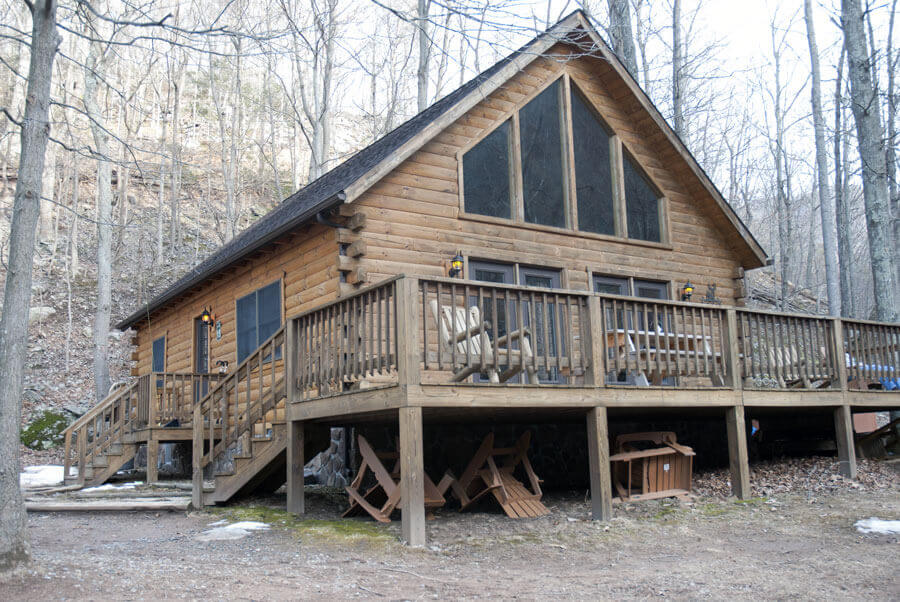
Every December for the past decade, dozens of veterans from across the country gather at Harman’s Cabins in West Virginia. The Quantico and Fort Belvoir programs are particularly well represented at the gathering; Harman’s has become a beloved weekend-long tradition during which these veterans celebrate all things fly fishing. The Harman family is well prepared for the onslaught of warriors; they’ve been hosting visitors to their property for more than 50 years.The nearly two dozen log cabins sprinkled along the edge of the North Fork of the Potomac River may appear rustic, but these outposts come complete with full kitchens, fireplaces, grills, and even hot tubs. The surrounding mountain scenery is captivating, and the nearby river is stocked generously with trout. Gartner stumbled across the property while on a fly fishing foray in West Virginia and immediately fell in love with the place. Recognizing its potential as an ideal gathering place for veterans, Gartner promptly contacted Laksbergs.
About 16 people attended the first Harman’s gatherings, and that included volunteer staff who cooked the meals; these days the annual getaway draws nearly 100 participants. The event has become so popular, in fact, that organizers now rely on a community hall and a caterer to feed everyone. Breakfast and dinner are held at the hall, and lunch is cooked over a campfire in a huge black kettle near the river. Expenses are paid for both participants and volunteers, thanks to the generosity of the Harman family and a PHWFF grant. This means that lodging, meals, and a complete fly rod-and-reel outfit for first-timers are all provided. Participants enter numerous raffles to win donated items like nets, chest packs, waders, fly lines, guidebooks, fly-tying vises, and fly-tying materials.
About five years into the annual gathering, Laksbergs was so moved by the generous support the group had received from West Virginia locals that he decided the visiting vets needed to give back to the local community. Eager to help those most in need, Laksbergs suggested thatparticipants and volunteers each bring a small donation of canned goods for the local food pantry. Thus far Laksbergs’ request has resulted in donations yielding nearly six tons of food for local residents.
The Harman’s weekend begins on Friday afternoon when participants arrive and drop off their food donations with Laksbergs, who then assigns vets to a cabin. After check-in, participants are paired with a guide and spend the next two days fishing the river. Some guides are professionals who take this time off to volunteer for this special weekend. Some guides may be veterans, who not long ago were experiencing Harman’s for the first time themselves. After breakfast the day is spent trying to land beefy rainbows and wily brown trout, some of which barely fit into nets newly acquired the evening before. After a short lunch break, participants head back to the river until the evening meal in the dining hall, during which vets and guides share tales of fish landed and lost and swap photos of smiling anglers and their catches.
Later that evening rods are exchanged for fly-tying vises. Some participants tie flies into the wee hours of the morning; others break up into small groups to share their physical and emotional burdens with the only other people on earth who can truly understand them. The distinction between participant and guide has dissolved, perhaps washed away by the current of the river or the camaraderie born of bringing a reluctant trout to hand together. What remains are new relationships and memories of time well spent with newfound friends.
Of course, the annual Harman’s weekend didn’t happen in December 2020. Like every other organization, Project Healing Waters had halted all in-person gatherings in the face of a global pandemic. So the long-anticipated Harman’s trip had been canceled. But for Todd Harman, joint owner of the property and longtime supporter of PHWFF, that couldn’t be the end of the story of 2020. Aware that many veterans live on fixed incomes and that others might have been out of work for months, Harman contacted Laksbergs and Gartner to offer up a number of cabins free of charge. Laksbergs and Gartner in turn reached out to their program members to gauge interest, stressing the fact that this was an unofficial invitation to a non-PHWFF affiliated weekend getaway.
When I received Laksbergs’ email, I jumped at the chance to attend. An extrovert by nature, I’d been floating alone on a dwindling slip of ice in a sea of isolation. Initially I had relied on frequent trips to the grocery store to keep me sane; now, with the ubiquitous masks, warning signs, and one-way aisles, picking up milk felt like venturing out into the zombie apocalypse. So Laksbergs’ email was extremely tempting, even though he made it clear that at this unofficial gathering we would not share group meals. Those attendees inclined to wearing masks, he continued, were welcome to do so, and fly tyers would be encouraged to spread out while at the vise. And although this was emphatically not a PHWFF event, Laksbergs requested that participants bring canned goods for the local food pantry as usual.
It will come as no surprise to anyone that participants rose to the occasion. Boy, did they ever: The unofficial December 2020 gathering was the smallest on record—and yet the food donations easily eclipsed all previous annual hauls. What’s more, on top of their record-breaking food contribution, participants donated more than $1,500 in cash so that Collins could purchase whatever else the food pantry might need.
Virtual meetings have their place. In fact, many of us dinosaurs, skeptical of technology at the best of times, have learned to be grateful for the digital lifeline our forefathers lacked. Some social activities—book clubs and writing groups, for example—may translate particularly well to the virtual platform. Fishing is, of course, not one of those activities. Fishing means being outdoors. Fishing leaves you feeling better whether you catch a fish or not. Simply disconnecting from the frenetic world of zinging text messages and tweets and social media posts provides a sense of calm. “Angling is an art,” said Izaak Walton, “which you enjoy when you purpose to give rest to your mind and divest yourself of your more serious business.” Fly fishing, with its rhythmic casts, constant micro-adjustments, and endless fly patterns, becomes all-consuming. It is this pleasant reprieve from the pains and stresses of life that restores a sense of inner peace. Wade in the river, and quietlysoak in the calm. And the only thing better than a good day of fishing is sharing that good day with a fellow angler.
This December I hope to return to Harman’s with Laksbergs and Gartner and those program participants committed to the hard work of restoring broken bodies and wounded souls.I look forward to helping Boatman and his crew deliver thousands of pounds of food to hungry fellow humans whom they will never meet. The volunteers who make Harman’s happen do so quietly, without expectation of being recognized for their faithful service to others. But the veterans whom they serve will attest that these volunteers save lives. We are not solitary creatures who can be easily comforted by computer screens; we are relational beings who need each other—and who sometimes need to be led by the hand back from the dark places we are tempted to wander alone.
The news cycle promises hope on the horizon in the form of vaccines, restriction lifts, and grand re-openings. It is of course my fervent desire that all nonprofit organizations will be able to make a big comeback this year, a return to their mission of helping those in need. But the people who give me the most hope for the future, the people I aspire to imitate, are those who never stopped.
Beau Beasley is the Director of the Virginia and Texas Fly Fishing Festivals. His latest book on the time he’s spent with members of PHWFF on their road to recovery will be released later this year.
With spring in full bloom and summer on the way, here are some of the books we’ve been enjoying.
Tenth Legion by Colonel Tom Kelly
Every year when turkey season approaches, we reach for our copy of Tenth Legion, arguably the greatest book ever written about the spirit of turkey hunting. Tenth Legion details the cult-like dedication and culture of hunting around this all-American bird. At times hilarious, at others poignant, and always intelligent and witty, Tenth Legion is unfiltered turkey gospel from one of turkey hunting’s most legendary figures. It’s one we read every year in anticipation of turkey season. Early spring mornings, gobbling toms, thunderstorms, shotgun shells, and full chokes—this is a “deviant subculture” we fully support.
Running Waters by Datus Proper
Datus Proper is probably the best outdoor writer most people have never heard of. From bird dogs to brown trout, he penned some incredible essays and short stories in his tragically short writing career. Running Waters is a collection of stories about people, rivers, flies, and fish. It presents Proper’s distinctive philosophy of fishing and life in lyrical essays that are on par with Hemingway and Harrison. Running Waters is filled with thoughtful observations on fly fishing: wild and beautiful fish, wild and beautiful places, wild and beautiful people. We highly recommend throwing this book into your pack and savoring it one essay at a time on a lazy streamside day.
You’re Not Lost if You Can Still See the Truck by Bill Heavey
No one can have you hurting from laughter one page, only to have you sobbing the next like Bill Heavey. Known for his dedication to being “America’s everyman outdoorsman” and immeasurable wit, Heavey has detailed his outdoor experiences in the pages of Field & Stream for more than two decades. Your Not Lost if You Can Still See the Truck, is a collection of more than 60 of his best essays. If you’ve never read Heavey before you’re in for a treat—think Mark Twain meets Hunter Thompson meets George Plimpton. While Heavey certainly “buys the ticket and takes the ride,” he also brings readers into his personal world, which at times involves tragedy, grief, and renewal. His essays are certainly funny, but they can also be raw and soul-baring. What we like most about Heavey is that whether he’s trying to catch a few fish or bag a big buck, he’s always alert to the absurdity of his pursuits and life in general, all while never losing reverence for it.
COVID-19 had a silver lining as it caused folks to trade indoor screen time to the great outdoors. Numbers in most disciplines-fishing, hunting, boating, biking, camping, kayaking, and the like-are off the chain. Swollen participation numbers in consumptive sports help fund Pittman-Robertson and Sportfish Restoration, and that means agencies have more money for education programs, stocking and habitat initiatives and clean water programs.
When it comes to fishing and hunting, we’re all one big fraternity, and that’s where COVID-19’s impact was negative; fraternity parties, the kind that come from fishing and hunting trade and consumer shows, were shuttered. A few shooting sports went on late in 2020, but virtually all of the fishing shows were scrapped, and all of the fly-fishing shows were put on hold.
A variety of paid and free casting classes were offered to festival attendees.
But phoenix’ do rise from the ashes, and that’s what made Beau Beasley’s 4th Annual Texas Fly Fishing & Brew Festival such a smash hit. Not only was Beasley’s show the first fly fishing industry to resume from the COVID backwash, but his did so in style. Beasley created a mixed-use event, with both indoor and outdoor activities. Mandatory safety precautions did not detract from his event. Sure there were wider aisles and limited attendance to meet state recommended levels. Classrooms were jumbo sized and required the wearing of masks and social distancing. Other sanitizing activities were arranged throughout the show space, and they all worked seamlessly together to give fly-rodders the one thing they craved: Hope.
Guide Karlie Roland spoke several times, and is seen here giving a casting demo.
The Texas Fly Fishing & Brew Festival brought together like-minded people for a two-day event at the end of February 2021. The event was the first since 2019 to showcase new product from over 60 manufacturers including major rod brands like Thomas & Thomas and Mystic Outdoors. Clothing companies like Kermode Outdoors and Dagon Apparel we also on hand as were multiple lodges and outfitters from Alaska, Canada, Texas, Colorado, New Mexico and Bolivia. Various non-profits like Fly Fishers International, Casting for Recovery, Altar Fly Fishing as well as Back Country Hunters & Anglers also participated. Programing was fun and festive. The Recreational Boating and Fishing Foundation’s Take Me Fishing helped sponsor pro guide Karlie Roland who offered a women’s focused seminar, Chris Johnson from the Living Waters Fly Shop talked about angling specific to Texas, while Executive Chef Jon Bonnell of the Bonnell Restaurant Group demonstrated cooking a favorite Texas fish, the redfish. Dallas-based Mariner-Sails offered one-on-one kayak fishing demos, and when it was all over, Master Brewer Peter Boettcher offered a DIY home brewing program.
This year’s Bourbon & Bass Bug Class was sponsored by Treaty Oak Distilling.
Beer goes well with fly fishing, so much so that a hatch of microbrews from Four Corners, Hop & Sting Brewing Company, SweetWater Brewery, and Tupps Brewery were on hand to “field test” their products. Beasley over-delivered by welcoming his first distillery, Treaty Oak Distilling. Jamie Biel, the Director of Science and Sustainability conducted a creative seminar called ‘Bourbon and Bass Bugs,’ which was the perfect way to learn about brown liquor while catching largemouths on the fly.
Les Gray from Southeast Productions orchestrates over a dozen consumer outdoor shows per year. After watching the cancellation of show after show, he’s happy to see a show like the Texas Fly Fishing and Brew Fest open for business. “In our industry for any event to have taken place the past 12 months has been a logistical feat that very few promotion companies have had the resources to tackle,” he said. “To have an event and be successful for the exhibitors while all the while keeping it safe for everyone… is and was a great accomplishment. Beau and his staff did a great job for his vendors and as the fly fishing enthusiasts showed… they were ready to support.”
Various lodges and guides both foreign and domestic were at this year’s festival.
The show must go on, and the show did go on, but not without hitting a few speed bumps. According to Festival Director Beau Beasley, “We pushed forward against some pretty rough opposition from nay sayers, but in the end I think we helped restore a sense of normalcy thanks to the City of Mesquite’s Convention and Visitors Bureau and all those hearty Texans who showed up. The fly-fishing industry thrives on strong personal relationships, and it is those relationships that saved the festival. I knew my sponsors and vendors were counting on me, and I wasn’t about to let them down.”
Now that the show is over, we’re all ready to fish. Spring is here, hatches are coming off, and saltwater fish are moving around. Maybe in 2021 we’ll have a little more normal year ahead. And if we don’t, we’ll look forward to Beasley’s next show. After all, we’re a fraternity, one that likes talking about fly-fishing with like-minded people over a beer. For more information on next year’s festivals, you can check out www.vaflyfishingfestival.org or www.txflyfishingfestival.org.
Have you ever wanted to improve your outdoor photography and writing skills? Have you dreamed of catching a Yellowstone Cutthroat on a dry fly?
This August, the National Bighorn Sheep Center in Dubois, WY is holding its first ever Wind River Writers Retreat for adventurous people who want to explore Wyoming and hone their skills. Strung Magazine’s fly fishing editor, Dave Zoby, will lead a week-long workshop that explores outdoor writing and publishing. Christine Peterson (http://www.shewillroam.com/) will focus on outdoor journalism. And Lee Ann Roripaugh will teach poetry. Mornings will be spent in intimate classroom settings, while the afternoons will be open for participants to roam and seek inspiration in the majestic mountains. Free activities include yoga, hiking, kayaking, fly fishing instruction, flint knapping, campfire conversations, live music, and more. The Whiskey Basin Conservation Camp, where the workshops will be held, is a sprawling, early-1900 ranch tucked along a singing trout stream. Meals and cabins are included in the tuition.
For shutterbugs, there are programs with wildlife photographers Bill Sincavage and Sandy Zelasko. Wildlife abounds, and these two artists are known for capturing images that tell complete stories.
Dubois is a true mountain town, one of the last Western destinations that retains its character. Only an hour away from Grand Teton and Yellowstone National Parks, Dubois retains its originality—you’ll see it in its wooden boardwalks and original buildings. There are no fast-food restaurants, or chains in Dubois. Instead, you’ll find friendly locals, nightly rodeos, and trout aficionados who know where to find the best cutthroat streams. Or better yet, workshop participants might book a half-day guided trip with one of the local fly shops There is a deep history here; petroglyphs are found along the gravel roads, and a side trip to the Wind River Reservation is totally possible for a person who wants to spend the afternoon getting to know the Shoshone and Arapaho cultures.
The keynote speaker will be Angus Thuemer, an award-winning investigative journalist for Wyofile.Angus pursues hard-hitting stories on environmental issues, wildlife preservation, and social justice.
The National Bighorn Sheep Center is a nonprofit dedicated to the education and preservation of wild bighorn sheep in North America.Funds raised from this event will go back to bighorn education and conservation. Contact Sara Bridge and her team at 307-455-3429. Or go to www.bighorn.org for more information.
Eukanuba Pro Trainer Al Arthur of Sandhill RETRIEVERS wins the 80th U.S. National Open Retriever Championship
Al Arthur of Sandhill Retrievers and his dog ‘Cropper’s Fire in the Hole’ wins the retriever world’s highest field trial honor, The U.S. National Open Retriever Championship
ST. CHARLES, MO, February 19, 2021
EUKANUBA™, a premium dog food brand specializing in high-performance nutrition for sporting and working dogs, congratulates pro trainer Al Arthur of Sandhill Retrievers and his dog FC-AFC Cropper’s Fire in the Hole (call name Deep) on their win at the U.S. National Open Retriever Championship. Held in November 2020 at the National Retriever Club in Giddings, Texas, the competition featured the top retrievers in the United States, with Arthur and Deep winning the championship.
“To qualify for the National Open, a dog needs seven points in designated field trials,” Arthur said. “While dogs can accumulate the necessary points by coming in second or third place, the requirement to have a first-place win makes the process so challenging.While COVID-19 related field trial cancellations made it difficult for dogs to qualify, nearly 70 world-class dogs qualified to compete in the 2020 championship.”
Arthur continued: “The judges did an excellent job of challenging dogs in the water and on land. Deep, a nine-year-old Labrador Retriever and veteran of the National, peaked perfectly over the course of the event. There were a lot of excellent dogs at the National, but Deep had plenty of experience. I’m thankful for the win, and proud to feed my dogs Eukanuba Premium Performance Sport 30/20, which undoubtedly helped provide a competitive edge for Deep.”
“The National is the Super Bowl of the retriever field trial world. All field trialers work hard, but Al’s work ethic is tremendous. His abilities and wins consistently rank him as one of the top five pro field trialers in the country. Al also won the 2015 National with FC-AFC Keeno’s Gizmo, and his knowledge of dogs, breeding and training is top notch,” said Brett Volmert, Eukanuba PRO Development Manager. “We are proud to have him on our Eukanuba Pro Staff and value his regular input into sporting dogs and their unique nutritional needs. Congratulations to Al on his significant win.”
Awards impact many people, and Arthur’s National win is no exception. Deep was bred by Virginia’s Dr. Jack Waltney and owned by Katherine Simonds of Morrisville, Vermont. Retriever field trialers recognize the Simonds name, as both Katherine and her late husband Pete are members of the Hall of Fame. Their contributions to the retriever world are significant, but despite significant wins they had never won the National.
“The best part of Deep’s win was calling Katherine to tell her,” Arthur said. “She and Pete have given so much to our sport, so the win serves as an exclamation point to their incredible contributions. A tear or two might have been shed.”
To read more about Arthur and Deep’s win and learn more about the achievements of Team Eukanuba, visit eukanubasportingdog.com.
Eukanuba™ For more than 50 years, Eukanuba has created premium nutrition that helps unlock the power and potential within dogs — from the unstoppable performance of sporting dogs to the life-saving abilities of working dogs, to the incredible companionship of service animals and family pets. Eukanuba formulas contain high-quality animal protein to help build and maintain lean muscle, DHA for healthy brain function, and vital nutrients to fuel a dog’s body, mind and energy. Eukanuba offers a range of formulas, each scientifically formulated for dogs with different activity levels, ages and sizes. Learn more at www.eukanuba.comor at www.eukanubasportingdog.com.
Welcome to Winter is a text conversation between photographer Doug Steinke and his friend Cory which ended up being a photo essay that was published in the December 2019 issue of Strung Magazine. The pre-game chatter while planning to decoy and hunt is something we all do but when it comes with world class visuals, it’s pretty hard to beat. All of the photos are, of course by Doug Steinke and he was responsible for the hash browns and eggs as well.
Friday morning. 10:00 am Platte River, Nebraska. Late November 2019
Cory: Hello
Doug: Is it snowing there?
C: Just started but it’s not sticking yet.
D: It’s about time winter got going. It’s been too warm for too long.
C: What we need is for this storm to bomb out.
D: Haven’t you seen the new forecast?
C: Not yet.
D: They upped everything. Blizzard warning for the Dakotas tonight. We’re in a winter storm warning. They upped the snow totals to 8-12″ by noon tomorrow and a blizzard watch tomorrow night. Northwest wind blowing 20-30 mph with gust to 50. Temps dropping to 10 degrees by sundown.
C: Really? Oh, that’s perfect! Maybe it’ll shape up like a couple years ago when we hunted that blizzard.
D: Yeah, we shouldn’t have been out in that storm.
C: Are you kidding? We didn’t even have to call. They just kept coming, wave after wave flying on the deck up the river.
D: Yeah. That was an epic day. It was totally worth it.
C: There were 5,000 canadas on the main roost yesterday and I saw more coming from the north on my way home last night.
D: A buddy who lives up by Mobridge, South Dakota said all their small water froze yesterday. Those birds have to be somewhere between here and southern South Dakota. Is Kevin out this morning?
C: Yes. He said they were just starting to see new birds migrating, but nothing was stopping. Lots of snows and specks heading south in a hurry.
D: They must be pushing ahead of the storm. If we can get to the blind tomorrow, we better be on our second cup of coffee by shooting time. There should be new birds roosting on the river and other hunters will kick them out of their decoys in the morning. We should have some easy decoying birds.
C: Why don’t we leave the full bodies in the trailer and just go with a few floaters and all the silhouettes? Then we won’t have to worry about brushing snow off the decoys.
D: Good Idea. I’ll bring extra brooms just in case. I’ll have two guys with me.
C: I’ll have two as well.
D: Perfect. I’ll stop by the grocery store and grab bacon, two dozen eggs and hash browns.
C: I’ll swing by the truck stop and grab some plates, more forks, and salsa packets.
D: Shooting time is 7:28 am. So, 6:15 at the gate?
C: Yep. Bring your dog tomorrow. I won’t have room with three of us.
D: Dude, there’s a huge flock of lessers flying over right now! They’re a mile high, headed south. It’s going to be tough to sleep tonight!
C: Yeah, it could be epic!
Doug Steinke is one of the best waterfowl photographers in the country. See more of his work and visit his studio online at the Siverbelly Workshop.


 One of the Marines spotted a hand truck in the corner of the room, and without saying a word went back outside, hand truck in tow. Minutes later he was back with case after case of green beans, canned corn, and stewed tomatoes. Once they’d been weighed, his colleagues stacked the cases with military precision. Boatman looked on his crew with admiration but said nothing; this was the kind of excellence he’d come to expect from his teammates. Because he is an airline pilot one might assume that Boatman would be a bit of a control freak, but this could not be farther from the truth. Although he somehow manages to be at the center of any work that needs to be done, he’s quite content to stay behind the scenes.
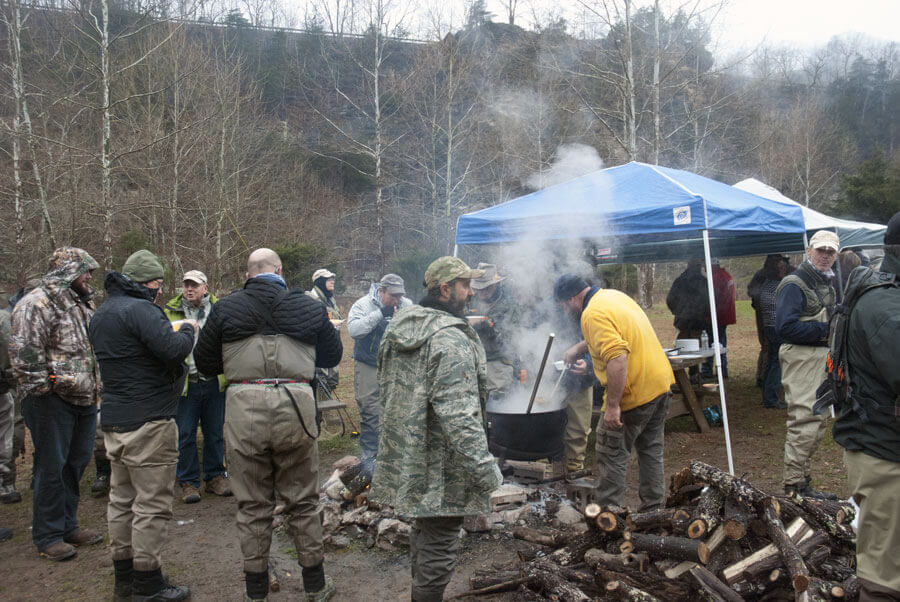 Every December for the past decade, dozens of veterans from across the country gather at Harman’s Cabins in West Virginia. The Quantico and Fort Belvoir programs are particularly well represented at the gathering; Harman’s has become a beloved weekend-long tradition during which these veterans celebrate all things fly fishing. The Harman family is well prepared for the onslaught of warriors; they’ve been hosting visitors to their property for more than 50 years. The nearly two dozen log cabins sprinkled along the edge of the North Fork of the Potomac River may appear rustic, but these outposts come complete with full kitchens, fireplaces, grills, and even hot tubs. The surrounding mountain scenery is captivating, and the nearby river is stocked generously with trout. Gartner stumbled across the property while on a fly fishing foray in West Virginia and immediately fell in love with the place. Recognizing its potential as an ideal gathering place for veterans, Gartner promptly contacted Laksbergs.
 About five years into the annual gathering, Laksbergs was so moved by the generous support the group had received from West Virginia locals that he decided the visiting vets needed to give back to the local community. Eager to help those most in need, Laksbergs suggested that participants and volunteers each bring a small donation of canned goods for the local food pantry. Thus far Laksbergs’ request has resulted in donations yielding nearly six tons of food for local residents.
 Of course, the annual Harman’s weekend didn’t happen in December 2020. Like every other organization, Project Healing Waters had halted all in-person gatherings in the face of a global pandemic. So the long-anticipated Harman’s trip had been canceled. But for Todd Harman, joint owner of the property and longtime supporter of PHWFF, that couldn’t be the end of the story of 2020. Aware that many veterans live on fixed incomes and that others might have been out of work for months, Harman contacted Laksbergs and Gartner to offer up a number of cabins free of charge. Laksbergs and Gartner in turn reached out to their program members to gauge interest, stressing the fact that this was an unofficial invitation to a non-PHWFF affiliated weekend getaway.
 SUBSCRIBE TO TAIL FLY FISHING MAGAZINE