Voluntary wing deposits help shape the future of upland birds and waterfowl
We had stopped momentarily, as I had observed the red barrel far off in the distance as we drove down from the sage flats. I exited the truck and went towards the back. I could see the spiny tail feathers protruding from my orange bird vest as they swayed gently in the wind. I reached for the vest and immediately felt its heft. The sage grouse is North America’s largest grouse. The bird derives its name, food, and shelter from the sagebrush on which it depends for its very life. The wavering smell of sage encompassed my surroundings and clung to my clothes.
Its physical appearance was striking. It had a mottled, brownish-gray body with white chest feathers. Its specialized head feathers and long black tail feathers with white tips distinguished it from a female. I had shot a big male. Later, while at a Wyoming Game and Fish Department Sage Grouse Checkpoint, I would learn the bird was approximately a two-year-old “bomber” based on the measurements of the wings and other identifying male features. I raised the gray bird and set it on the tailgate. From my pack I retrieved a pair of sharpened game shears. The wings were spread out. The primary feathers were brown in color, and the undersides were white. The right wing was removed by cutting it off at the joint as close to the body as possible.
I returned the sage grouse to its resting place in my bird vest. I walked to the barrel with the stenciled words “GROUSE WINGS” spray-painted in white on both sides. Below the barrel a sign with specific instructions for hunters to follow. Wyoming Game and Fish biologists have placed marked barrels at convenient locations in the field and near major access roads to popular hunting areas along highways. I placed the sole wing into the dark opening of the red container and walked away. What sort of information would be obtained from my sage grouse?
The number of sage grouse wings submitted depends mainly on the cooperation of hunters.Bird hunters who voluntarily deposit wings help biologists obtain valuable information. Personnel specifically look at the ninth and tenth primary feathers on each wing to determine gender. Shorter feathers would show that the sage grouse was a juvenile, born in the spring. The number of juvenile and female birds in the wing count give an idea of the sage grouse reproductive success. Hen feathers tell if there was success in raising a brood. Female sage hens that show signs of finished molting when killed are a good indication the brood was lost, which freed up energy to go into molting. On the other hand, wings that show a slower molting pattern indicate the hen spent the summer raising her brood. Wing data from harvested sage grouse are especially valuable in wet years, where the birds are spread out more across the landscape, making it harder to get a good sample on brood sizes. Researchers know that brood success combined with lek-count data from specific areas, such as places with recent prescribed burns, has led to areas closed to hunting to help sage grouse populations recover.
THE IMPORTANCE OF WING COLLECTION: SURVEY SAYS…
The importance of wing collection is vital towards the continued understanding of both upland birds and waterfowl, especially those birds that benefit from such retrieved information (sage grouse and lesser prairie chicken). Unlike pheasants, which are easily counted during roadside surveys, determining the reproduction of grouse and other game birds and providing a fall forecast to hunters is not as easy. State and federal agencies each do their part in conducting surveys through wing collection to better determine populations and set and evaluate hunting seasons and limits. Population gauge aside, the wing count also acts as an informal report card for agencies.
Greater Prairie Chicken Wing
The US Fish and Wildlife Service conducts the largest part of wing collection (dove, waterfowl, and woodcock) known as the Migratory Bird Parts Collection Survey. Wing surveys or wing-bees, as they are known, provide detailed information about the harvest. If participating in the federal survey, postage-paid wing envelopes are sent to randomly chosen hunters to send in their wings and parts to one of four collection points, one in each flyway. When the wings/parts arrive, they are sorted by species and stored in a freezer. The wings are then carefully reviewed for color, size, and shape of the feathers. Collected data are then entered into the national database for use in harvest management considerations.
Across the country in different regions, wing collection boxes or barrels are set up by various agencies and organizations (Ruffed Grouse Society, for example) for deposits from band-tailed pigeons, dove, grouse (blue, dusky, prairie chickens, ruffed, sage, sharp-tail), ptarmigan, snipe, and woodcock. Typically, hunters are asked to provide one wing from each bird taken.
An example would be the US Forest Service’s request of hunters in the Fort Pierre National Grasslands to provide a wing of each greater prairie chicken or sharp-tailed grouse shot. Collected wings help form a general idea of population conditions for upland birds in the grasslands. These chicken and sharp-tail wing counts are crucial, as they are umbrella or indicator species, along with prairie dogs. Their health and population numbers are suggestive of how animals who share similar habitats are faring. If these prairie grouse are doing well, it can be assumed other species are, too.
MORE THAN WINGS
Some states conduct wing surveys and othermiscellaneous parts collections to gain a better understanding in upland bird populations. The state of Washington requests that forest grouse hunters help by voluntarily depositing wings andtails of shot birds into collection barrels. This helps with species that are remote and difficult to study.
Alaska launched a wing collection program in 2013 to gain insights into the state’s four species of grouse and three ptarmigan species. Hunters are asked to provide one grouse wing and tail, and one ptarmigan head and wing. The additional parts are yet another component and tool in identifying specific data such as sex, age, and also help evaluate populations. Biologists know that most grouse are harvested between the first part of the season (early to mid-August) and Thanksgiving. After that bird hunters tend to switch to hunting ptarmigan in the winter. This data helps determine harvest compositions to which biologists use to better understand distribution and how harvest changes over areas and time, informing management decisions such as seasons and limits.
Sharp-tailed Grouse
Oklahoma researchers go as far as requesting hunters voluntarily donate one wing, preferably the right wing and the crop or crop contents of harvested quail (bobwhite and scaled quail). This helps in identifying WMA-specific (wildlife management area) fall and winter food sources and provides a broader picture of how quail use WMAs.
And of course, a wing survey wouldn’t be complete without a state requesting hunters to donate ruffed grouse wings. Cooperation between the New Hampshire Fish and Game and the New Hampshire Ruffed Grouse Society Chapter allows for an annual grouse wing and tail survey to be conducted throughout the state.
Samples provided by hunters allow biologists to determine age and sex composition, distribution data, and juvenile-to-adult female ratios. This information is critical about ruffed grouse and helps in determining populations and cyclic trends.
OTHER GAME BIRDS THAT WOULD BENEFIT FROM WING SURVEYS
Wilson’s snipe, sora rail, clapper rail, king rail, and Virginia rail–these five species are difficult to monitor because of their secretive habits, cryptic coloration, infrequent vocalizations, and use of difficult-to-access dense wetland habitats. Population sizes, and trends in abundance, are essentially unknown for snipe and rails at the flyway and national levels.
Harvest estimates are available for snipe and rails through the Migratory Game Bird Harvest Information Program (HIP), but annual harvest management decisions are made with considerable lack of information. At the moment, the Parts Collection Survey (PCS) for rails and snipe enables estimation of the species composition of the rail harvest and the age ratio of the snipe harvest. Wings collected as part of the PCS could be used for additional purposes to better inform management of these species.
Other uses for the wings include: (1) developing methods to age rail wings, (2) determining the spatial origin of the harvested rails and snipe, and (3) further assessing the species composition in the harvest. Surveys do not exist for rails and snipe. Surveys or wing-bees such as those for other species (i.e., doves, waterfowl, and woodcock), do not exist for rail and snipe. One possible solution would be to hold a rail and snipe wing-bee/survey in conjunction with the annual woodcock wing-bee.
THE REASON TO “WING IT” – PRESERVING THE OPPORTUNITY FOR FUTURE GENERATIONS
Data from the collection of wings can be used by biologists to better understand the distribution and the timing of game bird harvests in specific areas, the relative proportions of harvested birds, and the sex and age structure of game bird populations. Distribution and timing of harvest has relevance to obtaining information pertaining to game bird populations and trends, season structure, and to hunter participation for coordinating law enforcement activities.
Collections of game bird wings from volunteering hunters is a reasonably low-cost method in obtaining valuable information such as demographic profiles of game bird populations, overall health of species, and correlating habitat in specific areas. Consistency in wing collections is important in comparing harvest and hatch dates, and age and sex ratios between areas and years.
That is why there is a need to continue education efforts to increase hunter awareness and participation in returning wings, tails, and other requested parts. These efforts should emphasize the need for hunters to voluntarily drop wings off in identifiable boxes and barrels.
So if you’re a bird hunter and want to do your part, I recommend volunteering a wing or two (or tails) from harvested birds in the name of science. This is especially true when hunting those birds that are on a fine line of being accessible to hunt, e.g. the sage grouse. By committing a wing, hunters are in a sense preserving future hunters’ opportunity to hunt upland birds and waterfowl. Hunters going into an area can contact DNR offices and obtain information as to whether or not the area is participating in wing collection. Some agencies provide wing box locations via their website to better help hunters locate drop-off boxes. Once the decision is made to drop a wing off at a collection site, after that it’s relatively easy. Hunters just need a good sharp knife or pair of game shears.
It was a gloomy, overcast day. There was a bit of chill in the air, enough where I had to zip up my jacket even further to keep the chilly breeze out. My boots trudged along the worn path without purpose as we walked past tangled messes of saplings. Patches of red sumac swayed gently in the wind, as Mallards could be heard in the distant background, and crows overhead squawked at our uninvited presence. It was late February, and they were all but subtle reminders of a bird season that had ended roughly four weeks prior. I was glad to be back out and excited for the possibility of coming across spring woodcock migrating through Kansas.
My friend Rich and I were following up on a tip that woodcock were making a layover in The Sunflower State as they returned north. They are known scientifically as Scolopax minor, but colloquially referred to as timberdoodle, bog sucker, swamp & night partridge, Labrador twister, mud snipe, timber rockets, and “dood’s” or doodles. No matter what they are called, our goal was to pinpoint their specific habitat, so we could hunt them in the fall on their reverse migration south. For years there had been rumors of the little pudgy bird with oversized black eyes and elongated bill living in the damp shadows as it stopped between flights in Kansas. There was no hard evidence, only chance encounters by a very few quail hunters. And even less eyewitness of the mythic bird during the spring. Until now.
An amped up, small, tricolored blur bounded about like an excited child at a playground. The mostly black, little French dog was excited to have returned to the field to do what it was bred and trained for…to find birds. Stormy zipped by us, almost causing me to trip when she abruptly stopped in mid stride. Suddenly, a trilling fluttering of wings launched from the ground. My brain immediately processed the twittering sound and sent a message to my mouth, where I loudly exclaimed, “Woodcock!” I had not heard the familiar sound since hunting Southern Missouri last October, and certainly, never in Kansas!
Optimal Woodcock Habitat & the Woodcock Dance
As woodcock journey home, they make stopovers in the central states in early spring. The birds key in on specific habitat such as moist, young forests or shrubby old fields and thickets, which are concentrated along edges and riparian areas. These specific sites provide ample cover and food resources as they probe for earthworms. This makes their distribution in Kansas limited to the eastern side of the state.
These plats also become a place for males to court females by establishing “singing” grounds. At dawn and dusk, males perform ground displays by making their trademark nasaly “peent” call, then spiraling upward to fly over the singing ground. As males execute their aerial “sky dance,” air passes through the wings, creating a unique twittering sound. While zigzagging downwards in flight, melodic chirps are sung. Once mates are chosen, nesting is typically from early March into June. Nests are created in slight depressions on the ground amongst dead leaves in young upland woods. Females lay one egg a day until completing a normal clutch of four.
The area we were in met all the requirements needed by the birds. Walking, we found woodcock splash or chalk scattered about – vital indicators of prime habitat. The various island thickets and edges of tangled groves we passed were met by flushing birds.
More often than not, woodcock sensing pressure would take flight just as Stormy would pick up their scent. On a few occasions the wind played favor to Stormy, leading to statuesque points that resulted in photo captures. Sometimes, the woodcock would run along the ground before bursting through twisted brambles. Each time we watched the overly plump birds whisk away effortlessly, only to set back down a short distance away.
I have always described the underside of the woodcock’s wings as “pinkish,” highlighted with an orange-buff belly. The whistling-like chirp produced when flushed is similar to the takeoff sound of mourning doves. Its rhythmic whistling notes are a delight to hear as they depart post haste almost bat-like, twisting and banking, flying a short distance to land in another thicket.
For three hours we explored a large area focusing on very distinctive habitat. A slight change in the landscape would be met with no woodcock. We in turn would abruptly turn around and within a fleeting period of time find woodcock again. This cat and mouse game resulted in a dozen birds being located. With their cryptic camouflage pattern, they morphed into the littered ground debris, while being pointed by Stormy.
With a renewed enthusiasm of finally finding the diminutive, little shorebirds in Kansas, we returned repeatedly. Each time, we took note of the weather patterns and focal points of habitat where we had previously located birds. Over a period of three weeks with fluctuating temperatures, we returned four more times, cataloguing counts of 25, 27, 18, and 8 on my flush counter, not including re-flushes.
In the end, the month of March had me walking thickets with an energetic French Brit in search of woodcock. We pieced together pieces of a vegetive puzzle that we hope proves its worth when the season begins. Dare I say that come October, if their migration south can be dialed in…ohhh, what a wonderful time it will be to chase ‘doodles in Kansas.
“I want there to be woodcock forever flying over in October, and solitude…”
– George Bird Evans
“The woodcock is a living refutation of the theory that the utility of a game bird is to serve as a target, or to pose gracefully on a slice of toast…Since learning of the sky dance, I find myself calling one or two birds enough. I must be sure that, come April, there will be no dearth of dancers in the sunset sky….”
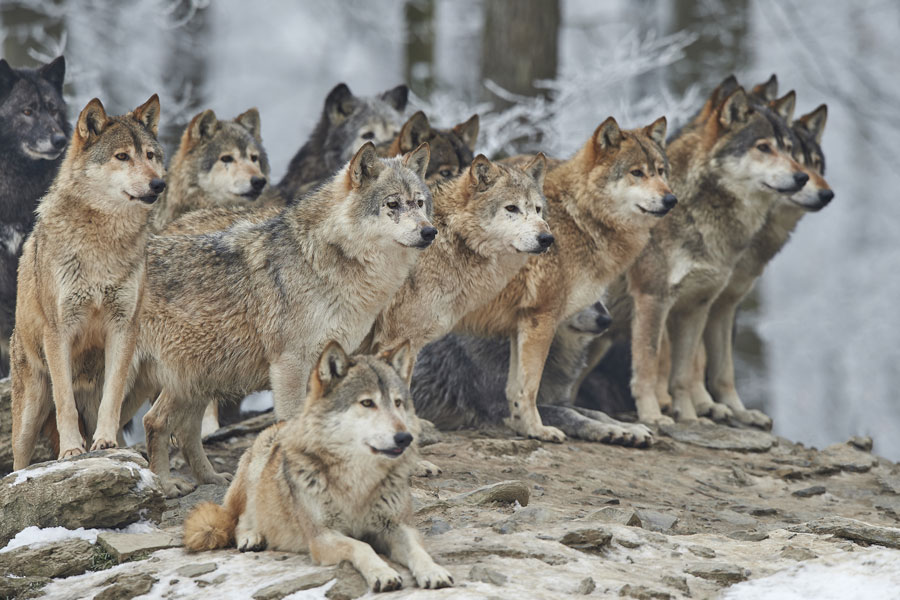
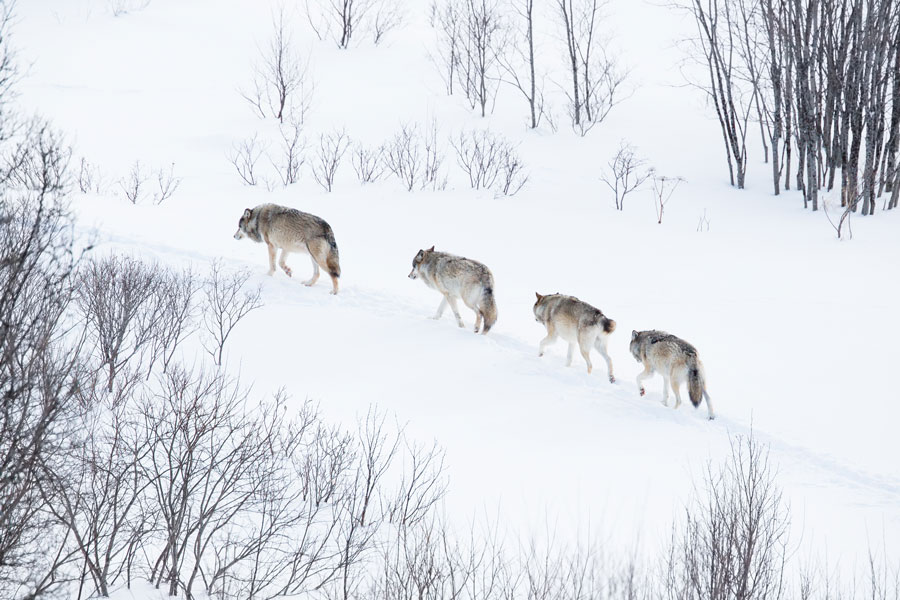
In all the animal kingdom, no species is more contradictory than the gray wolf (Canis lupus): divisive and celebrated, iconic but despised, persecuted yet undisputed sovereign over remote parts of the earth. No animals have caused more blood and ink to be spilled than wolves, where merely writing about them is an invitation to calumny. And nowhere on earth is the animal’s status—its very existence—more charged than in the United States, where the wolf issue melds animosities born on the historical frontier with the cynical polarities of contemporary politics. In November 2020, spurred on by an eleventh-hour nudge from the Trump Administration, the U.S. Fish and Wildlife Service (USFWS) officially removed wolves from the Endangered Species List. A culmination of decades of debate, the delisting drew fierce criticism from scientists and environmentalists, and it is quickly transforming how wolf populations are managed. The termination of protections marks a unique inflection point in the wolf’s history: a moment for asking hard questions about the human-wolf relationship and for revisiting old dilemmas.
Viewed from a certain distance, the change in legal status doesn’t change much: Wolf hunting has continued unabated for decades in Alaska and Canada, whose respective populations of 11,000 and 50,000 to 60,000 animals dwarf the lower 48’s estimated 6,000 gray wolves. Likewise in the Northern Rocky Mountains (Montana, Idaho, and Wyoming), where reintroduced wolves have thrived beyond expectations, the animals have been delisted and hunted intensively since 2011. Love it or hate it, the process of prying wolves away from Endangered Species protections has been underway for decades, without seeming to reverse a steady growth in wolf numbers. In immediate terms, delisting alters only the status of wolves in their most populous stronghold: the Western Great Lakes region (northern Minnesota, Wisconsin, and Michigan), where modest hunting seasons are now in the offing and where some three-quarters of (non-Alaskan) American wolves reside.
If, for the sake of argument, we set aside the wolf’s mystique and charisma (features not universally recognized anyway), there is a certain cold logic to arguments for delisting. The original conservation goals, dreamt up haphazardly in the early days of the Endangered Species Act (ESA, 1973), have been met and exceeded. Wolves have done better than anyone expected, both by recolonizing habitat from the Canadian side of the border and in a handful of successful reintroductions. Supporters of delisting point out that turning responsibility over to individual states will free up federal funding for more seriously threatened organisms. If wolves are no longer dying out, why not focus on species facing real extinction—and let states manage their own wolves? For delisting advocates, including many USFWS officials, doing so seems consistent with both the letter and spirit of the law.
Take a closer look at the wolf, however, and things get more complicated. Questions multiply, simple answers evaporate, and unplanned consequences start to unfold. The ESA, put in place as a legal mechanism for stemming the decline of American biodiversity, has always been an awkward fit for the wolf, a geographically diffuse top predator that once ruled over much of the continent. Most of the United States is former wolf habitat; how much of it can still sustain wolves? How much of it should? The ESA offers little concrete guidance on these questions, beyond the vague mission statement of protecting species “in danger of extinction throughout all or a significant portion of its range.” By 1973, after more than a century of vigorous extermination, the wolf was confined to two small, precarious populations on the Great Lakes—in other words, unambiguously endangered.
Today, however, that metapopulation is stable and growing, and wolves have an increased presence in the Northern Rockies and the Pacific Northwest. At the heart of the matter is the question of where (if anywhere) Americans are willing to let wolves expand and multiply—and buried within that, the deeper and still more intractable problem of how we understand the animal.
A certain kind of hunter won’t linger on these questions. To them, the wolf is only an exotic quarry—something to kill and mount as a trophy. Methodically gunning down a pack from a helicopter offers them a kind of unreflective thrill, not unlike playing out a video game or action movie in real life. I invite anyone who finds this caricature unfair to spend five minutes Googling trophy wolf hunts.
To another, more numerous brand of hunter, steeped in a particular relationship to the landscape and its animals, the wolf is something else: a menace to a cherished way of life. For such men and women, often the descendants of homesteaders, the notion of protecting or reintroducing wolves—undoing the hard bloody work of past generations—is madness. Their belief that wolves should be confined to a few wilderness redoubts or wiped out altogether is amazingly tenacious across the American West. (Sporting the silhouette of a wolf framed by crosshairs, a popular bumper sticker in Montana reads, “Smoke a Pack a Day.”) And the attitude has deep historical roots.
The historical frontier was a place of astonishing upheaval, and much of its spectacular violence was waged through and for control over the environment. The destruction of the great buffalo herds is broadly familiar to many Americans, but the related, century-long campaign against the wolf is less well known. Yet it was every bit as thorough as—and waged far more creatively than—what befell the American Bison. As it happens, states being recolonized by wolves today once hosted the most sophisticated and successful predator killing spree in history, sparked by an ecological collision course between settlers and wolves. In the classic account of human-wolf history, Of Wolves and Men, the late Barry Lopez traces the progress of wolf extermination from its earliest colonial roots through to the 1970s. As trappers and settlers entered the West, they slaughtered prey animals—buffalo, elk, moose, antelope, and deer—by the millions while bringing their own, more vulnerable beasts to multiply across the emptied land. The inevitable outcome was a virtual war between wolves and humans. First glutted on the countless carcasses of bison, then increasingly desperate as traditional prey disappeared, packs of wolves fell upon the settlers’ slow-moving, guileless livestock. Retribution was swift and merciless. The struggle reached its apex with the sheep and cattle boom that remade the intermountain West (roughly 1875 to 1895), when bounties were paid on hundreds of thousands of wolf pelts. Lopez, like many authors, acknowledges that early ranchers had no choice but to kill wolves, but the intensity and cruelty of the killing, and its continuation for decades and into regions far beyond the necessities of the ranching economy, have puzzled scholars and naturalists ever since. It is, arguably, the only planned extinction on record.
In these years of heroic conquest, wolves were inscribed in the Western mind as nemesis: cruel, gluttonous, indolent villains unworthy of a place in the natural world. They were shot, beaten to death, trapped, poisoned, burned, and tortured in countless ways, pursued into desolate reaches far from humans and livestock. As Lopez and others have recounted, the big predators came to function as a scapegoat for all the cruel hardships of life on the frontier: Brutal weather, disease, livestock rustling, market fluctuations, and poverty stalked the rancher, and the wolf paid in blood for the rancher’s misery. By the turn of the century, the animals were all but wiped out in the heart of the ranching empire, but state legislators continued doling out exorbitant bounties for a handful of lonely stragglers. By midcentury, they were gone.
While hostility to wolves is rooted in history and geography, handed down across generations of rural families, it is also colored by present-day politics: Rural communities have weathered the vagaries of economic globalization and the ebbing of traditional ways of life (chief among them ranching), and politicians have made good business out of harnessing their pain and frustration. For many in the intermountain West, the hated figures of autocratic feds, tree-hugging coastal elites, and wolves form a baleful triumvirate dedicated to the destruction of rural liberty and prosperity. An often-theatrical resistance to those forces has helped turn the Northern Rockies deep red in the last 30 years and cultivated a widespread, potent antipathy to wolves.
A turning point in this synthesis arrived with the wolf reintroductions of the mid ‘90s. In 1995 and 1996, the USFWS released two small populations of Canadian wolves: one in Yellowstone National Park and another in Idaho’s Frank Church River of No Return Wilderness. The projects were greeted with intense hostility by ranchers across the region, whose fear that the wolves would multiply were soon borne out. Protected for roughly 15 years in prime habitat, the reintroduced wolves quickly increased their numbers by an order of magnitude, expanding beyond the protected areas even before 2000. Their legal standing was ambiguous, however: A 1982 revision to the wolf’s ESA status had categorized any reintroduced populations as “experimental and nonessential,” paving the way for state management in the Rockies and ensuring that deliberations over ESA delisting considered only the larger, Western Great Lakes population. While the measure of recovery was thus pinned to the Eastern population, the consequences of last year’s delisting have come down most dramatically in the mountains.
The struggle to delist Rocky Mountain wolves got underway around 2000, finally succeeding in 2011 in Montana and Idaho (and a few years later in Wyoming). In the meantime, environmental organizations used the ESA to challenge the delistings, and when the region’s wolves were returned to state management it was agreed that states would abide by relatively restrained conservation plans—written in collaboration with the USFWS—that would preserve wolf numbers roughly at contemporary levels. In 2021, with the wolf now fully delisted, those management plans are dead letters, and Western politicians have already enacted a flurry of legislation to put the wolf back “in its place.” Common features of the new laws are expanded (or unlimited) hunting seasons, liberalization of hunting methods, and new versions of the old bounty systems. It is virtually impossible to eradicate wolves in significant numbers using traditional hunting methods, so all possible means are back on the table: unlimited bags; hunting from aircraft, snowmobiles, and ATVs; night vision; poison; baiting; and traps. The frenzy of legal restructuring has extended to adjacent states like Utah and South Dakota, where any wolf that strays over the state border may be shot on sight, putting a significant brake on recolonization of further habitat.
Most extreme among the laws passed so far is SB 1211, introduced by Idaho Governor Brad Little. The law mandates extermination of 90 percent of Idaho’s 1,500 wolves, drawing the population back down to the original reintroduction goal of 150 animals. Although opposed by the Idaho Fish and Game Commission and the USFWS, the bill passed the state house in May, with lawmakers citing the urgency of defending game populations (particularly elk) and Idaho’s ranchers from wolf depredations. These rationales, although grounded in historical memory, cannot withstand even casual scrutiny. On average, 118 livestock were killed by Idaho’s wolves each year between 2018 and 2020. Compared with the roughly 40,000 animals claimed annually by bad weather and disease, the deaths represent a tiny drop in the state’s 2.8 million livestock—certainly not enough to justify spending hundreds of thousands of taxpayer dollars on bounties. Moreover, unlike livestock killed by other predators or by weather, the USFWS compensates ranchers for half of the value of livestock that fall prey to wolves. In a further ironic wrinkle, strong scientific evidence suggests that killing wolves disrupts the ability of packs to coordinate in taking natural prey, leading directly to increased predation on livestock.
Likewise, claims that Idaho’s elk need protection from wolves are unsupported by basic facts: Idaho’s present population of 120,000 elk is significantly higher than it was when the wolves were reintroduced. As conservationists are fond of pointing out, all biological evidence suggests that wolves are good for ecosystems. Detailed studies conducted in Yellowstone over the past 20 years have produced overwhelming evidence that wolf predation culls diseased animals from the population (notably, individuals suffering from Chronic Wasting Disease) and disperses herds across the landscape in a way that benefits the health of the entire ecosystem. By the same token, wolves almost certainly make elk and other ungulates appear more scarce: more wary, less vocal, less concentrated, and less conspicuous along roadways. For hunters this can be a real frustration that is easily misconstrued as a decline in the target species.
While the most dramatic immediate impacts on wolf populations are certain to unfold in the Northern Rockies, the larger, foundational population in the Western Great Lakes also faces consequences from delisting. In Wisconsin, the most anti-wolf of the region’s states, this year’s trial hunting season ended in an uproar symptomatic of the contradictions at the heart of wolf management. In just three days this February, Wisconsin hunters killed some 216 wolves—nearly twice the 119 specified in the state plan. The federation of 11 Ojibwe tribes, which elected to forgo hunting its allotted 81 wolves on behalf of conservation, condemned the overkill and criticized the decision to open the hunt during breeding season. The wolves killed represented roughly 20 percent of Wisconsin’s total population—nearly double the proportion hunted in Canada or Alaska, and potentially a high enough rate to drive the population down significantly within a decade, if continued.
In some ways, the explosion of enthusiastic wolf killing since November is misleading. There are numerous examples of formerly anti-wolf individuals coming around to more nuanced positions, and communities where antagonism has given way to something else. In countless local instances, ranchers and rural folk have been instrumental in wolf conservation. And of course there are hunters who pursue the animals from a more thoughtful, respectful vantage point—hunters who insist that they value the existence of the wolf “in its place” and do not seek its ultimate destruction. Ask any gathering of interested parties to define that place, however, and responses quickly disintegrate into a babel of contradictory positions and recrimination. Nobody seems to have a clear or practical vision of where the line might be drawn, and this impasse hints at intractable tensions at the heart of the modern human-wolf relationship.
The matter of the wolf’s future in the United States boils down to questions of place, in two distinct but related ways. In the literal sense, Americans have yet to resolve the question of where the wolf belongs. Its range once encompassed much of the continent, but many of the wild landscapes that made up that habitat mosaic are gone—bulldozed into fields, highways, suburbs, and parklands of all kinds. By and large, the few big remaining tracts suitable for wolf recolonization are home to rural communities that are ambivalent about or hostile to the prospect of sharing fields and valleys with toothy, unpredictable neighbors. Which brings us to the second, more abstract sense of place: What place are we willing to give the wolf in the natural world, and in relation to our society?
Like humans, wolves are apex predators who kill to live, inscribing their supremacy all the way down the food chain. Though industrial meat production and tidy packaging conceal this reality from most consumers, it is something hunters and ranchers grasp intuitively. Unlike most humans (excepting those who fill their own freezers or otherwise contribute to maintaining healthy wildlife populations), wolves have an inborn capacity to make some ecosystems healthier and wilder. Also unlike humans, wolves cannot adapt the fulfillment of their metabolic needs or place themselves in a position to accommodate other living beings. They are at once too near to us and too alien, and the wages of this unhappy intimacy are historical cycles of cruel violence and burning hatred. The wolf’s removal from the Endangered Species List seems poised to set in motion another round of this dismal cycle.
To most hunters, hatred of the quarry is an unwelcome and unfamiliar feeling. The frequent metaphorical slippages aside, hunting is neither warfare nor extermination. When the killing of animals approaches those extremes, it becomes something else. Having read through reams of documents surrounding last year’s delisting and its consequences, I cannot escape the impression that recent shifts in wolf policy are motivated mainly by hatred of the animal—originating in the wolf’s challenge to the human prerogative of ruling over nature and perpetuated by profoundly cynical politics. The legislation being written in Idaho, Wyoming, and Montana reflects a desire to destroy the animal, or if that proves legally impracticable, to confine it in populations so small and remote as to be little more than open-air zoo exhibits. Personally, I would not hunt a wolf, but the issue at stake is not wolf hunting per se. The problem is what one might call exterminationism: an unquenchable hostility fed by a thousand fears and insults that have little or nothing to do with actual wolves. It is difficult, but worthwhile, to continue imagining new ways of transcending this attitude.
To hammer out a working relationship with the wolf, Americans may need to simultaneously embrace one kind of human supremacy and abdicate another. The first recognizes that we have transformed most of this continent into environments built around the satisfaction of human needs, and that having wolves alongside us—free roaming, intelligent predators capable of travelling hundreds of miles and adapting to diverse habitats—means making coherent decisions about where they live and taking tough steps to implement those decisions. If the ESA was a flawed instrument for defining the wolf’s present and future reality, we desperately need some kind of wolf-specific replacement: a coherent national policy. This sense of responsibility also entails working closely with rural communities, so that wolf management isn’t autocratic or indifferent to local concerns. The second kind of supremacy—the older, biblical variety, which insists man must have perfect, absolute dominion over all the earth—has to go. It is out of touch not only with the realities of coexisting with wolves but also with the larger planetary context, in which balancing human needs with the preservation of natural systems is now more difficult than ever.
Certain consequences of the state management of wolves may be positive. Probably if wolves continue expanding into coastal states where citizens are more sympathetic (or from another standpoint, naïve), we may see bold experiments in carving out new-old places for the wolf. There is certainly still room in the West. The same month the USFWS delisted the wolf, Coloradoans voted by a narrow margin to begin reintroducing wolves to the Southern Rockies, America’s greatest remaining expanse of quality wolf habitat and home to the world’s largest elk population. It remains to be seen how the tensions arising from this decision will be negotiated (and how they will be influenced by the recent delisting), but for now, the future of the wolf in the Southern Rockies looks promising.
Whatever positive outcomes might arise from returning wolves to the mercies of state control, the negative outcomes are more predictable and swifter to arrive. Environmental groups have lost their major legal recourse, and it is unclear how the wolves in several of the recovered populations will survive. In places where politicized anti-wolf sentiment reigns, packs will be whittled back down to scattered, dysfunctional fragments, killing the odd lamb or calf but ceasing to contribute to a larger, national wolf presence that crosses borders and exists within larger ecosystems. In such places, ironically some of our wildest landscapes, we will have decided that there is room for only one top predator—and that a place for wolves can exist only when they have effectively ceased to be wolves. It is a hard-hearted, small-minded way of treating nature, one that dresses up a loathing of real wildness in the phony livery of a rugged, nostalgic frontier spirit. Inside today’s Western state houses one can see the jealous fulfillment of an old, familiar desire to see nature wholly subjugated and the howling wilderness converted to a garden, a feedlot, or a zoo.
A tale of a chance meeting with strangers, new friends, and a bird that binds us as upland hunters.
By Edgar Castillo
“Is anyone home?”
I lay in my sleeping bag all bundled-up. In fact, all five of us had crawled into our synthetic cocoons. I was already drifting off into sleep. Everyone had been up for twenty-four hours. Myself, over thirty. The wind was picking up. The tent walls were flapping. At first, I thought I was dreaming as I could hear voices outside. Moments later Dan was out of his bag and unzipping the tent. Two strangers entered. Rick an older gentleman in his late sixties, wore an orange knit cap over a billed hat. The other, Trey, a young man in his twenties. Bird hunters no doubt.
It was evident that Wyoming was a collection point for avid bird hunters. The Cowboy State boasts some of the finest sage grouse hunting around, as well as an ample amount of accessible public land to hunt. These two factors lure a lot of out-of-state hunters to the state for a chance to harvest a truly magnificent bird during the 10-day season. This could not be more apparent from everyone in our tent. Rick was from Colorado and had been coming to Wyoming for years. Being retired allowed him to travel throughout the region experiencing a variety of upland bird hunts. Trey was a college student from Texas on an extended hunting trip.
Our ragtag group came from the very heart of the Midwest – Kansas and Missouri. We had traveled close to fourteen hours from Kansas City to Wyoming. Our ensemble consisted of Dan, and his teenage son, Easton, and their mother and daughter duo of bristled-haired Drahts, Macy and Abi.Accompanying us for a second time was Damin, dubbed “The Driver”, a nickname he received during our first visit to Wyoming in 2019. He was again in charge of transportation for his ability to maneuver through and around questionable BLM mountain and high-desert roads. Rounding out our bunch was newcomer, Sam and his young dog Jaeger, Abi’s littermate.
Rick took the lead and began to explain their abrupt visit to our camp, being that we were somewhat “neighbors” and all. We had passed Rick’s truck at three a.m. over twelve hours prior. We learned Trey was camping also but had set up a tent several miles away. They too had only met recently. Strangers, but connected by the land and birds. Right away the conversation shifted to why we were there…to hunt sage grouse of course. Rick asked how we had done that day. I’m not sure if he felt sorry for us for only shooting two birds, as he and Trey spoke of sage grouse merely a couple of hundred feet from our camp or he genuinely wanted to help-out his fellow bird hunters. I opted that he felt somewhat guilty for the untold numbers of grouse they had seen on Wyoming’s opener that day.
We listened to Rick talk about where to find sage grouse and the next thing I knew, he said “Well, what time do you want to hunt in the morning?” I thought to myself, was that an invitation or an order? Dan responded, “Well, we were going to get up at six.”. “Six?! “Okay, I’ll see you in the morning.” And that is how plans are made with complete strangers. I drifted off to sleep soon afterwards with visions of spiny-tailed grouse tail feathers swaying in the wind protruding from my bird vest. It’s always good to dream.
Faint noises of stirring hunters were the signal to get up. Our group moved quickly with the precision and quickness of a Marine squad (Sorry to those other branches, I’m a Jarhead.). All three wiry-haired dogs were excited. There was an anticipation in the cool morning air. Shotguns and vests were stowed. Dogs were corralled into their crates and we were off down a dusty dirt road. The truck’s headlights danced off Rick’s dingy white truck camper -a mobile bird-camp. Trey’s youthful enthusiasm was evident, as he waived the caravan forward and three trucks raced down the high desert road.
Forty-five minutes later, the metal wagons halted. It seems once you have bird hunted, routines become ingrained. Everyone donned bird vests, shells dumped into pockets, and shotguns unsheathed. No words muttered.
Rick and Trey were standing by their trucks looking toward a crooked break in the landscape as far as the eye could see. Trey explained he had seen a couple of sage grouse near the area and the place would be a good place to start. He pointed to the earthen crack and said the birds would likely be on top of the edges or down in the break. For his youth, Trey was very well educated and experienced. With a B.S. in Wildlife & Fisheries Sciences, a M.S. in Range and Wildlife Management, and soon a PhD, Trey had firsthand field experiences researching and trapping sage grouse in Wyoming. He assisted with relocating sage grouse to North Dakota and helped monitor populations. Hearing Trey rattle off names of mountains, nearby points of interest, and roads, he sounded more like a local than a visiting bird hunting tourist.
The dogs were getting antsy. We were too. We wanted to hunt. I walked over to Trey and Rick and shook their hands to thank both for allowing us to accompany them to one of their spots. “Oh, we’re not going with you. We are going to watch.”, Rick said. I was instantly perplexed. Strangers offering up honey-holes. Only in the uplands. I began to see a pattern. I returned from my thoughts only to notice the guys were already twenty-five yards ahead of me. I waived to Rick and Trey.
I opted to stay on the edge of the cracked formation. The sands through the hourglass did not wait long, as a mere hundred yards of walking, shouts of “Grouse!” pierced the air.Strong winds carried unrecognizable words of excitement. Sage grouse hoisted up in celebration. Grins barely seen from across the way, but obviously apparent. Shots rang out like the popping of balloons. Giant winged birds erupted from down in the break and along the opposite edge. Suddenly a greyish blur took flight in front of me. Two shots. Two misses.
I glanced back. Rick and Trey were still standing by the trucks…watching the action play out. Why would they miss out on such opportunities? They didn’t owe us anything. Our conversation the night before was brief. As I walked, I asked myself what was our connection? The shooting continued. More birds fell from the blue sky, others glided safely away. Vests were being filled. Though maneuvering through the sagebrush was easy, my ankle injury from earlier in the year was starting to ache. More birds were taking flight below and on the opposite side. Getting across would be a task. I turned to see blurry figures standing on the road. Still watching. The shapeless wind howled out on the open sage sea as it hit me as I turned to make my way back.
My return trek to the trucks was not without any reward. The same path provided two sage grouse waddling a mere ten feet in front of me. The over-under found one target, while the other high-tailed it out of there with a couple of strong flaps from the bird’s giant wings. The sage grouse sailed out of sight morphing into the pale sagebrush.
When I arrived at the trucks, I produced my feathery quarry. Rick took the grouse and hypothesized the bird was from this year’s hatch. Its size more akin to a hen pheasant or prairie chicken. Smaller than the bombers normally associated with sage grouse. As Rick and Trey talked, I returned to my thoughts as to why they did not hunt with us. They had watched our group hunt for over an hour. They could’ve easily have left or showed us a different spot not as productive as this one. In the distance, orange figures appeared to be getting closer. Forty-five minutes later the guys arrived, each recounting their hits and misses. Each grouse taken from their vests displayed as trophies from the land that birthed them.
Morning turned to into hours later in the day. Our journey continued. There had been more stops along the way. Most were short hunts based on Trey’s direction. Each produced, birds. By late afternoon, the fleet of trucks were back on the road headed yet to another destination provided by our camp neighbors. Trey was in the lead, adjusting his speed for signs of movement from the sagebrush or on the road, to deciphering the landscape. I should’ve jumped in his truck to pick his brain. To learn. Dust flew, only to settle as we slowed to a snail’s pace. Minutes later, Trey was standing alongside his truck staring at the open road in front. Curiosity couldn’t keep us from getting out of the truck. I came up on Trey who was talking to Rick, arms were extended. Movement in the ditch caught my eye. Taking their time, were about three sage grouse out for an evening stroll. The birds looked like young, gray-colored turkey poults. The ditch was being used as a travel corridor.
Rick came over and suggested we walk out into the sage in a wide arc so the dogs could get the wind in their faces. Road hunting may not be glamorous, but instead of just walking up on the birds and ground sluicing them, we attempted to make it as sporting as possible.
I opted to stay with Trey and Rick. Dan, Easton, Damin, and Sam quietly slipped on their vests and loaded shotguns on the go. A trio of Deutsch–Drahthaars took to the sage like slow-moving black blurs against a faded green backdrop. They went about a hundred yards then arced to the right to get the dogs nose into the wind. Minutes later they had closed the gap between them and the ditch. The grouse had moved. Afterwards, Easton would describe the small trench as a dirt highway full of sage grouse tracks. “It’s going to get real in a couple of seconds.”, I said to Rick. Outstretched wings took to the air as darkened silhouettes came into view against the hazy sky. Barrels swung, and shots fired…birds fall flightless, and dogs raced in for the retrieve. I shared in their joy silently.
Sam was the first to approach from his walk back to the trucks, a large lifeless bird hung from his hand. The sage grouse was at least twice as big anything we had shot thus far. Again, my thoughts returned to “Why?” Rick and Trey congratulated him, and the tailgate stories began automatically as if on cue. A ritual amongst bird hunters everywhere that is ingrained the instant they pick up a shotgun.
Trey began an impromptu course on aging sage grouse as we gathered around and listened. Words drifted off into the slight breeze, my attention focused on the sea of sagebrush. So fragile the habitat, that the green plant is intertwined with governmental feuds and policymakers arguing the future of the bird. Throw in hunting during times of re-evaluation and you’ve stirred up a hornet’s nest. Yes, it is true that hunting is by far the largest funding mechanism for wildlife, and the economic benefits help in conservation.
Hunting boosts the economy and in-turn brings in more funds for the continued sustainment of helping in restoring and protecting crucial habitat. Our group’s stop at the local Loaf ‘N Jug in Rawlins for fuel, groceries, and supplies will add dollars to the state’s economy. The hunting licenses and daily trout permits we purchased will go directly towards conservation. Local and out-of-state hunters contribute in so many ways that add fuel to Wyoming’s austerity. The state’s healthy population of sage grouse in turn brings in traveling wingshooters for a chance to hunt the iconic gamebird.
There is no question sage grouse are in trouble. The iconic bird of the west once numbered in the millions. It is speculated their range extended from Texas to southern Canada and from California to the eastern border of Colorado. Now there are an estimated 400,000. The sage grouse’s range dwindled down to a fraction of what it once was. However, Wyoming continues to maintain a stronghold for sage grouse.
Wildlife biologists continue to talk about sage grouse numbers and the yearly loss of habitat across core states. One thing in agreement is that there is no reason at the time to discontinue hunting of sage grouse in those areas where the bird flourishes and numbers are strong and there is minimal impact. Implemented are shortened seasons and certain areas closed to hunting, all to protect the sage grouse. However, what I do envision coming is an argument, and how that will play out is unknown.
I return to the moment as Rick talks about going after the birds that escaped and flew to the other side of the road. The others agree and start walking out into the sage. They sailed to the bottom of a series of sage hills. Trey points to a stretch of sagebrush that is indistinguishable from the rest of the cover we’d been hunting. This land is a mystery to me. There are murmurs within our group that we do not understand sage grouse habitat nor hunting the bird. Put us in the middle of Kansas pheasant, quail, and prairie chicken country and we can distinguish “birdy” cover. Out here in the Wyoming sage flats, we are like fish out of water. It all appears the same to us. However, Trey does his best to identify the small traits of the land known to hold sage grouse otherwise overlooked by us. We start connecting the dots and those places overlooked in the past by us, now appear “birdy”.
I pull on my vest and stuff shells into pockets. My over-under broke open, resting on my shoulder as if I were a human mantle. I walk out slightly into the sage and bend slightly to touch the top of a sage stalk. I gently pull off a piece of sage leaf and crush it into small flakes. I bring it to my nose and inhale. Aroma therapy at its finest. I had become used to the pungent sage odor. Its fragrance omnipresent when we first arrived. As the days passed by, the smell had disappeared from my senses. I had forgotten about its existence. I think being out here amongst the sage, it helps me understand how crucial the ecosystem is for not only the sage grouse, but a wide range of other living organisms.
The sun is slowly moving towards the horizon causing long shadows in the high desert. The sky a brilliant color of orange. I turn to watch camp visitors who have become friends, walking out into what appears an endless sea, and then I observe the quartet of sage grouse on the tailgate. Puffs of white sage grouse feathers sail across my path…and it starts to click – though we are strangers in an ocean of rolling delicate green shrubs, there has been a symbiotic relationship formed between three components. We are ever so linked amongst the sage, the grouse, and those that hunt the winged buffalo of the Wyoming landscape. The sage grouse will survive. And so, will those that hunt them.
Anglers spend countless hours walking up and down the slate-lined streambanks in search of a shadowy fin, a tail, or the unmistakable flash of a feeding fish. Nary a cast is made without prior confirmation that a steelhead is present, and even if a fish is spotted, hooking one is far from a foregone conclusion.
The many small streams along the Pennsylvania’s Lake Erie coastline offer a unique setting for chasing such an unforgettable fish as the steelhead. These aren’t the temperate, rainforest-lined glacial rivers of the Pacific Northwest that grace the covers of magazines and books. To experience fishing for these monsters of the deep is intoxicating and addicting. While their time in the “tribs” (rivers flowing into Lake Erie) might be fleeting, thoughts of their arrival and our pursuit of them is something that never wanes. It becomes a lifestyle.
Lake Erie steelhead are a sight fisher’s paradise, and with that uniqueness lies a challenge that’s unlike anything else in fly fishing. It’s not often that using multiple egg patterns with a brace of split-shot is categorized as technical, but the small streams, gin-clear water, and sight fishing to 30-inch steelhead weave a style of angling that’s not found in many places.
When you’re probing for these behemoths, they seem docile and almost tepid, much tamer than the stories of old in Field & Stream and fly-fishing catalogues. To the unsuspecting, a holding steelhead might seem an inch from death as it waves its fins just barely enough to stay put and is in no hurry to go anywhere fast. This notion comes to a screeching halt when a steelhead hits, and it becomes painfully clear this was all nothing more than a carefully executed ruse.
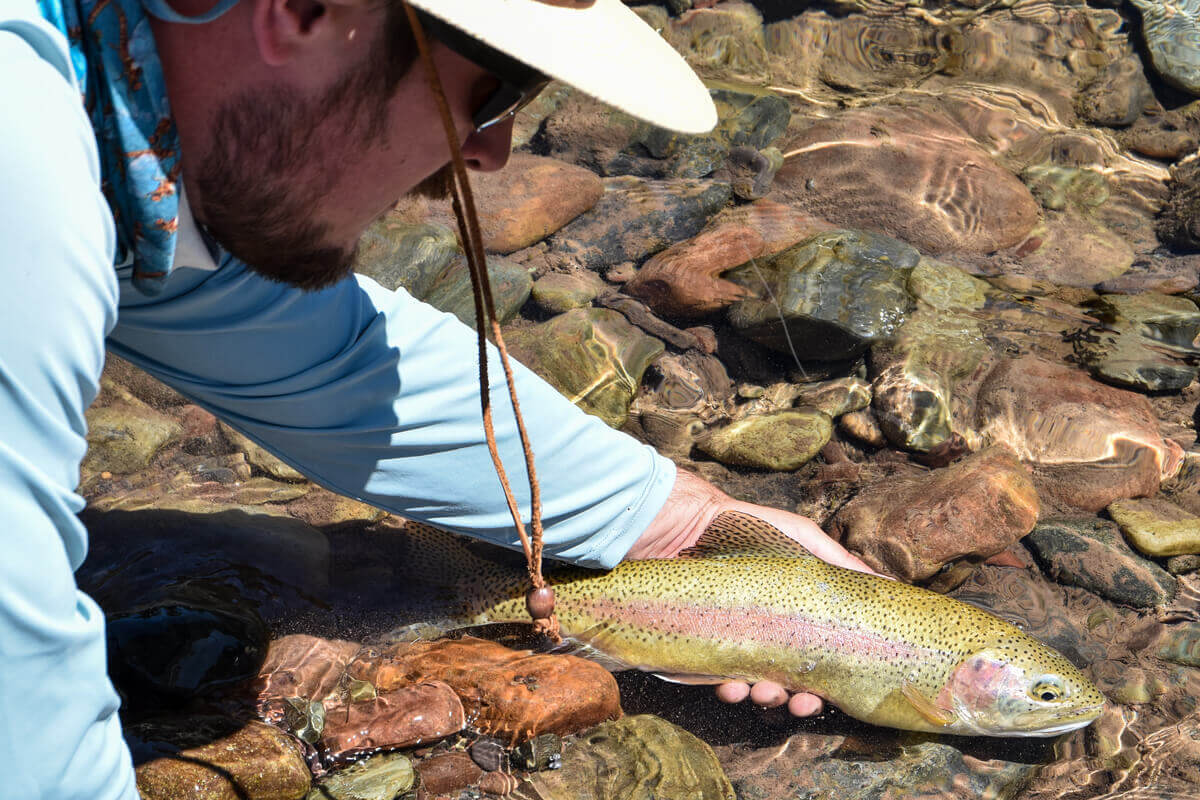
Drift after drift can run near these supersized rainbow trout while their interest seems minimal at best. Then out of nowhere, a strike indicator pauses for the briefest of moments and the entire day changes in a split second with the realization that a chrome torpedo is now on the line. Time stands still and the fish ascends to the surface with thrashing, violent head shakes as it tries to determine what is happening. The fight is on. This is steelheading in Pennsylvania.
After the first few heart-stopping seconds, when all parties are trying to get their bearings, the battle is akin to boxing an alligator in a phone booth. The steelhead is a fish that spends eight months a year living in the depths of an immense playground where it can go where it wants, when it wants. To ascend from the icy depths of Lake Erie to these tiny tributary streams is about as stark a difference as going from downtown Erie—with its factories and warehouses—to the quaint farmland of inland Pennsylvania only a few miles away. Steelhead apparently don’t care about the confines of their new stream homes, and they cartwheel and rip line as though they still have an entire Great Lake at their disposal.
Steelhead don’t belong in these streams, but don’t tell them that. They are quite at home in the Great Lakes, despite their native range being several thousand miles away in the Pacific. The bays and lagoons surrounding Erie, Cleveland, and Buffalo might be a far cry from the Bering Sea and Puget Sound, but the attitude of the fish endures. They have just traded the tang of salt for the tartness of rust, thanks to shipwrecks loaded with iron ore.
There’s a ruggedness about these fish; perhaps it’s perpetuated by the region their ancient ancestors called home, or maybe it’s thanks to their battle scars after a tangle with a hungry pike or muskie. Whatever the reason, the steelhead of Pennsylvania have a toughness about them that’s on full display in their screaming runs and their ability to spend the winter entombed under ice that locks in the streams each January.
That winter of ice holds another piece to the steelhead hardship puzzle. The months when steelhead enter the streams happen to coincide with some of the harshest weather imaginable. Extreme cold, blinding snow, and biting wind aren’t reserved for Siberia, Wyoming, and the Arctic Circle. To anyone familiar with Great Lakes steelheading, the lyrics of Gordon Lightfoot’s song “The Wreck of the Edmund Fitzgerald” sounds more like a Tuesday morning weather report than romanticized embellishment.
The dullness of walking, peering into water totally devoid of life, and countless refusals seem like distant memories when a steelhead is frantically racing downstream toward the lake, which could be many miles away. It doesn’t take many days fishing for steel in Pennsylvania to understand why hundreds of thousands of anglers flock here from all corners of the country. Other fisheries undoubtedly have prettier backdrops, more elegant fishing methods, and of course the opportunity to catch fish in their historic range, but none of that matters to those who travel to the Keystone State in search of chrome.
By Nick DelVecchio Photos by Stephanie DelVecchio
Nick DelVecchio is a freelance outdoor writer and the owner/head fishing guide at Wildwood Outfitters. He guides anglers of all skill levels on the many trout waters in Pennsylvania, providing all of the necessary gear on trips customized for each guest.
Winding 110 miles from its montane headwaters to an unassuming juncture with the Missouri River, Montana’s Smith River has long been recognized as a priceless treasure by the state’s citizens and outdoor enthusiasts. Just over 60 miles of the river flow through a steep-walled canyon, weaving through serpentine bends flanked by lush meadows, fragrant pine forests, and varicolored limestone cliffs arching hundreds of feet overhead. Bordered along much of its length by private land and labelled as a “semi-wilderness,” the Smith feels self-contained and otherworldly like few places on the continent.
The Smith easily ranks among the state’s most iconic and scenic destinations, as well as the most regulated: It is Montana’s only river permitted with a lottery system. Applications open in February, and competition for a few days in paradise is fierce. The odds of drawing a golden ticket range from year to year: Between 1 in 6 and 1 in 9 applications receive a permit, entitling the recipient to float in a group of up to 15 individuals between the put-in at Camp Baker and the take-out at Eden Bridge.
After the initial hurdle of drawing a permit comes the question of timing: The float season extends from late spring into early fall, but within that window conditions may fluctuate wildly, and only certain river levels allow visitors to make the most of the river’s mythologized trout fishery. If the river gods should grant the right combination of insect hatches, temperatures, and flow levels, an angler can take fish averaging around 15 inches from sunrise to sunset, with specimens pushing 20 inches not uncommon. In recent years, however, rising temperatures and inadequate snowpack have delayed, disrupted, and shortened float seasons, and the quality of both fishing and floating more and more often hinges on perfect timing. If the water is too low, navigation becomes difficult and fish populations suffer; if it rises suddenly as snowmelt releases too quickly, the river becomes swollen and murky, and late season flows down the line are impacted. Also linked to the higher annual temperatures of recent years, algal blooms have become the recurring bane of fisheries biologists and anglers alike.
Compared to the groups of 15 that often ply the river in midsummer, our cadre of four was scaled for relative solitude: three old friends from the environmental history program at Montana State University, plus a younger brother tagging along on his first river experience. That this legendary destination might be in imminent danger was the last thing on our minds, dizzy as we were with anticipation of flashing trout, nights around the campfire, and cold rushing waters under open skies. For months before our put-in date, we tracked the river’s surging and ebbing flows on the USGS website. As it happened, 2019 was a good year for Smith floaters, owing to a combination of moderate rainfall and lower temperatures than preceding seasons. When we launched on July 16, flows measured around 330 feet per second–modest enough to make for excellent fishing but still comfortably navigable in our boats.
Only our intrepid leader had floated these waters before, albeit in subpar conditions. (Two in the party were veteran anglers who owned boats and had worked as fishing guides.) This time around luck smiled on us, and we enjoyed five days of round-the-clock fish rises, congenial weather, and sublime natural beauty. Indeed, we had lucked out twice: first by drawing a permit, and then by receiving a launch date coinciding with prime conditions.
To the hardcore trout bum the aesthetic and ecological qualities of a river sometimes amount to so much background noise; on this trip, however, the phenomenal fishing had to fight tooth-and-nail for our attention with the river’s astonishing succession of scenery and wildlife. On the one hand, the Smith is indeed timeless: a pristine, primordial ribbon that is home to countless species of plant and animal–and that provides a balm to humans from the chaos and stress of modern life. Looked at historically, on the other hand, a more dynamic and ambivalent picture emerges. Since long before the first Euro-American settlers arrived, the river has been inhabited, utilized, and modified by diverse communities of people. Much of that history, as well as the Smith’s ecological richness, is tied to the fact that the Smith is an ecotone–a transition zone between two biomes. Neither fully of the plains, which stretch away eastward, nor belonging to the mountain vastness of the interior Rockies looming to the west, the Smith’s high grassy plateaus and plunging wooded canyons embody a mixture of both landscapes, providing a refuge for ancient peoples as well as later Euro-American populations in transition.
In centuries past, the river valley hosted a succession of indigenous cultures: initially the Flathead people, then later Blackfeet and Shoshone populations. Occupation by these groups ebbed and flowed, sometimes violently overlapping and other times flowing along peacefully. The arrival of Euro-Americans, and the mining and ranching booms in adjacent valleys and mountain ranges, signaled the twilight of indigenous control over the river, bringing new modifications to its landscapes and ecosystems. Some of the river’s original inhabitants were killed off–including the grizzly bear, mountain goats, and wolves–and have not returned. Other organisms were introduced, including a variety of invasive or domesticated species and, eventually, the non-native rainbow, brook, and brown trout that delight today’s anglers. A relict population of native cutthroat is still found on Tenderfoot Creek, but its future is uncertain. The hardy, native mountain whitefish is still abundant, but the Arctic grayling has gone.
In recent decades the river has become a battleground for competing public and private interests, including ranchers and landowners, recreation workers, and government agencies. Montana Fish, Wildlife & Parks (FWP) achieved preeminence over other agencies in the ‘70s, but battles over property and water rights, recreation development, taxation, and environmental regulation have persisted up to the present. Indeed, the Smith River has always been a place in flux, an environment of remarkable richness–and an object of powerful competing visions.
To make these observations is not to diminish the exceptional qualities of the Smith as a place for recreation or for contact with the natural world. As environmental writers from Barry Lopez to Bill Cronon have argued, understanding the natural world as a setting that has always been marked by human presence can actually deepen our ability to appreciate “wild” places, while also motivating us to appreciate the smaller-scale natures found in our communities and backyards. Compared with locales like Glacier National Park or Yellowstone, where the lines demarcating human and natural seem more inviolable and neatly drawn, the Smith’s patchwork of ranches, forest plateaus, private cabins, float-in campsites, and fishing holes is a remarkable setting for contemplating the entangled fate of humans and nature.
Drifting languidly down a placid river in summer, it is tempting to banish such arcane thought and likewise to forget a more concrete but no less crucial fact–that the region has always been defined by aridity. All living things in and around the Smith are touched by seasonal changes in the availability of water: water encased in alpine snowbanks, precipitated in storm cells, seeping underground, and flowing along the riverbed. It is water, too, that flows through the center of a long-standing controversy that has made bumper stickers declaring “Save the Smith” or “No Smith River Mine” a common sight across Western Montana.
For upwards of 20 years, a diverse field of conservation organizations, from Montana Trout Unlimited to the Save Our Smith coalition, has worked to block extraction of an exceptionally high-grade copper deposit located a few miles up one of the Smith’s two most significant tributaries. Entering the river just after the float launch at Camp Baker, Sheep Creek represents both a vital source of the river’s flow and a crucial stretch of trout habitat; in fact, FWP studies indicate that roughly half the trout that spawn naturally in the Smith’s tributaries are born in this stream. In the years since the discovery of the phenomenal copper deposits underneath Sheep Creek, however, mining interests have moved forward with purchases of land and water rights around the tributary while waging a running legal battle with the state over extraction permits. Several years ago the original interest, a small Canadian mining concern, partnered with Sandfire Resources, a publicly traded Australian conglomerate, gathering legal and financial momentum like a powerful storm roiling across the Pacific.
This April, having rejected the mining interests’ previous draft proposals, Montana’s Department of Environmental Quality (DEQ), citing Sandfire’s guarantees of unprecedented water protection measures, mitigation investments, and consent to government oversight, finally issued permits for the mine development to proceed. Construction of facilities and excavation are scheduled to take place over the coming two years, although it remains to be seen whether circumstances surrounding the COVID-19 pandemic will delay or modify these plans. The threat of mining on the Smith has made strange bedfellows: Conservationists, landowners, and activists alike have greeted this news with dismay and frustration, fearing acid leaching, explosive nitrate residue, high arsenic levels, water depletion, and more environmental damage as a result of the proposed mining interests. For Smith River landowners, the prospect of mining is even more alarming than the government oversight and recreational development many have previously opposed; bold, hand-painted signs on private land abutting the river exhort boaters to save the Smith and authorities to stop the mine from moving forward. Similarly, river guides, outfitters, and others who depend on the millions of dollars generated annually by recreation on the Smith view the decision with predictable fear and skepticism.
By contrast, the thousand-or-so residents of nearby White Sulfur Springs have their reasons for welcoming Sandfire’s mining project. Like countless others in the rural West, these locals have struggled for decades as the ranching economy stagnated and growth passed them by for better-situated regional hubs. To the citizens of this small community, the approximately 240 middle-income jobs promised by the mine’s 16-year development plan represent a major–though necessarily finite–economic windfall.
Recent approval of the Black Butte Mine on Sheep Creek is a puzzle embedded in several larger puzzles–from the long regional history of degraded Montana waterways to the evolving palimpsest of state water law and resource management. I spoke at length with a water rights consultant, formerly employed by the Montana Department of Natural Resources and Conservation (DNRC), about the proposed development, and he dug up some revealing figures. Although the mining company has purchased what appear to be adequate water rights for its projected needs and mitigation planning, the vast majority of rights in Sheep Creek and elsewhere are what experts refer to as “paper water.” That is because the combined volume of all rights held on the Smith, nominally for agricultural use, vastly exceeds the total water available in the river and its tributaries–even in the best years.
In fact, like many Montana rivers with extensive backlogs of contested and largely hypothetical water rights, the Smith is under adjudication, which after an unpredictable number of years will result in significant reductions in the number and extent of water claims. The rights now held by Sandfire’s Black Butte project, whether or not they prove adequate in the long run to offset depletions involved in operating a large-scale mine, are likely not based on real historical use and may have little relevance to the Smith’s future water predicaments. They are better understood as a legal foothold that anticipates a contested future rather than a true guarantee of protections for a river basin in which neither man-made nor natural changes in the environment are wholly predictable.
Moreover, the projections in official documents surrounding the permit are full of caveats and qualifications, underlining the point that the deposit’s unique geological characteristics preclude ironclad predictions and necessitate experimental and admittedly capital-intensive mining techniques, including cutting-edge methods of tunnel backfill and water purification. What emerged from my discussions with water experts and examination of reports in the public domain is a picture of irresistible financial and legal momentum coupled with deep-flowing uncertainty about the Smith’s ecological and recreational future. Perhaps the mine’s mitigation technologies and flow remediation will protect the fragile and already imperiled Smith; perhaps they won’t. The only guarantee on these fabled waters is a future of uncertainty.
Perhaps the greatest enigma of the Smith is that it is none of the things it is commonly described as: It is neither a pristine wilderness nor a well-kept secret nor even, simply, a treasured public resource. It is a complex hybrid environment, a product of entangled and often conflicting human and natural forces. It is at once a messy patchwork of private and public land, use rights new and old, native and non-native organisms, ancient and novel ecosystems, and watery riparian spaces that confound tidy legal and economic frameworks. As anybody who floats down the river comes to understand, it is all the more mysteriously beautiful for this complexity: The non-native trout flashing under the water’s surface, the moldering cabins of earlier generations, the Smith’s soaring limestone walls with their cryptic indigenous traces, the campfires that twinkle along the river’s banks–all are parts of a remarkable, enduring whole.
In his memoir of growing up on a Smith River ranch, Montana author Ivan Doig penned the line that perhaps best expresses the fate of the Smith River as well as those who love and depend upon it: “There is more time than there is expanse of the world and so any voyage at last will end.”
The author, Reed Knappe is the Conservation/Resources Editor of Strung Magazine.