Timing matters – especially when it comes to training, feeding and caring for your hard-working canine athlete and hunting partner. Knowing what to do, when to do it and when to slow down or even stop can keep your hunting dog physically and mentally sound and even more productive in the field.
Timing is both an art and a science according to two experts who work with elite canine athletes on a daily basis.
Dr. Jennell Appel is an expert in canine rehabilitation. She specializes in postoperative rehabilitation, sports medicine, athletic conditioning, and injury prevention. Dr. Appel is based in Georgia during the winter and Wisconsin during summer months, but she’s always mobile with her Sports Medicine Mobile Clinic – a 28-foot unit equipped with state-of-the-art equipment combining the benefits of hydrotherapy and electrical stimulation for pain management. Dr. Appel founded SportVet Canine Rehabilitation in 2013 and provides services to professional retriever kennels and regional and national field trials throughout the year.
“Canine athletes take on stresses that are abnormal,” Dr. Appel says. She notes that hunting dogs can take a pounding while negotiating uneven, rough terrain, busting through heavy cover, leaping over obstacles and stopping on a dime. “The potential for injury is inevitable. It’s not a question of ‘if’ — it’s a question of when. Everything we can do to help prevent injuries is what we should do. That’s where timing plays a role with proper nutrition, proper conditioning, and proper treatment of injuries.”
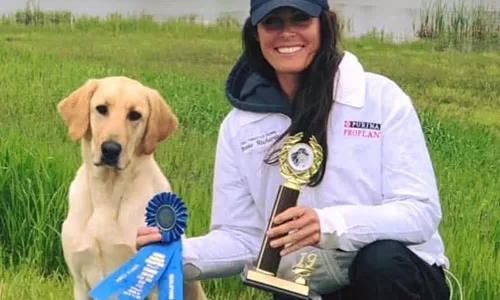
Jessie Lee Richards owns and operates Full Throttle Kennel in Campbellsport, Wisconsin. She specializes in training retrievers for waterfowl and upland hunting and competes in AKC Hunt Tests and Field Trials. While Jessie has a passion for “full throttle” training and turning dogs into hunting machines, when it comes to training and timing, she believes a common mistake is getting in too big of a hurry. Especially when introducing new experiences and training concepts.
“Every dog is different,” Jessie says. “You need to adjust your pace according to the dog. Don’t rush. If you take the time to do it right the dog will learn and actually develop faster and you won’t have to go backwards and do it all over again.”
Dr. Jennell Appel – known as “Dr. J” to her many clients and friends – and Jessie Richards agreed to tackle various timing considerations from A (when to air dogs) to ZZZZ (allowing time to rest and recover) and everything in between.
To air is humane, to air frequently is divine
A typical day at Full Throttle Kennel starts by letting dogs out to air and eliminate at 6:30 a.m.
“We do chores at 7 and are doing yardwork by 8 and hit the field by 11,” Jessie says. “We are usually done with field work by about 4 p.m. and then feed. We air after feeding and do evening chores and get a bit of a break until 8 p.m., when we turn all the dogs out for another night airing.”
Jessie says that providing numerous opportunities for airing throughout the day plus the timing of the night airing is important. “It makes for a more comfortable dog and a cleaner kennel, which is healthier. When it comes to young puppies, we air even more frequently – probably twice as often. Same goes for airing while traveling with your hunting dog. Stop frequently – every 3-4 hours at a minimum.”
Dr. Appel says it’s important to know your dog and develop a routine. “Dogs that travel constantly are conditioned to eat and air immediately afterward. Whereas a pet dog could eat and perhaps wait an hour or more to eliminate. Know your dog and air accordingly.”
The BEST time for a Vet Check-up?
Make an appointment for your hunting dog at least a month before the hunting season starts.
“A thorough exam in advance of the season makes the most sense because it allows time to address any issues that may be detected,” Dr. Appel says. “For example, if we diagnose tick-borne disease or some other issue you can do something about that versus going to the vet three days before the season starts and finding an issue or illness that causes you to miss the opener. I also recommend getting your dog checked out at the end of the hunting season.”
Timing considerations when feeding hard-working canine athletes
Most experts recommend feeding a high protein, high fat diet like Purina Pro Plan Performance once per day – after exercise and at the end of the day to allow food to be digested and move through the gut before the next day’s hunt.
Dr. Appel agrees with that strategy but adds that timing of feeding can be very dog specific and her recommendation on whether to feed once or twice a day might depend on the dog.
“We definitely have research to show that having the least amount of stool bulk is best for performance dogs and elite canine athletes,” Dr. Appel says. “That means the more time that passes between a meal and a bout of exercise – the better. As a result, a lot of performance dogs are fed once a day. It’s efficient and effective. At the same time, I’ve seen some dogs that are difficult to keep weight on when fed once a day. For those dogs, it makes sense to feed a small amount in the morning and the main meal at the end of the day.”
Jessie Richards follows Dr. Appel’s recommendations and adds that she feeds most of her retrievers once per day except dogs that eat more than 4 cups of Pro Plan per day. “Say you have an active dog with a high metabolism that needs 5 cups of Pro Plan a day,” Jessie says. “With that amount of food, I’d typically feed one cup in the morning a couple hours before doing any work and then 4 cups in the late afternoon at least an hour after doing work.”
Float that kibble
Much like you would add milk to cereal for your breakfast, Dr. Appel advocates adding water to effectively “float” the Purina Pro Plan dry kibble at feeding time.
“Water helps move the food through the stomach quickly,” she says. “What we see in dogs not fed with water or moistened kibble – they will need water about 45 minutes after feeding and tend to really bulk up on too much water. We don’t want a bunch of water sitting in their stomach.”
Dr. Appel has strict timing rules for feeding before – and after — bouts of exercise.
“If you do feed a small amount in the morning, my rule is you need to wait two hours before they work or hunt,” she says. “This is based on pure physiology – transit time of food moving through the stomach is about two hours.”
Even more critical is allowing your dog to cool down after exercise and before feeding at the end of the day.
“I prefer waiting at least an hour after exercise to give the dog time to cool down before feeding,” she says. “What most people don’t realize is that the internal temperature of the dog can be 2-3 degrees higher than what the rectal temperature indicates. As soon as we put food in the dog’s body, the body temperature rises. That food is creating heat inside the body as food is being digested and broken down. That’s why it’s so important to allow the dog to cool down before feeding.”
Puppy time
Jessie Richards offers a “Puppy Head Start” program as part of her training regimen that introduces young dogs to water, birds, obedience and the “boom” and “bang” associated with guns and hunting.
“You want that first experience to be a great experience,” Jessie says.
With introduction to water, Jessie factors in the pup’s age and experience along with the weather.
“If it’s 80 degrees I might take the litter with Mom to the shallow water. When they see Mom get in the water, and me going in, they’re likely to go in – gradually, at their own pace, to join in the fun. Now, if it’s March or October and the water is cold – ugh – no way. That would not be a pleasant introduction.”
Jessie says proper socialization and exposure to all things outdoors help dictate timing. “Expose them to grass and gravel and bushes and other potentially scary things and surfaces. It’s also important to get that retrieving instinct up before you introduce them to water. Let’s say a dog comes in for training at 6 months and hasn’t been in the water. In that case, water isn’t the first thing I’m going to do with that dog. And when I do take them to water, if they don’t want to go in or balk – that’s OK. I’ll come back in a couple days and try it again.”
Likewise, introduction to birds and guns requires patience, pre-work and common sense.
“Before I introduce young dogs to birds, or guns, I’m going to get that retrieving instinct going,” Jessie says. “I’ll use a lot of bumpers. Bumpers aren’t as fun as feathers, and well-bred retrievers are going to like birds. So, we tend to use way more bumpers than birds.”
When the retrieving instinct is up, and the dog is loving bumpers, and a few birds – it’s generally a good time to introduce the gun at a safe distance.
“Our dogs and even puppies are used to hearing guns and noise in the distance,” Jessie says. “Key word here is ‘in the distance.’ You want puppies and young dogs to associate the sound of guns with fun and retrieving. It’s what they love to do.”
Typically Jessie will position an assistant with a cap gun or blank gun in the distance. Jessie has the assistant fire the blank gun at the arc of the throw while the dog is en route to the retrieve.
Time for training and obedience
Training starts the day you get your puppy home, Jessie says.
“Let them be a puppy, but they need to know and understand rules and boundaries. I also believe in introducing pressure and corrections at an early age. By pressure, that’s NOT punishment or pain. It’s that little tug on the flat collar when you say “come” or “here” that puts a tiny bit of pressure on the neck. It’s teaching them to sit and wait at the crate, not leaping out when you open the door. It’s leash pressure, on and off, and teaching them to heel. It’s putting your knee up to block jumping up. That’s how they learn and once they learn, it’s up to you to enforce the rules. If you only enforce rules some of the time, it’s not fair to the dog.”
Time to warm up
Think of a relief pitcher in baseball who goes to the mound without any warm-up tosses and tries to throw a fastball. At best he’s going to get clobbered. At worst, he’s going to hurt his arm.
Most hunters are accustomed to dropping the tailgate, opening the crate and releasing the dog – who is more than happy to hit the ground running. Dr. Appel would highly recommend a little warm-up before going full throttle. “Warming up is really important,” she says. “It’s critical to bring blood flow to all the soft tissues consistently. Think about a dog sitting in the crate on the drive to a hunt, not moving. The heart is supplying blood to the internal organs, but what’s needed is blood flowing to the limbs, the muscles, the external tissues. Before any strenuous exercise I recommend a consistent, fast-paced walk on lead for 5-10 minutes. That would be a good warm-up, before hunting or testing or trialing – with blood going to the extremities.”
Once warmed up, the dog is ready and better prepared to work.
Dr. Appel says taking time to properly condition hunting dogs in the weeks and months before hunting season not only enhances performance, but it can also help reduce or even prevent some injuries.
“It’s not just a matter of being able to get through the hunt or field trial, but a well-conditioned dog at ideal body weight is less likely to suffer injuries. When the body works hard, stresses increase. When muscles are fatigued, the joints and tendons take on more of the stress. Muscles are not supporting the joints as well as they did at maximum capacity. This can lead to tendonitis and other soft-tissue injuries. There’s also fatigue mentally that affects a dogs’ ability to perform. A dog that’s not properly conditioned gets hotter faster. Heat impacts the brain. A hot dog is not thinking clearly. In addition, smelling and scenting capability decreases.”
Time to recover
“Dogs are tough,” Dr. Appel says. “They love to work and love to hunt and tend to want to keep going. By the time a dog is actively showing signs of injury or lameness there’s probably already a significant issue that needs to be addressed.”
Dr. Appel recommends resting the dog for 24 hours at the first sign of an issue and seeking veterinary care if there’s little or no improvement.
“A common mistake is not giving dogs enough time to heal,” she says. “People are anxious and if the situation looks to be improving, they’re eager to go right back to work. The problem is, when a dog is injured, the body will try and find ways to compensate for that injury, shifting weight to other limbs. Now the problem gets worse because that shifting can cause breakdown and injury to other limbs, joints or areas of the body.”
Time to see a specialist
Soft-tissue injuries to tendons, muscles and ligaments are among the hardest issues to resolve.
“Typically, we can manage pain associated with joint injuries and inflammation, but blood flow is needed to heal chronic soft tissue injuries and that takes time,” Dr. Appel says. “Tendonitis might take from one to three months to resolve, while you’re looking at six to nine months for something like an Achilles tendon.”
Dr. Appel recommends finding a certified sports medicine veterinarian with training in rehabilitation and access to technology like diagnostic ultrasound and MRI. Once a proper diagnosis has been made, a rehab plan can be initiated.
“Again, I go back to soft tissue injuries that can come and go. Your dog may not be exhibiting lameness, but that tendon is still healing,” she says. “You have a dog that looks normal but is still healing and that’s where a professional expert can help guide you through timing and the rehab process.”
ZZZZ – Time to Rest
Jessie Richards believes all dogs need a day off once in a while.
“Just like people need time off from work, I think dogs can benefit from a break or a weekend off,” she says. “It’s also important to keep training sessions short and sweet – especially with puppies. You always want to try and end on a positive note. Keep them wanting more.”
Dr. Appel adds that in addition to rest, consideration should be given regarding too much exercise for puppies and potential growth plate issues.
“There’s a tendency to want puppies to mature and progress faster than ever to compete – especially in field trials,” she says. “The more water work you can do with your puppy, the better. Swimming helps improve core strength and creates the least amount of stress on their joints.”
Time to seek professional help?
Going to a pro – either a professional trainer like Jessie Richards or an expert in canine rehabilitation and sports medicine like Dr. Jennell Appel — can help your hard-working dog reach its potential and enjoy more productive and healthy days in the field.
“The average person who works 40 hours a week doesn’t have the time, the equipment, the grounds or the experience a good pro trainer should have,” Jessie says. “It’s an investment in your dog, for sure. But a dog that’s worked a couple times a day is typically going to advance faster and do better than a dog that’s worked a couple times a week.”
And if your dog has an injury or illness that requires advanced diagnostics and the expertise of a certified sports medicine / canine rehabilitation veterinarian– your veterinarian should help you find one.
“The professional with that training and experience can help develop your rehabilitation plan and guide you through that process,” Dr. Appel says.
For more information about Full Throttle Kennel and Training Tips from Jessie Richards, go to www.fullthrottlekennel.com
For more information about SportVet Mobile and Dr. Jennell Appel, go towww.sportvetmobile.com
WHY COLD AND MISERABLE CONDITIONS MAKE FOR BETTER DUCK HUNTING
By Don Thomas
THE SCIENCE BEHIND COLD WEATHER AND SOUND TRANSMISSION
The thing I notice first when the thermometer descends past 10-below here on the high plains isn’t the cold; it’s the acoustics. The physics are straightforward. Cold air is dense air, and molecules of nitrogen and oxygen transmit sound waves more efficiently when they’re packed tightly together. But to the observant outdoorsman, the complexity of the results defies the simplicity of their explanation. This morning, the sound of the spring creek babbling past the front of our makeshift blind offers an orchestral range of tone and timbre. Dry snow squeaks beneath the dog’s paws. The tinkle of frozen willow branches yielding to a browsing whitetail’s teeth sounds positively intimate even though the deer is over a hundred yards away. And when the first wave of mallards rises from the stubble fields two miles to the south, I can hear contented feeding chuckles long before I ever see the birds.
I have been told by responsible adults that hunting waterfowl in these conditions is a lunatic passion and they no doubt have a point. But they don’t know the local game the way I do. We live in an arid county on the cusp of the Pacific and Central Flyways. Absent abundant wetlands and a position in the middle of the great autumn flight paths, the first two months of duck season here are largely unproductive. That’s not to say I don’t hunt ducks then; I just don’t expect to kill a lot of them. Come December though, several thousand mallards will be wintering in the valley, feeding in grain fields and living on whatever open water they can find. When the mercury plummets and ice grips the rivers and reservoirs, they flock to spring fed creeks and ponds where the hunting can be spectacular. The Catch-22? If it’s warm enough to be comfortable in a blind, you’re not going to shoot any ducks.
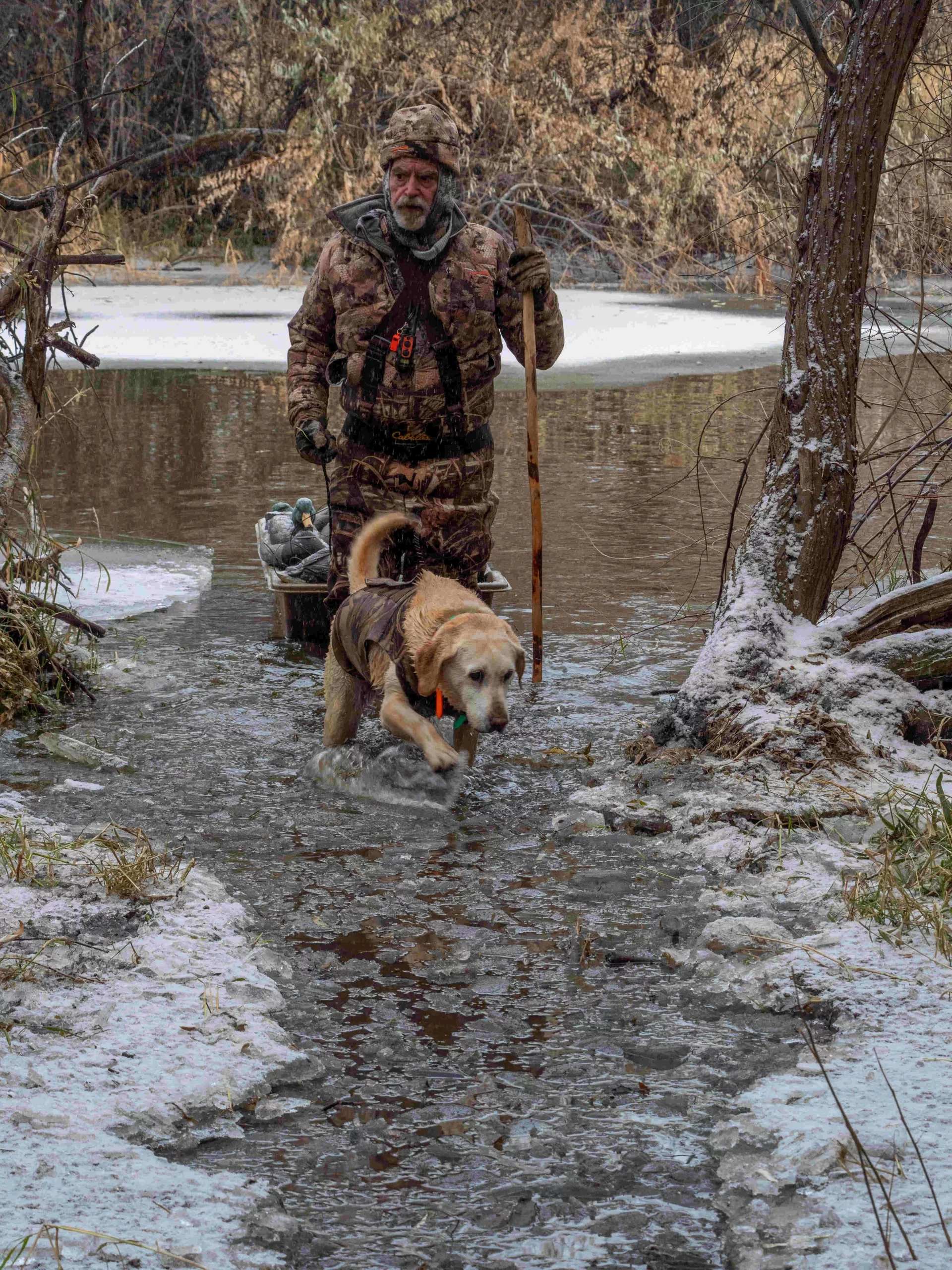
Since the converse is true as well, Lori and I are bundled head to toe in an assortment of low, medium, and high-tech clothing adequate to stock a sporting good store. Canine companionship this morning comes from Rocky, the seasoned half of our kennel’s current yellow Lab duo. The temperature means nothing to him. Muzzle framed in a halo of icy whiskers, he’s busy scanning the sky for birds. We’ve loaded our guns – the chink of brass on steel still seems to be echoing from the hills – but there’s nothing to do but wait, providing an opportunity to reflect upon years of experience with the correlation between great wing-shooting and miserable weather.
WHY WATERFOWL HUNTING IN MISERABLE WEATHER WORKS
Even as a kid, I quickly realized that bluebird days are anathema to waterfowling. I still remember a long hike through the sagebrush to a large Columbia Basin pothole one clear, still October morning. Sunrise revealed a huge raft of puddle ducks and divers in the middle of the glassy lake, none closer than 200 yards from shore. Lifeless as decoys, they stayed there all morning. The few new arrivals all bypassed our spread to join the pajama party far out in the water. Down to shirtsleeves by mid-morning, my hunting partner and I finally circled the shore shouting and waving in a futile attempt to get some ducks airborne. The only shot we fired all morning came in a pointless attempt to flush the flock. Damn, but that was a gorgeous day.
The value of rain, snow, wind, and other forms of climactic misery is old news to seasoned waterfowl hunters, but bad weather has its place in upland cover too. Hot, dry scenting conditions can render even the best flushing dogs helpless. Weather concentrates upland game as well as waterfowl in predictable ways and there’s nothing like a foot of fresh snow to slow down running pheasants and chukar. Here in Montana, I’ve long been partial to the waning weeks of pheasant season, for reasons that have nothing to do with easy limits. I’m hunting educated survivors then, and a few cagey December roosters mean more to me than game vests full of naïve birds during the opening week. The dogs can run all day without overheating and so can I. Only a few fellow madmen are foolish enough to hunt pheasants in blizzards and they’re the folks I’m happy to run into out in the field anyway. Indian summer days early on make for nice pictures, but angry winter weather often makes for better bird hunting.
CLOTHING CHOICES FOR WATERFOWL HUNTING IN BAD WEATHER
Today’s new generation of outdoor clothing has made it easier to hunt birds in nasty weather and I certainly take advantage of modern synthetics and rain gear when I’m heading out into the worst of it. But as an incurable romantic, I’m not ready to forsake all of the old ways. I like the smell of wet wool; like a good whiff of pronghorn or moose, that aroma instantly evokes countless subliminal memories, most of them pleasant (at least after the fact). No matter how comfortable a good arsenal of modern outdoor wear can make you during the thick of the fray, I sometimes think we should chuck it all and go back to cotton long-johns, plaid wool shirts, and no-camo slickers just for old time’s sake. Granted, that kind of sentiment usually goes best at the end of the day when you’re dressed in fresh, dry clothing and sitting in front of a crackling fire with a glass in your hand.
No matter how you’re dressed, nasty wing-shooting weather can eventually cross the line from inconvenience to serious discomfort. One day years ago I was hunting the Cook Inlet tide flats in mid-October with my old Lab, Skykomish. The weather was beautiful when I took off from the dirt strip beside my house, with nothing serious ahead on the weather map. That’s a dicey time of year up north though and winter can arrive in a hurry… as it did a little after nine o’clock the following morning.
I was bundled up beside the decoys shooting nothing when I saw a wall of weather start to spill over the top of the Alaska Range behind me. I would have packed up and run for cover, but all the ducks that had been riding out the Indian summer deep in the Alaska Interior arrived right along with the storm. By the time I’d shot a limit of puddle ducks and Sky had retrieved them, ice was already forming on the decoys and I had gale winds and sleet in my face all the way back to the duck shack. But that was a gorgeous day too, at least once I’d reached the comfort of the oil stove.
HOW TO STAY WARM HUNTING IN COLD WEATHER
Before we progress to the dogs and their responses to cold weather, let me offer a brief review of proper protection from the elements based on years of experience in the field of wilderness medicine. Dressing properly to prevent hypothermia involves three layers of clothing. The inner wicking layer conducts heat-robbing moisture away from the body. Polypropylene or silk long underwear serves this purpose well. The middle insulating layer creates a thermal barrier to prevent loss of body heat to the environment. While newer synthetics accomplish this adequately, it’s still hard to beat wool, or even down as long as you’re sure you can keep it dry. The outer barrier layer protects everything inside from both wind and rain. Gore-Tex is an excellent choice if you’ll be exerting enough to work up a sweat, since it allows both inner layers to breathe. If you’re sitting still in a duck blind, an impervious fabric such as oilskin or rubberized cloth may keep you even more comfortable on rainy, windy days.
HUNTING DOGS IN COLD WEATHER
A retriever’s ability to thrive in such conditions – while plunging in and out of icy water, no less — seems utterly amazing, especially to non-hunters who sometimes wonder aloud how we can make our dogs do such things. There’s an easy answer to that question. We can’t make them hunt in cold weather; they’re too busy volunteering. Thanks to centuries of selective breeding back when our dogs’ ancestors were retrieving codfish from the North Atlantic, today’s retrievers come dressed naturally in water repellant, insulating coats that no human technology can rival. The problem isn’t making them go out on frigid mornings to fetch ducks; it’s making them come back home with you once you’ve shot your limit… or given up because you can’t stand the cold anymore.
Friends from lower latitudes sometimes wonder why I don’t dress my dogs in Neoprene vests on such cold weather outings, and I appreciate their concern. I also have experienced friends who do use vests on their dogs, but I’ve always taken the position that it’s hard to improve upon nature. Left alone, a Lab’s coat will shed water, fluff out, and begin to trap insulating pockets of air moments after a single shake at the end of a water retrieve. (Note how well a retriever’s coat, with its combination of guard hairs, under fur, and body oils, mimics the function of wicking, insulating, and barrier layers of clothing as described above.) And of course my dogs are conditioned to cold by habit as well as genetics. If I were taking a retriever from Mississippi to northern Alberta to hunt ducks over water, I would argue for some supplemental insulation. The same applies if I were asking a short haired breed like a GSP to handle the duck blind chores.
The only time I’ve ever seen any of my Labs act uncomfortably cold while hunting was when they were puppies. While still a youngster, Rocky whined so hard when we threatened to leave him behind one day that we relented and took him along despite the cold temperature. He spent the morning curled up on Lori’s lap while old Sonny handled all the retrieving chores. Young dogs have a high ratio of surface area to body mass, which promotes the loss of heat to the environment. Moral: if a pup objects to being left behind when you head out the door on a bitter day, leave the dog behind anyway.
Back down at the creek, Lori, Rocky, and I are shivering and waiting for Godot. Fully adapted to the cold and clad in the best insulation nature can provide, the dog looks happy as a pig in slop. He knows why we’re here and instinctively recognizes the mission as his raison d’etre. Lori seems less certain. She makes no bones about the fact that she’d rather shoot one shoveler on a nice day than a limit of sub-zero greenheads, but she’s too proud and stubborn to show the white feather. If anyone’s going to decide we’ve had enough and start picking up the decoys, it’s going to be me.
WHY SUBZERO TEMPERATURES ARE RELATIVELY SAFE TO HUNT IN
One important technical consideration amidst all this story-telling: 20-below may be damn cold but this isn’t the kind of weather that gets hunters in real trouble. Frigid temperatures like this are almost always the result of stable high pressure systems, which means little wind or moisture. You’re much more susceptible to hypothermia on a wet, windy day with temperatures in the 30’s than on a calm, clear one like this, no matter what the thermometer says. And that’s my rationalization for hanging on a little bit longer. I know we’ll survive; I just hope my marriage does too.
The face, feet, and hands always go first on days like this. Wool ski masks have the first concern covered, although frozen condensation from my breath has turned my beard into a bib of ice. Cold fingers have long been Lori’s downfall, but she’s learned to stuff her pockets with chemical hand-warmers and I can feel their heat against my side as we huddle together on the fallen log. Insulated waders and heavy socks notwithstanding, there isn’t much to do when your toes start to go numb except stamp your feet and hope the birds arrive before common sense prevails.
We’ve just reached that stage when Rocky glances sharply back over my shoulder. He’s too well trained to break, but the rules don’t say anything about excited whining. The noise of setting wings sounds like a jet engine spooling up for takeoff. Then the birds are circling the blocks and it’s time to start mentally isolating drakes from hens.
By pass-shooting standards, there isn’t much to the gunning here in the late season, when most birds fall at ranges I could reach comfortably with my fly rod. But the show is all mallards, and the goal is to kill five birds with green heads while leaving the ladies untouched. The epic part of the morning will belong to the dog soon enough.
“Take ‘em!” I whisper on the next pass and seconds later three drakes are tumbling as the rest of the flock claws its way back into the sky. Two of the fallen birds leave neat little entrance wounds in the snow bank across the creek while the third tumbles away on the dancing current. After handing my empty gun to Lori, I line Rocky up on the troublesome retrieve and he’s off in a spectacular geyser of spray.
Suddenly the cold just doesn’t feel cold anymore, and it’s another gorgeous day after all.
There are a number of culprits that can stress a dog out, such as separation, unfamiliar visitors, a change in weather, loud noises or novel sounds. Sporting dogs, in particular, could demonstrate anxious behaviors over a disruption in routine or location, whether it be due to travel or going to a new trainer.
“One of the biggest stressors for bird dogs especially is inactivity,” says pro trainer Ike Todd of Todd Kennels in Somerville, Tennessee. “A dog’s anxious behavior is best controlled by regular physical and mental stimulation. Anything you can do to keep your bird dog active, such as running, roading or providing a more spacious kennel or outdoor enclosure, will help promote calmer behavior.”
“What’s more, a dog showing anxiety about training situations, in particular, even after he or she has been adequately exercised, will sometimes respond better when worked with more well-adjusted dogs,” Todd says. “A dog learns by association and being around other willing participants can help boost his or her confidence.”
Anxious behaviors in a dog typically are signaled by pacing, reluctance to accept treats, and excessive barking or panting. An anxious dog living in a state of chronic physiological stress may be prone to chronic health issues.
“It’s important to talk to your veterinarian if your dog is displaying undesirable behaviors,” says Purina Director of Veterinary Technical Communications Jason Gagne, DVM, DACVN. “What might be perceived as just a characteristic of a particular breed or part of a dog’s personality could really be an anxious behavior that needs attention.”
Follow these tips to help manage your dog’s anxious behaviors caused by external stressors.
1. Expose ‘Em Early
First things first. Learning to cope with stressful situations begins during puppyhood. Puppy gyms, or boxes made of PVC frame with various dog toys suspended from ropes or plastic chains, can promote early socialization and sensory stimulation, the foundation for a well-rounded, adaptable dog.
“Anything that involves physical and mental activity for young pups is good,” says Todd. “The more a pup is exposed to, whether it’s a puppy gym or true field-like conditions, the better he or she will be prepared for life as an adult.”
Do your homework before buying a pup and check with prospective breeders on their socialization philosophy.
2. Don’t Set an Expiration Date
A pup should be introduced to the world outside the whelping box, and socialization doesn’t expire once a dog enters adulthood. Continue exposing your dog to new people, places and experiences throughout his or her life, ensuring positive interactions by using common sense and safety considerations.
“Socialization throughout a bird dog’s life is best accomplished through time spent in the field,” Todd explains. “Dogs love it and thrive on it.”
3. Make Noise
A dog should be exposed early and regularly to household noises such as the vacuum cleaner, blow dryer, blender, washing machine and clothes dryer, as well as outdoor noises such as the tractor, lawnmower, weed eater, blower and all-terrain vehicles. Furthermore, a sporting dog should have an early gradual introduction to especially loud sounds to reduce fear of noise.
“Early exposure to loud noises is ideal for a bird dog, provided it’s in a controlled environment,” Todd advises. “Any loud noises should be introduced from a safe distance away initially and be associated with something enjoyable, such as eating or playing, so that whatever is being introduced is associated with a positive experience.”
4. Practice Makes Perfect
Ensure your dog is well-accustomed to travel before leaving on any trip. Start by putting your dog in a crate and taking him or her on short errands, increasing the length of time each trip, to gradually condition the dog for riding in a vehicle. The more comfortable your dog is in the car, the longer he or she can ride.
To further desensitize a dog to travel, give him or her plenty of exercise prior to traveling. “Just like a tired child travels better, so too will a bird dog,” says Todd.
5. Calm During the Storm
“A dog with storm anxiety should be given a safe, confined and comfortable space for the duration of a storm,” says Todd. “Anything you can do to help put your dog at ease can help alleviate his or her fear of storms.”
Keep your dog distracted during a storm by offering his or favorite toys and treats and playing light music to drown out rumbling thunder. Products such as the Thundershirt can also help ease storm anxiety.
6. Relax Together
A dog depends on his or her owner for security, so patience and persistence on your part is key to helping your dog be stress-free. Always keep desensitization sessions short and fun, offering praise or a treat for positive interactions.
Purina Pro Plan Veterinary Supplements Launches Probiotic Breakthrough for Helping Dogs Maintain Calm Behavior
What if you could help support your dog with a probiotic to help him or her stay calm? Purina Pro Plan Veterinary Supplements Calming Care is a canine probiotic supplement available through veterinarians, online retailers, and select pet specialty stores containing Bifidobacterium longum (BL999), a probiotic strain shown to help dogs maintain calm behavior.
“The gut is sometimes referred to as a ‘second brain’ because of the bi-directional communication between the gut and the brain,” explains Purina Director of Veterinary Technical Communications Jason Gagne, DVM, DACVN. “There is scientific evidence that manipulating the gut bacteria can also have a positive influence on dogs displaying anxious behavior. For example, Bifidobacterium longum (BL999), the probiotic found in Calming Care, has been shown to help dogs maintain calm behavior.”
“Different strains of probiotics have different effects on the body,” Purina Research Scientist Ragen T.S. McGowan, PhD, says. “In a 15-week blinded crossover design study, we evaluated the effects of administering BL999 to 24 Labrador Retrievers that demonstrated anxious behaviors. By the end of the study, 90 percent of dogs showed an improvement in displaying anxious behaviors, such as excessive vocalization, jumping, pacing and spinning. Dogs in the study also showed improvement in physiological factors, including positive cardiac activity during stressful events1.”
Calming Care helps support dogs with anxious behaviors such as excessive vocalization, jumping, pacing and spinning, and helps them cope with external stressors such as separation, unfamiliar visitors, novel sounds or changes in routine and location. It also helps dogs maintain positive cardiac activity during stressful events, promoting a positive emotional state, and supports a healthy immune system.
Available through veterinarians, Calming Care should be given under your veterinarian’s supervision. If you have concerns about your dog’s behavior, talk to your veterinarian.
1McGowan, R.T.S. (2016). “Oiling the brain” or “Cultivating the gut”: Impact of diet on anxious behaviors in dogs. Proceedings of the Nestlé Purina Companion Animal Nutrition Summit, March 31-April 2, Florida, 91-97.
As outdoorsmen know, there are few experiences as peaceful as walking the uplands with your dogs. Watching the mist rise over the fields at dawn, listening to the birds and wildlife begin to awaken, takes us to a place that we have always known. A place that calls to us when we are away and welcomes us when we return.
This deep reverence for the outdoor lifestyle is not only understood but lived by the field team at Purina. It’s the inspiration behind Pro Plan Sport Performance formulas that keep dogs strong and energized in the field, and it’s the foundation of trust shared among the field team, fellow outdoorspeople, trainers, and competitors.
As the food of choice for the most sporting dog champions, including National Bird Dogs and National Retrievers, the secret to Pro Plan’s fervent following is rooted in two pillars: nutritional expertise and real, on-ground sporting experience from both researchers and field members.
No one understands this dual responsibility better than Purina Senior Research Scientist and champion dog musher, Dr. Arleigh Reynolds, DVM, PhD, D.A.C.V.N. Dr. Reynold’s research in Alaska has directly informed the development and optimization of many of the Pro Plan Sport formulas, as well as Pro Plan Veterinary Supplements like FortiFlora.
Dr. Reynolds explains, “Like fellow competitors, we want our dogs to be their best, and we need them to be in order to compete at the highest level. I’ve fed Purina Pro Plan for 25 years and raised close to 1,000 dogs, many of whom ate it their whole lives. The nutrition is outstanding, the quality of ingredients is really high, and people trust it because it’s always consistent.”
The combination of expertise and experience runs through every aspect of Pro Plan’s work in the sporting dog world. That’s why a field team of experts – many of whom have competed and finished nationally in their segments – not only talk the Pro Plan talk, but walk the walk themselves. And they thrive on sharing ways to help sporting dogs be their best in the sports they love the most.
Karl Gunzer, Purina Director of Sporting Dog Programs and a national champion trainer, sums up the field team’s passion and impact perfectly. “Purina’s culture of excellence in nutrition and support of Sporting Dog events allows me to give back to the sporting dog world which has been such a big part of my life for the last 30 years.”
Today, you’ll meet the Pro Plan field team at every major national event, including the Retriever Nationals. In between the introductions, the familiar handshakes, and the exchange of tips and tricks, they proudly speak to the always advancing nutrition of Pro Plan, and celebrate the wins fueled by it. It’s a passion that lives in the hearts of each member, and a purpose that will continue to drive them today, and for decades to come.
Eukanuba, a thought-leader in performance sporting and working dog nutrition, has created their best puppy nutrition yet. Eukanuba Premium Performance Puppy Pro is specially formulate with optimal levels of protein and fat to help promote lean muscle and sustained energy for peak performance. Puppy Pro provides complete and balanced nutrition that helps puppies grow and mature at the appropriate rates. It contains clinically proven levels of DHA for smarter, healthier puppies, glucosamine and chondroitin sulfate with EPA to help promote healthy joints, and an antioxidant complex to help puppies develop healthy immune systems. The unique kibble shape promotes chewing and slower food intake, while increased energy content offers enough fuel for high-drive puppies. To prepare puppies for a life spent in the uplands, in the marshes, and on the field trial/hunt test circuits, Eukanuba’s new Puppy Pro is the first step in their Premium Performance suite of products.
Available at chewy.com, Amazon and Petco. MSRP: 28 pounds: $90.99 MSRP: 4 pounds $24.49
EUKANUBA™ LAUNCHES PREMIUM PERFORMANCE PUPPY PRO, NUTRITION FORMULATED TO SUPPORT THE GROWTH AND DEVELOPMENT NEEDS OF HIGHLY ACTIVE PUPPIES
Eukanuba™ announces the launch of Premium Performance Puppy Pro, a nutritional formula designed specifically for highly active puppies. Sporting and working breed puppies may require advanced nutrition during their developmental months to support their needs for growth and activity, and Premium Performance Puppy Pro can help puppies build the strong physical and mental foundations they will need for an active and healthy life.
ST. CHARLES, MO, April 20, 2022 – Eukanuba™, the pet food company founded in 1969 to bring scientifically developed kibble for sporting and working dogs, now launches a new puppy formula Premium Performance Puppy Pro. Puppy Pro joins the company’s award-winning, Premium Performance line, and provides sporting and working puppies with the unique nutrition to support their active lives.
“Athletic puppies and dogs are truly remarkable and remain the focus of our research and development. We continue to define ways Eukanuba™ nutrition can help unleash their innate abilities not just as athletes, but also as working partners.This commitment is what lead us to our newest innovation, Premium Performance Puppy Pro,”said Brad Wadler, Vice President of Eukanuba™ North America. “You only have one chance to support a puppy’s physical and mental development, which is why it is our mission to provide nutrition with comprehensive benefits to help unleash the potential of our active puppies.”
Premium Performance Puppy Prois a premium complete and balanced puppy formula that contains high quality protein, fats, carbohydrates, vitamins and minerals in the specific amounts that active puppies need throughout their development. Puppy Pro reinforces the Eukanuba™ full range of products, and fuels canine athletes of all life stages. Each Premium Performance formula has been specifically designed to help active dogs maintain their health while achieving peak performance.
Growth & Activity. Active puppies have elevated nutritional needs. Eukanuba™ Premium Performance Puppy Pro provides the nutrition to help build the body and sustain energy for play and activity.
Digestive Health. Eukanuba™ Premium Performance Puppy Pro features a tailored fiber complex to support digestive health by optimizing absorption. Optimal efficiency of vital nutrients helps give puppies the nutrition they need, when they need it.
Trainability. Nutrition fuels healthy brain function and learning. Eukanuba™ Premium Performance Puppy Pro delivers a training edge with clinically proven levels of DHA for smarter, more trainable puppies.
Agile Joints. High energy, active puppies can place increased load on their joints. Eukanuba™ Premium Performance Puppy Pro provides glucosamine and chondroitin sulfate with EPA to promote agile joint health.
Immune Support. Active puppies need support to help protect them from the effects of high activity and from their natural exploration. Eukanuba™ Premium Performance Puppy Pro is equipped with a tailored antioxidant complex to help support a healthy immune system and age-appropriate exercise recovery.
Advanced Kibble Design. Puppies with higher energy tend to eat with enthusiasm. Eukanuba™ Premium Performance Puppy Pro helps increase chewing and slow the intake of food through a special kibble design that’s easily hydratable.
Gestation and Lactation Benefits. Eukanuba™ Premium Performance Puppy Pro meets the needs of growth, gestation, and lactation. This highly nutritional diet delivers appropriate levels of DHA, antioxidants, high energy content needed in final stages of reproduction, and essential levels of core nutrients like essential amino acids, vitamins, and minerals.
With nearly 50 years of research, Eukanuba™ offers a complete food lineup, and delivers exceptional, customized nutrition. Eukanuba’s products cater to all types of dogs and are categorized according to life-stage, breed size, andhealth-and-performance requirements. For more information visit www.eukanubasportingdog.com or www.eukanuba.com.