A review and comparison of Smith Optics latest lens technology
By Sammy Chang
Anglers frequently encounter challenges with variable light conditions. Early morning light creates a reflective glare on the water’s surface, while remaining too dim for standard polarized sunglasses. Midday sun often overwhelms low-light glasses, and this cycle repeats at sunset. This forces anglers to choose between poor visibility or no polarization, or the inconvenience of carrying multiple pairs or interchangeable lenses.
While sunglass manufacturers offer both light-adapting and polarized lenses, these features were historically separate, leaving anglers to compromise between options. Smith Optics presents a potential solution: Chromapop Glass Polarchromic lenses. These lenses automatically adjust light transmission based on ambient conditions, while polarized glass provides superior glare-cutting clarity both above and below the water’s surface. Chromapop technology enhances color perception adding significant vibrance to what you see. By combining these features, Smith Optics allows anglers to benefit from variable light adaptability, polarization, and stunning clarity in a single pair of sunglasses.
After eight months of daily use both on and off the water, I can attest to the fact that these lenses are a true game changer for anglers both salt and fresh, and are definitely worth the spend.
Two lens options are available: Brown Green Mirror for lower light conditions and Yellow Blue Mirror for brighter conditions. As a quick reference, VLT, or visible light transmission, is the maximum amount of light transmitted through a lens. 11% VLT means a maximum of 11% of light is transmitted. The Brown Green Mirror lenses allow slightly more light transmission (VLT 11-23%), and are optimized for dimmer or cloudy days. They have a warming effect on what you see. The Yellow Blue Mirror lenses allow slightly less light transmission (VLT 11-20%), work great for brighter days, and provide a cooling effect on what you see. Both lense types will work well as your daily and angling glasses, depending on what effect (warm vs cool) you prefer. I used the Brown Green Mirror on blue bird bright days and it never felt too bright. Likewise, I used the Yellow Blue lenses on overcast days, and didn’t feel the need to take the shades off.
Yellow Blue Mirror (top), Brown Green Mirror (bottom)
Below are side-by-side comparisons of the two lens options. I recommend testing and purchasing at your local shop, but if you are unable to do so I hope these images help “shed some light” on what you’re getting in to (see what I did there?). There is no way to capture what you actually see through these glasses using a camera, but these images will hopefully at least give you a sense. At $305 dollars, these glasses aren’t cheap. But they will be the only pair of glasses you’ll likely ever need.
Chromapop Glass Polarchromic lenses are currently available in their angling line of glasses, including the Guides Choice, Guides Choice XL, Redding 2, and Hookset. The type reviewed in this post is the Hookset, which I found to be perfect for my rather round and medium-sized face. I will post a full review on the Hookset’s in a later post. In summary, they provide great coverage and no light leakage, are very comfortable, but due to the glass lenses have a propensity to slide down some if your nose is on the smaller side.
Note – this post contains affiliate links. If you make a purchase, Strung receives a small commission at no increased cost to you.
Hookset: Black Frame with Yellow Blue Mirror (L), Matte Tortoise Frame with Brown Green Mirror (R)I did my best to capture the polarization and effect of each pair of lenses. The left-most image is what the “naked eye” sees of the water surface. The middle image is the Brown Green Mirror lens, and the right-most image is the Yellow Blue Mirror lens.Top: Yellow Blue Mirror. Bottom: Brown Green Mirror.Left most glasses both images: Yellow Blue Mirror. Right most glasses both images: Brown Green Mirror.
To catch steelhead and salmon, you need to swim the fly at the right angle, the right depth, and the right speed. The right rod can help solve that puzzle.
But steelhead and salmon are the fish of a thousand casts, so preferences also play a big role. You can fish the same fish in the same water with a single-hander, a short two-hander, or the very longest rod. You can fish floating line, sinking line, dry flies, wet flies, traditional swing, riffle hitch, nymph and indicator. The variations are endless. The team at Scott understands this, so they made a series of rods to satisfy every preference.
Scott’s Swing rods were meticulously developed and are loaded with technology and attention to detail to meet those demands.
Fished and tested by professional anglers and casters from Alaska to the Great Lakes, from Canada to Norway, and from the Pacific Northwest to the Northeast, Scott left no stone unturned making sure each rod was fine-tuned for its intended purpose.
Swing rods feature progressive loading actions, fast recovery speed, directional stability, and a light-in-hand feel from combining finely tuned new tapers with our multi-directional, multi-modulus layups, ARC2 reinforcement, Carbon Link resin system, and the very finest components.
Breakthrough components include new titanium tangle-free stripping guides with Silicon Nitride inserts that allow casts to shoot further and help prevent tangles in mono or braid running lines. Snake Brand Universal snake guides grace the rest of the rod to round out the guide set.
Scott also designed a new fully milled aluminum reel seat with aggressive threads for operating with cold hands, type 3 hard coat, and specially milled reel foot pockets that securely hold current performance reels and most vintage reel feet. All new front- and rear-grip designs turned from Flor grade cork ensure comfort, feel, and longevity.
“This was a particularly satisfying project,” commented Scott Rod President and Designer Jim Bartschi. “The challenge of creating high-performance rods for both single- and double-handed fishing applications to pursue the world’s most magnificent fish species was a long, and at times, arduous process but always compelling and fun. For this project, I had the opportunity to work with intensely dedicated salmon and steelhead anglers worldwide to dig into the smallest details. When you collectively get to the finish line on a project like this, there’s a lot of shared pride and excitement.”
Like all Scott fly rods, Swing rods are handcrafted, one at a time, in Montrose, Colorado.
About Scott Fly Rod Company:
Since its founding in 1974, the Scott Fly Rod Company has been dedicated to handcrafting the ultimate fishing tools from start to finish. Based in Montrose, Colorado, Scott has a history of innovation, dedication to performance, and a commitment to protecting the environment while also supporting local fly shops. For more information about Scott Rods, please visit their website and follow Scott on Facebook, Instagram, and Twitter.
Gravel roads spray out from Dubois, Wyoming, in all directions. Follow one of these long enough and cross a wobbly bridge, and sooner or later, you’ll find a trout stream—not one of those famous ones you read about, but the mediocre streams that have framed my life and so many lives around me, and yours, too, if we’re being honest. Too thin to float a drift boat, these creeks and rills sprint down from the high country, braid, wander, and carve cut-banks under rooted gangs of willows. There are dispersed campgrounds, rumors of nearby petroglyphs, and those skinny range cattle that stare you down without irony as you string up your rod and begin to walk some serious miles. High-country streams teem with brook trout, which suffer a bit from bad PR, as perhaps they should. But high-country brookies are always abundant, beautiful, and stupid about dry flies. You can clean house with a size 16 Adams or a yellow Humpy in 14, ginked to the max, of course. Catch a few fish right off the bat and you begin to think that you’ve learned something about fishing over the years, that this whole thing hasn’t been an entire waste of time. There’s no better place to break out the 3-weight and knock the stink off the last few years.
Dubois is 195 miles from my house; there are no stoplights between Casper and my favorite stream. Dubois is the last town of note that I can think of without any chain restaurants. I’ve been stopping at the Cowboy Café for over 20 years, and I can say that the food hasn’t gotten any better or any worse. The men’s room is the size of a phone booth, and the toilet has been ghost-flushing since 2014. Only this year I spotted avocado toast on the breakfast menu, a sign that change comes slowly to the rural West. I often stop at the Cowboy for one last mediocre meal and a cup of bottomless Folgers before I set off into the wilderness. Whiskey Mountain heaves up over the little mountain town like a bully. The highway follows roughly the Wind River up to Togwotee Pass. If you drove that direction you’d crest the Continental Divide, then fall into the Teton Valley. You’d see the Tetons and the corresponding tour buses. You’d end up in Jackson, at a drinking establishment peopled by fit and beautiful hippies who work nonstop on their social media platforms, but this isn’t that kind of story. We’re staying in Dubois.
Take out the map and pick a stream: All of them are fishy; all of them tumble eventually into the Wind, and the Wind unfolds out onto the reservation, winding through farmland ringed with “no hunting” signs, buffalo graveyards, and Indian ambush points. Crowheart Butte seems to follow you as you drive the highway. The Wind River curls towards Thermopolis. The whole drainage supports wild populations of rainbows, browns, and brook trout. But the cutthroats are the fish that define the area. Cutthroats have become a fascination of mine of late; they are at once secretive and gullible. It seems like one of these two traits would eventually erase them from my life, but they haven’t disappeared and have only become more important to me as I trundle along.
Once a year, in August or early September, a group of professors from the college where I work do an expedition. A guy from Education, the Spanish professor, a sociologist, an English teacher who dreams of publication, another English professor who specializes in True Crime, maybe the guy from the History Department—we are a ragtag group who feel compelled to do at least one big trip before the semester begins. These outings prove the point that we live in Wyoming for a reason, and during the semester, when things are grim and you realize you haven’t had a pay raise in seven years, you can look back and remember the three trout you caught on three consecutive casts somewhere in the vast folds of a trail map. You do these trips to underline the fact that you choose to affiliate with certain people who work hard, who don’t sell out or give in to the usual hacks and their five-year plans—these are trips of resistance.
The first night around the campfire is fully dedicated to bitching about the administration’s latest effort to cancel the international program and pivot toward canned curriculums—but after that, we talk trout and elk. Someone breaks out a plastic elk tube and lets one rip. At first, these were backcountry gatherings where a fair amount of suffering took place. We hiked dozens of miles, camped above tree line, pumped water through purifiers, and ate the disagreeable dehydrated camp food that comes in foil packets. Ravaged by black flies and homesick, we often fished until we couldn’t stand it anymore, and used one day to hike to the highest point just to gaze across the tawny steppes of Wyoming. On a tiny camp stove, we’d attempt to fry a cutthroat or two, but at that altitude you can’t harness the heat, even with a lid made of tree bark, and the fish would be crisp in the middle, but raw at the tail and head. Someone would make a joke about sushi, and only the true believers would gulp down the slightly undercooked flesh. (I am one of those believers.) But these trips were exacting a terrible cost in terms of blood blisters and grumpy wives. Slowly our forays into the wild became less ambitious, the fishing became day trips out of camp, and the meals improved. We parked nearby so that we had ample cooler space and were able to bring collapsible tables and fold-out chairs. We brought steak and eggs for breakfast, a heretofore unthinkable concept. Fishing an ice-cold brew out of a 100-quart cooler seemed odd, and a bit cheap, but none of us complained about the experience becoming too inauthentic.
“See that burned area over there?” I said, making sure I had an audience, pointing into the dusty distance. “Tomorrow I’m going to hike over that bench and drop into the river basin.” I asked if anyone wanted to come along.
“Dave, that’s five miles away—that landscape would eat you up.”
[the_ad_group id=”1060″]
This year was a bit different. In April I had a breakup with an art dealer in Jackson Hole. We had only been dating a few months, but I was thrilled about her. It was a COVID winter, and we solved our loneliness by skiing and walking our dogs up snowy forest roads. Perhaps it was in my mind, but I thought we were a perfect fit. I decided to skip Alaska that summer and hang around Wyoming just to see. Sure, I’d miss the salmon run—forecasted to be a record-breaker—but when she talked about the Gros Ventre Range, she did so in magical terms. I wanted to see what she saw. But Chiffon said the summer was coming quickly, and she didn’t want to get bogged down in a relationship. “I want to bop around with my dog, do what I want when I want,” she said. And just like that, I was released back into the trout stream of 50-year-old singles. Unlike most breakups, though, she kept in contact with me as the summer wore on. She sent me photos of herself in her workout clothes, her auburn hair swirled under her baseball cap that advertised a tarpon lodge in Florida. Herein I realized that these love affairs are most vivid in our own minds, and they are only truly dead when you forget to revisit them.
Chiffon began dating a war vet from Rock Springs. It was too late for me to flee to Alaska, where I do most of my healing and terminal fishing. I hooked up with a marathon runner from South Denver, a neighborhood of Sudanese restaurants and hookah bars. I was bummed about Chiffon primarily because I never got to take her fly fishing. I thought that I was sufficient enough with my 3-weight to show her how it was done. She owned an Orvis combo that her last boyfriend had purchased for her. They had never even strung it up. But soon after our breakup, she began to fish almost every day. She sent photos of herself on the Snake River with a nonplussed and undersized whitefish, her first fish on a fly. She sent photos of her little Idaho Shag cattle dog curled up in the shade of spruce trees, river scenes that I placed in the Gros Ventre, sweepers of spruce trees breaking the current on Crystal Creek, and her new fly vest so thoroughly stuffed with unnecessary items that I figured she was getting bad advice. Often there was a hulking shadow of her fishing partner casting over the sage and rabbit brush. Is this the guy who replaced me? I wondered. I really couldn’t criticize a Marine who blew his knee out in Iraq for my freedom, but I couldn’t be happy for him either—my version of patriotism only goes so far. She suggested that we should get together and fish around Pinedale, but these trips never materialized. And why Pinedale? Was I no longer welcome in Jackson?
Then towards the end of the summer, she sent a text: do you ever miss me? She asked me to show her how to nymph. Was I reading too much into this? There was an upscale restaurant at Turpin Meadows. I knew of a gorgeous bend in the Buffalo River where big whitefish and the occasional cutthroat stacked up in the late season. A guy (or gal for that matter) could fish a whole day there without having to move. There were so many whitefish in that deep run that I often felt bad for the mechanical way I pulled them out one after another. These kinds of places are terrific for newcomers, as they require perfect drifts, and they provide enough action that the tyro begins to connect technique with success. And, in my mind, I’d take her to that restaurant afterwards and she’d invite me back into her life—this time with sincerity. But I was already moving forward with the runner; she was turning out to be the real deal, even if she frequently flew across the globe to scuba dive on the world’s receding and imperiled coral reefs with a pair of commercial pilots she called friends. I was, as they used to say in my hometown of Newport News, writing checks with my mouth that my ass could never cash. I found myself packing for Jackson with a lump in my throat. Socks, underwear, a plastic cup full of size 12 Bitch Creeks with rubber legs. If Chiffon dragged me down into her basement bedroom would I ever reemerge to clear my name?
Luckily she canceled, saying she had a friend coming to town. It reminded me of the Eagles’ classic song, “The Hotel California,” that lyric where she got a lotta pretty, pretty boys that she calls friends. I had been listening to that song for 40 years, but I never understood it until this past summer. So I fished dispassionately around Casper with a thumping sensation in my chest. I caught and released a dozen trout from the abandoned uranium mine 50 miles out in the Shirley Basin. I stayed until the sun went down, until the sage purpled, or until my Lab, Henderson, swam out into the lake to bother the geese and their young-of-the-year. Some days I forgot to eat. Still, the texts continued, and Chiffon continued to say she wasn’t catching much.
The morning I was setting out for the annual professors’ fly-fishing trip, I received a last-minute text from her saying her plans had fallen through and she’d love to meet me on Sunday morning in Dubois. We’d finally be able to fish together. We decided to meet at 7 a.m. at The Perch, a coffee spot where we had been in the past.
“I won’t have any cell service, so you have to be there on time,” I said.
“You know I’m solid,” she said.
The professors I fish with don’t take themselves too seriously. New this year was a guy from Dubois who once took some of our classes. Matt now runs a painting company in Dubois, where the dude ranches and millionaire spreads keep him busy. Apparently, just keeping the expansive decks and outbuildings covered in stain and protective lacquer can keep a crew of two busy all year.
And Matt knows these streams. I fished a branch of the Wiggins Fork with him on the first day. He remarked on the temperature of the stream and said that maybe the fishing wouldn’t be so great. There was a caddis hatch, and a little mayfly species I had never seen before. Still, we staggered over the braided sections of cobble and caught little, feisty brook trout until it was time to get back to camp.
Eric Atkins, our Spanish professor, had brought fixings for fajitas. Mike Olson slow-cooked the marinated steak on a huge flat pan that looked like a field disc. The camp hosts whirred up on an ATV and showed us some fossilized wood they had “washed.” These chunks looked more like jewelry than petrified wood. They offered some beautiful examples to us. I took an ivory-colored piece. I thought I’d give it to Chiffon. I gave 50/50 odds that she’d be in Dubois at the appointed time.
The next day Atkins, Henderson, and I split from the group and walked up a horse trail that paralleled the creek. Though we were tempted to peel off and hit the deep pools, we continued up the trail for an hour. We held true to the philosophy that if we could show some discipline and get thoroughly upstream, we might have a good experience. Atkins, who once lived in Los Barriles, Mexico, hardly fly fishes these days. Mostly, he comes along on these trips to provide his deadpan humor, to tend fires at camp, and to listen to our embellished stories about 40-fish days. He says he’s unlucky when it comes to fishing.
And guess what? We fell into a rhythm of catching trout at an alarming rate. We caught cutthroats and brook trout mostly. We also caught browns, which, in local lore, were not present in this stretch. Let’s not go into numbers. Atkins carried the one can of bug spray available to us, and the only complaint I can muster is that the clouds of black flies were particularly virulent. I made the mistake of wearing wading shorts, while Atkins had on Tevas. The flies seem to focus on our calves and feet. Poor Henderson had 15 flies feasting on his nose at any one moment. I killed a few—five with one slap—but Henry thought I was beating him for no reason. So I quit striking, and only cringed while the back flies settled on his muzzle and around his eyes. One guy would spray the other guy’s feet while he casted into the pool. We took turns catching and releasing fish, exploring further and further upstream. We sweated in the muggy, smoke-heavy air. But the fishing was better than we could believe. We didn’t linger too long at any one pool. I had the passing thought that I could bring Chiffon here the next morning and the pools would have reset from the day before. But I worried that she might be wearing shorts, and her perfect legs would get ravaged by black flies. Atkins and I exhausted the whole can of Deep Woods Off! and therefore had no other choice but to head back to camp. We stopped to eat lunch, but everything we touched tasted of Deet.
The next morning I drove out of camp before sunrise. I stopped at a kidney-shaped turnout to change clothes. I tossed my boxers into a bear-proof trashcan. I tossed my t-shirt, too. I brushed my teeth in a gas station bathroom in Dubois. I doused myself with off-brand eau de toilette. I told myself, She’s just a person you dated for a few weeks. I bought two fresh cans of Deep Woods Off! and various upscale snacks I call “girl food.” I was delighted that the store carried the sparkling water Chiffon prefers. I had an hour to kill, so I took Henderson to the public park behind the Bighorn Sheep Center and let him wade to his belly in the Wind River. Midges were coming up already.
Chiffon rolled into town at exactly 7; she leapt from her truck and jogged to the tailgate. She freed her Idaho Shag and he sprinted over to Henderson for a quick snarl to reestablish dominance. I had a fresh cappuccino ready for her. She hugged me, but it was motherly, complete with a back pat—sort of how an aunt pats you upon graduation from a state school with a degree in business administration. She looked diminutive, thinner, and I had to wonder how such a small person had such a profound impact on a galoot like me. And then we were on one of those gravel roads that wind out of Dubois in every direction. I hadn’t seen her in the flesh in months. I studied her jawline, her flowing auburn hair. She caught me staring.
“What’s your deal, man?” she said.
She played Miles Davis on her truck stereo and told me about some of her summer highlights. It had been “beautiful,” “epic,” “stunning.” Her training had intensified, and she was now on a diet called The Whole30. She offered me some strips of baked eggplant. They reminded me of dried, oily fish. She told me not to mention anything about her diet to the professors if we happened to bump into them along the stream.
“They’re probably already out fishing,” I said.
Suddenly, she realized the scenery—it had been there all along. She jumped out of the truck and snapped a few photos with her cell phone. And she drove a tad over what I thought to be a responsible speed. The truck fishtailed and got squirrelly once or twice.
At the trailhead I tied a size 12 stimulator on my tippet and a size 10 Purple Haze on hers. The Purple Haze was the fly of the day the previous day, and I wanted her to catch something. It’s a long understood act of passive-aggression to offer your fishing partner the superior fly. I watched her pull on her wading boots. Luckily she had brought long pants. I warned her about the black flies. All of the introspective and cunning things I had planned to say upon seeing her flew away, and I fell silent. Perhaps I should have had some notes to work from? Most of the snacks I had brought didn’t meet her current dietary needs.
We walked upstream, roughly as far as I had marched the day before with Atkins. There was no sign of the professors, so we had the area to ourselves. The anticipation of fishing was making her irritable. Several times she asked if we shouldn’t just descend to the river and fish the obvious pools. We talked about how quickly the summer had flown, but we avoided specifics. She never asked if I was dating someone new; and I didn’t ask her because my gut told me she was abundantly entertained.
Finally, we pushed down through the blowdowns and thimbleberry bushes to the streambank. I saw a gray drake wobble drunkenly from a pool, and I pointed it out. Unbelievably, the black flies had disappeared. They had terrorized me and Akins not 24 hours before. It was overcast, and perhaps that was the cause of their absence. But just ask Chiffon and she’ll tell you that, in her life, things have a way of always working out. She’s lucky like that.
She kept her hand on her line when she casted the little 4-weight. She let the line purl through the guides. She did a downstream mend, and a little brook trout snapped at her Purple Haze. The fish was too small to take the fly, but it thrilled her to see the trout rise to her first cast.
“You’re pretty good already,” I said. “I thought we were going to have to start from scratch.”
“I’ve had a lot of instructors,” she said. This made me frown. I always wanted to teach her myself. She could tell that her joke hit a nerve. She smiled and blushed.
“Sorry,” she said.
A rookie would counter this moment by telling her about his new girlfriend who may or may not be related to Bill Withers. Angelyn had convinced me to run in a 10K in Denver a month ago. And though she finished 15 minutes before I did, she ran back and paced along with me for the last two miles, her hair pulled back in a power bun, her smile glowing. I lost two toenails and had to ice down my calves for a day. Without prompting, Angelyn ordered a pair of inserts for me—she described herself as a problem-solver. I kept this information to myself. This was, after all, a fishing trip, not an audit.
We continued upstream. She missed fish, caught a few dinks, and eventually said that I should go off and fish by myself. She didn’t want to hold me back. Her cast was faltering; she couldn’t manage even the few feet required to fish these tiny Wyoming streams. She was becoming frustrated. Worse, though, was how her dog was beginning to tremble. The slightest distant thunder made him quake and pant. During ski season, when ski patrol is avalanche bombing, the dog burrows in her closet and refuses to come out. She lashed him to her waist with a leash. The two of them, trundling along in a light mist, cut tragic figures. I tried to help her with her cast.
“Will you please just go away for a second?”
I noticed that she had missed a guide when she had strung up that morning. I took her outfit, bit her fly off with my teeth, and restrung her rod. And then she was moving from pool to pool, picking up fish, and even calling her shots. In four casts she caught two brookies and two cutthroats. Finally, I saw that grin that took me in so many months ago. She unleashed her dog and he didn’t flee the scene, though he often snuck off and curled in the thigh-deep fireweed. When she couldn’t see him she became instantly stressed and called his name. He stood up in the fireweed and she sighed in relief.
“What do you think about this weather?” There were some ugly clouds coalescing in the west.
“Medium,” I said, and kept fishing.
“Medium?” She was beaming, her rod bent on another trout. “What the hell is medium?”
I shrugged.
On the walk out I pretended to get lost. She didn’t buy it. A light rain began to fall. I told her that when I was in college, when my sole transportation was a Honda 350 motorcycle (with a top speed of 60 miles an hour) or hitchhiking, I carried a two-dollar plastic poncho. If it ever began to rain, I’d park the motorcycle and walk off in the woods where I’d deploy the poncho as a makeshift bivy sack and listen as the drops intensified. I didn’t have a map or a GPS, so I often got lost for days in the Virginia countryside.
“You told me that before,” she said.
“I didn’t think you were listening.”
We had to bushwhack up a slope to find the main trail. It was steep and I found myself winded. Henderson was winded, too. But Chiffon pushed up and up. We were pressing through some serious old-growth. Wild raspberries and thimbleberries grew everywhere. I saw her plucking them and shoving them into her mouth as she climbed over deadfall. We were in one of those sacred patches of forest where, if a full-grown bear suddenly stood up from a nap, you’d have to pretend to be surprised.
I lost sight of her for a moment. I saw her cattle dog moving through the woods, but where was Chiffon? I found her on her back eating raspberries. She was holding her cell phone out, trying to capture the old leaning trees, the ancient spruce that grow to unheard of proportions, the grandmothers that topple and rot in anonymity.
“These trees,” she said. There was raspberry liquor on her lips and cheeks.
The professors had broken camp and headed back to Casper. School started the next day, and they were no doubt working on their syllabi. I felt that familiar lump in my throat. Maybe I should be more devoted to my profession? I wanted to introduce her to the professors. All that was left of the campsite was a ring of stones and soot.
In Dubois we had dinner at the Cowboy Café. “Anyone in this day and age who eats more than a quarter of a club sandwich is some kind of pervert or ne’er-do-well,” I said. Nothing on the menu worked for her so she ordered a salad sans dressing. Under the table she clutched a baggy of dried eggplant. I had a burger. Across the street was the hotel where we stayed the night we met. I stared it down. She said she had to get back to Jackson to help her mother who was planning a big party for Rosh Hashanah—otherwise, she said, we could get our old room back and have some fun. But comments like these merely underscore the fact that the romance has collapsed, and all that’s left is some housekeeping. Sooner or later you have to admit that enough is enough, even if it wasn’t enough.
The town was hopping. Octogenarians were crowding the boardwalks. Many of them wore blue ball caps denoting the Navy ships they had served on, the conflicts they had fought in. Korea. Vietnam. On their forearms there were deep green echoes of tattoos. Their wives steered them around and toted sacks of trinkets picked up in the multitudes of gift shops. They held hands.
Chiffon surrendered and ate a few fries off my plate. She said that those trout were the prettiest things she had ever seen, and that she had never been as lucky as she was today. I told her that these streams are like that: overlooked, out-of-the-way, and unpublished. Anyone can catch fish here.
“The famous places are pretty much ruined,” I said.
Are you the kind of guy who is going to act, or are you too meek to do what needs to be done? I queried myself as we stood beside her truck to say good-bye. I was facing a three-hour drive across the Indian reservation and natural gas operations. It was impossibly hot and dry. The storm had blown itself out and blue skies were breaking over the Absaroka Range.
She attempted a quick goodbye and hugged me. We were like that for a while. When she went to pull away, I pulled her back. I said, “Do you remember how you used to sleep on me?” Or at least I think I said that. My head was buzzing. She smelled like DEET and sweat, but in a good way. She reached up and massaged my neck. It seemed like we could stay like this forever.
“Get a room!” yelled a teenager with a pronounced Adam’s apple. He was putting through town in an old Honda, the same year as the one I inherited from my mother. I made a note of his license plate in case I ever ran into him under other circumstances.
The thing about driving across the Wind River Indian Reservation is that you have plenty of time to think. Crowheart Butte accompanied me for the first hour. Then it was just me and Henderson and the road. The asphalt was wet from the passing storm. It’s best not to stop along the highway at the various impromptu monuments to Indian deaths. I tuned into the reservation radio station and listened to the drumbeats and high-pitched wails. The sun was still up and it was hot. I tried not to think about Chiffon. I had to get back to my life in Casper, and she had to get back to hers.
Three years ago I received a call from a friend who detailed a special place in Northwest Canada. A floating barge hidden in a cove just off the Pacific coast called the Nootka Wilderness Lodge. Every year a group of friends assemble at this location for four nights and five days of chasing species like salmon, halibut, and lingcod. It’s not particularly about the fishing as it is the yearly gathering to catch up over a common hobby, in a remote destination, with amazing food and accommodations.
Nootka Wilderness Lodge nestled 40 minutes outside of Campbell River
But lets be honest, the fishing is absolutely incredible. Unfortunately, like the rest of the world the last two COVID years have been tough. Restricting access to the lodge’s business and out of country travelers ability to visit. Luckily, the worst seems to be behind us and “normal” life resumes. This year, the crew reunited for its triumphant return to the Pacific waters.
One of the 5 plane rides to our destination.
Ever since I managed to hook a king salmon with an 8wt in the Milwaukee River I have been itching to chase chinook again. After some internet recon on the local waters there in addition to help from the lodge, I was able to come up with a game plan to specifically target coho salmon. Here’s the scoop, while most of the other anglers are chasing chinook by trolling large flashers with trailing spoon lures at 60-100 feet deep I was told coho salmon have been known to make their way to the surface chasing bait fish. The plan consisted of throwing an 8wt with Orvis Depthcharge 300 grain sinking line, a 20lb floro leader, and a de-barbed buck tail fly (thanks to the Phoenix Orvis fishing manager Jakob for helping tie a few) about 20-30 feet into the prop wash of the boat’s motor.Here’s the problem, somehow my 7wt made its way into the Clearwater 8wt rod holder so that’s what we ran.
Amazing views off the boat watching Bald Eagles fish on their own.
Long shot, right? Well if you’re anything like me, you would rather spend eight hours on the water throwing streamers off the back of the boat all day than sitting and wait for tackle in a rod holder to wiggle. Some laughed, some questioned, including my fishing partner on the boat who worried I would just get in the way citing “there’s no way you will catch anything, you aren’t deep enough”. I won’t lie, after about 40 minutes even I worried in my execution. I started changing the length of the presentation, slowly stripping line, quickly stripping line, and then the line snapped tight. “Fish on!” – I hear the boat caption behind me start to laugh and “unbelievable” murmured in dismay spoken by my boat buddy. The Hydros reel drag immediately began to sing as the fish went for the first of many runs out and deep. The fish finally tired and appeared within eyeshot only to hear the caption exclaim “holy cow, that’s a king!” as he netted the fish. Shortly after, we were able to hook into a couple of cohos before the Pacific weather stepped in.
Sometimes, proving people wrong is such an accomplishment.
After chatting with the lodge about wanting to do some more fly fishing, I was able to convince on of the fishing managers to arrange for a three person plane to pick us up and deliver us to a remote lake only accessible by water taxi. It was a recon mission since neither of us had ever been there but heard there were cutthroat trout cruising around. We packed the plane with Yeti panga bags, a few cold All Hands, inflatable stand up paddle boards, and the trusty Garmin In-Reach just for good measure. This was reinforced because as soon as we threw our bags off the plane into the white sand of the lake’s beach we noticed it was littered in bear, wolf, and deer tracks. After inflating the paddle boards we quickly moved towards the less windy side of the lake noticing a shawl smack in the middle of the lake.
Gear dropped! Someone’s exited to hit the water… and away from these bear/wolf tracks.
Unfortunately, the water was extremely comfortable and not as cold as expected leading us to believe the streamers we packed likely wouldn’t be effective unless deep. In true fashion, neither of us packed strike indicators. Somehow one of our bags held a wine cork. I was able to gnaw off a side of the cork (tougher than you would expect with only your teeth) to rig up a make shift strike indicator enabling me to throw a blood leach and midge approximately 30 feet deep. Luckily, we were able to get into a handful of fish before the wind kicked up turning our stand up paddle boards into sailboats. We get spoiled with our Fishcats and flippers in days like these. That said, I still wouldn’t have traded anything to have had the opportunity to enjoy that experience.
Our first fishing spot of the day.
A few years back, I decided to make a conscience effort to start saying yes to opportunities like these. Obviously, it’s a tremendous help to get invited for the opportunity to go to places like these but it is more experience driven than location. Really helping to find yourself by embracing experiences in situations that most others would excuse as “too busy” or “don’t have time”. It could be as easy as exploring new waters near where you live or just spending a night in a tent somewhere you have never been. Putting yourself in uncomfortable (not to be confused with unsafe – minute the bear/wolf tracks above) situations often are remembered more fondly than finishing the next bingeworthy series on your tv streaming service.
Our Nootka Wilderness Crew
Chuck Coolidge lives in Phoenix, Arizona, and travels a lot to feed his fly-fishing passion.
If you press him hard enough, Damian Wilmot might tell you he’s a pretty fair fishing guide on a pretty fair trout stream in northwest Wisconsin. He’ll likely also tell you he’s an itinerant trout bum and bird hunter. He may even mention some of the incredible fur-trade era artifacts he has pulled from the Bois Brule, a river that was crucial to French voyageurs three centuries ago. But he will surely tell you about his meticulously restored Joe Lucius Guide Canoe.
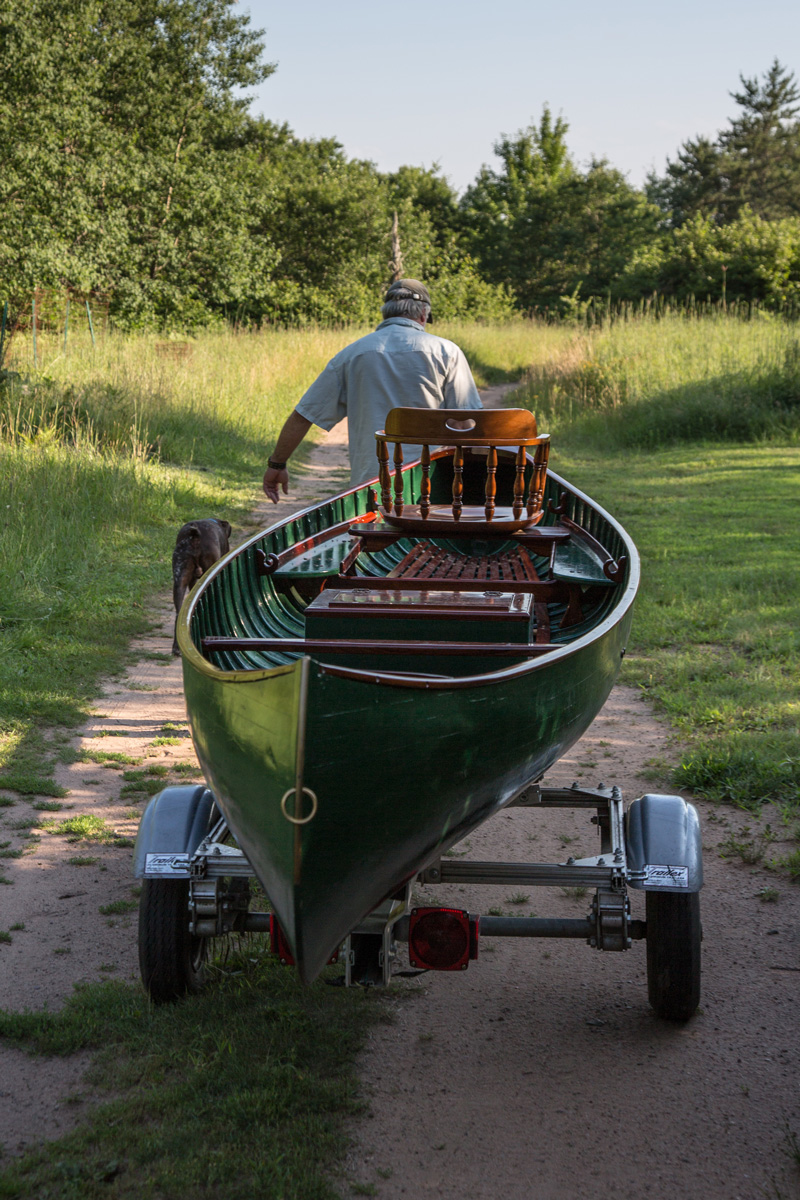
Wilmot is immensely proud of that boat, and he should be. He spent two years resurrecting the 100+-year-old Lucius boat from certain doom, and now it’s a thing of aesthetic and functional beauty. Most importantly, it’s back ghosting over the Brule, serving as Wilmot’s guide boat. Calling the 20-foot canoe lovely is an understatement akin to calling Wilmot a decent fishing guide.
With a snow-white beard and an even whiter shock of tousled hair, the cigar-chomping, 50-something Wilmot looks the part of an Old Brule guide. He speaks with quiet reverence about the river, the fish, and especially the rivermen who came before him: men like Joe Lucius, Johnny LaRock, George Babb, and Johnny Degerman.
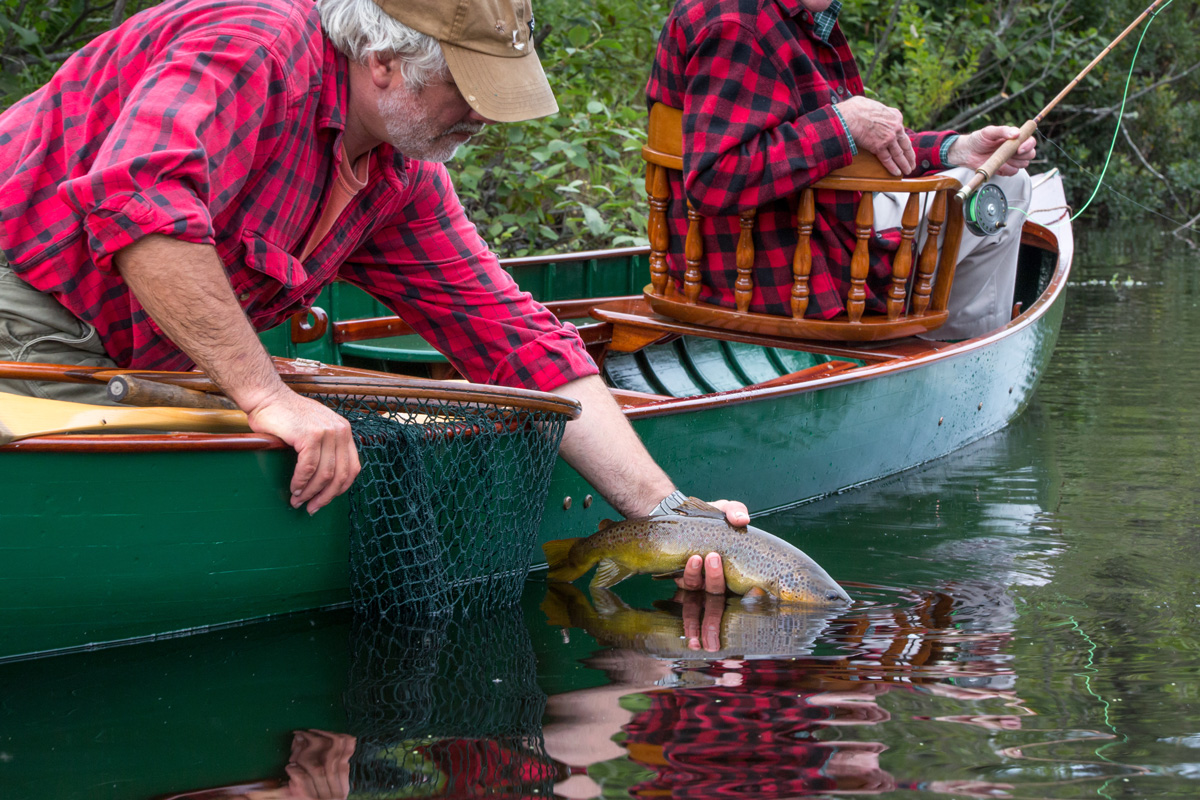
Brule River Guide Damian Wilmot releases a nice brown trout caught by angler Matson Holbrook while fishing from a 1895 Lucius guide canoe restored by Wilmot.
He has a special affinity for Lucius and his handmade guide boats. Wilmot believes the Lucius boat he rescued is circa 1900, maybe even as early as 1895, and hand built by Lucius on the banks of the great river. Resuscitating the craft and making it Brule-worthy didn’t happen easily.
It was part luck that brought this boat to Wilmot—and it was part destiny. He had helped restore another Lucius boat with local boat builder Stub Swenson a few years back and loved the way it handled the swift Brule waters. “There is nothing like fishing out of a wooden boat,” Wilmot exclaims. He enjoyed it so much that he was on the lookout for more of the wooden canoes. When he learned about this one, he immediately went to check it out. Lucius was a prolific builder, even if not many survive. “Those boats got used hard,” explains Wilmot, “but this one was really in a bad way. It was literally on its way to the dump at one point.
“Once I got it home and looked at it closely, I thought there was no way it could be done right. I was going to turn it into a planter in my yard,” says Wilmot. “Seriously. I was going to fill it with dirt and put flowers in it. But Stub reminded me that anything can be fixed, and Lloyd convinced me we should try to bring her back.
“I can’t begin to describe the condition it was in when I got it,” says Wilmot. “It had been stored in a boat shed where the roof had collapsed. The hull had caved in, and there were massive breaks on both ends of the boat.” All the ribs, the planks, the decks—everything needed replacement or major repairs. According to Wilmot, “It would’ve been so much easier just to build a new one from scratch. No one in their right mind would have looked at that boat and said, ‘let’s fix it.’”
But that’s exactly what he did.
Wilmot removed the shattered hull from a riverside shed and carted it to his friend Lloyd Hautajarvi’s workshop in Duluth, Minnesota, 40 miles away. Two years, 700 man-hours, and several thousand dollars in materials later, Wilmot guides out of it daily and sometimes runs the river just to run the river. “There’s no point leaving it sitting on the trailer,” Wilmot explains. “It was built for this river, and it’s tough enough to take whatever the Brule gives it.” The Brule has been “giving it” to boats for a long, long time. More than one modern canoe made of aluminum, fiberglass, or even Kevlar has had its spine broken on infamous Brule boulders.
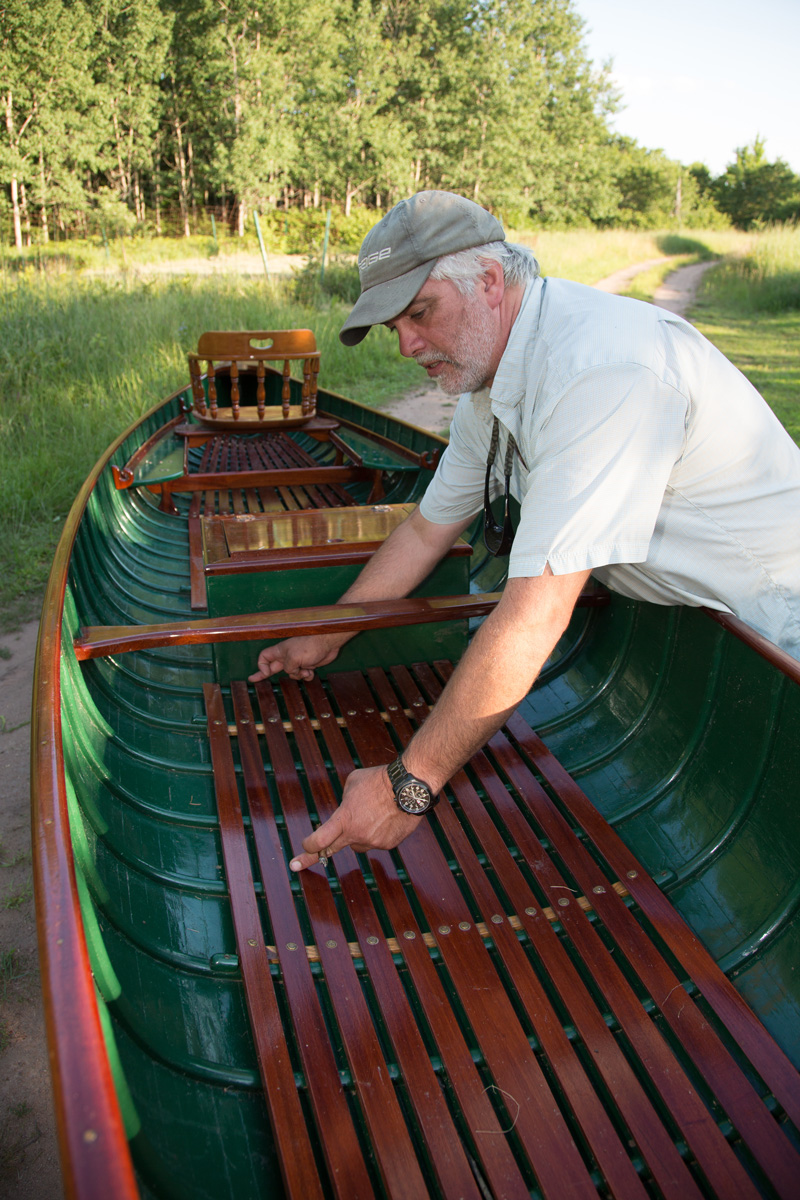
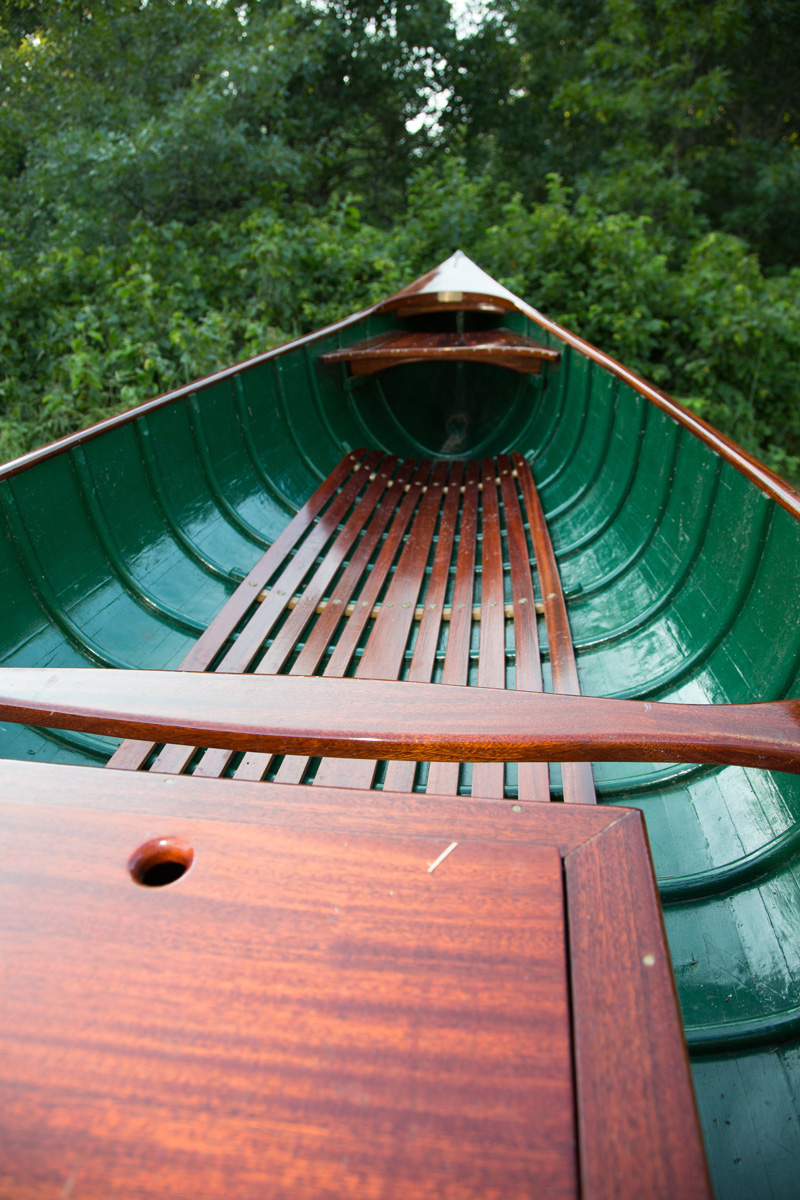
Brule River trout guide Damian Wilmot describes the restoration process of his ca. 1895 Joe Lucius Brule Guide’s Canoe. Lucius guide boats featured built-in, tin-lined livewells and high-backed chairs for the angler. Wilmot and his friend Lloyd Hautajarvi meticulously restored the wooden boat over the course of two years and Wilmot now uses the boat in his daily guiding trips on the river, located near Lake Nebagamon, Wisconsin.
The 44-mile-long Brule draws people from around the world and has for centuries. The first European to travel the Brule was Daniel Greysolon, Sieur du Lhut, in 1680. Duluth, Minnesota, was named for this French soldier and explorer. Sieur du Lhut discovered that the headwaters of the Brule, flowing north to Lake Superior, came within a mile of the headwaters of the St. Croix River, flowing south to the Mississippi River and the Gulf of Mexico beyond. This short portage from one watershed to another made it a natural and efficient corridor for commerce—primarily furs in those days—from the center of the continent to the Atlantic and Gulf coasts.
Joe Lucius came to the Brule region in the early 1880s. He was a settler, a builder, and a fishing guide on the Brule and St. Croix Rivers. Lucius Lake and Little Joe Rapids on the Brule River are named for him, as is Lucius Woods a few miles away from the Brule in his adopted hometown of Solon Springs. He was a handy guy to have around, having learned much about building things that float at the shipyards in Superior, Wisconsin.
Brule River trout guide Damian Wilmot moves his ca. 1900 Joe Lucius Brule Guide’s Canoe into the light for examination. Wilmot and his friend Lloyd Hautajarvi meticulously restored the wooden boat over the course of two years and Wilmot now uses the boat in his daily guiding trips on the river, located near Lake Nebagamon, Wisconsin.
About the time Lucius arrived, lumber barons discovered the vast tracts of old growth white and red pine. Iron ore was also discovered nearby in both northern Michigan and northern Minnesota. Railroads crisscrossed the region, and commerce was king. Somehow, however, the Brule River Valley was left unscathed. Perhaps because of the region’s unique beauty, early settlers and anglers fought to hold back the forces of industry, and they succeeded: The Brule Valley looks much as it did in its primordial beginnings as the last ice age glaciers retreated north.
What the ice left behind was the perfect recipe for trout: Clear artesian springs feed the Brule headwaters with cold, pristine water. The sinewy upper river winds through wide bogs, alder-studded marshes, and upland swales until it narrows and begins a 35-mile-long descent toward Lake Superior. Mucky bottoms and shallow gravel runs lead into broad, still pools. The river darts between boulders and skips over ledges until it begins a steeper, faster run for its last dozen miles, where it dives through clay cliffs and slick passages to Lake Superior. In its upper reaches it is ideal trout-rearing water, and where there are trout there are trout anglers.
In years past, the Winneboujou Train Station platform, situated close to the midpoint of the river, was the busiest station on the river. Set on the rail line built by the Duluth, South Shore and Atlantic Railway, the Winneboujou Station saw thousands of anglers and countless trout cross its platform from the late 1800s through the mid-1900s. The Winneboujou Station, named for a mystical Anishinaabe (Ojibwe) prophet, is long gone, and now a steel and concrete bridge crosses the river there. But the landing itself is still a popular put-in and take-out point on the river.
Just upstream from Winneboujou lies the most storied part of the river. Famous fishing holes are found throughout the central section of the river. Just mention May’s Rips, Rainbow Bend, Lucius Lake, Wildcat Rapids, or McDougall Springs to the Brule faithful, and their heart rates will climb and their casting arms will start to twitch involuntarily.
As it has been for more than a century, the middle section of the Brule is home to numerous old estates owned by wealthy families from Duluth, St. Paul, Chicago, and beyond. For most of its modern history the Brule has been a summer getaway for families with names like Rand, Ordway, Congdon, and Weyerhaeuser. Originally they came for the clearwater springs, the cool summer days, and the brisk nights, but when they discovered the trout fishing, the legend of the Bois Brule was born. As word spread among the wealthy elite, big rustic lodges and compounds were constructed along the banks of the river. And they hosted some famous visitors.
Five U.S. Presidents have fished the Brule: Ulysses S. Grant was first, coming to the river in 1870. Grover Cleveland was next in 1880. Calvin Coolidge, Herbert Hoover, and Dwight Eisenhower all fished the “River of Burnt Wood.” Today, celebrities and VIPs still fly into a private runway just up the hill from Stone’s Bridge and another downstream at Cedar Island.
Most of them come for brief fishing sojourns, but when President Calvin Coolidge came in June 1928, he stayed for three months, making the Pierce Estate on the Brule’s Cedar Island his “Summer White House.” Legendary Native American Brule riverman Johnny LaRock guided him that summer, and Coolidge fished with LaRock out of a Lucius canoe named “Beaver Dick.”
Everyone used Lucius-built boats back then. Wilmot estimates that about 90 percent of the boats on the river during the end of the 19th and first half of the 20th centuries were built by Lucius. LaRock apprenticed under Lucius and eventually began building a few of his own guide boats, too. But if you saw an angler in the front of a canoe, sitting in a high-back chair, with a stoic guide standing in the rear directing the proceedings like a Venetian gondolier, chances are they were in a Lucius boat.
To build these immense summer lodges required a certain level of ingenuity by the local tradesmen. Joe Lucius was one of the most sought-after builders, and he determined that the most practical way to move the required lumber up and down the river was using big, wide canoes. Since no one in the region was building such a craft in the late 1800s, he did it himself, perfecting a design stout enough to handle the rocks and ledges of the river but nimble enough to maneuver through tight chutes and shallow riffles. For more than 20 years of building riverside lodges, Lucius boats carried tons of construction materials through the treacherous Brule rapids and across countless shallow rock bars. When the work was done, Lucius converted the big canoes into guide boats, complete with thru-hull fitted livewells.
The lodge owners saw the newly minted Lucius fishing boats and turned Joe loose to build a fleet of them. By the turn of the 20th century, the big Brule lodges had dozens of Lucius custom canoes in their boathouses.
That’s when Lucius transitioned from local guide and contractor to full-time professional boat builder. He set up his shop in Solon Springs and streamlined his boat-building process. Many of those shop-built canoes survive in various states of repair—or, more commonly, disrepair—throughout the region. The few Lucius boats still in existence sit idle in long-term storage. “You still see them in boathouses up and down the river,” Wilmot laments, “but they never get used anymore.”
The earliest Lucius boats, like the one Wilmot restored, were built by hand on the banks of the Brule. “You can tell those early boats,” Wilmot, a machinist by trade, explains, “because the rib spacing varies just slightly. The later boats are all precisely measured and dead on.” Wilmot still marvels at the workmanship in the original Lucius canoe. “The stem and stern were the real masterpieces. They were the only pieces we didn’t really have to fix,” Wilmot says. “Lucius used tamarack knees. Incredibly strong stuff, and you don’t have to bend it into shape.” The knee is the natural flare where the trunk transitions into the roots, and as Wilmot explains, “It was a favorite of wooden boat builders for a reason.”
Detailed view of Damian Wilmot’s ca. 1895 Joe Lucius Brule Guide’s Canoe. Wilmot and his friend Lloyd Hautajarvi meticulously restored the wooden boat over the course of two years and Wilmot now uses the boat in his daily guiding trips on the Brule River, located near Lake Nebagamon, Wisconsin.
Wilmot did take a few liberties when he rebuilt this boat. You might call them extravagances. For one thing he used mahogany for most of the secondary woods. “Lucius used what he had, which means a lot of painted white pine for seats and decks,” explains Wilmot. “But if he could have gotten his hands on mahogany, he would’ve used it.” The planks and ribs and keel are the same materials as the original: white cedar, white oak, and white pine, respectively. The results are exquisite.
Like Lucius before him, Wilmot wasn’t a boat builder in the beginning—but he is surely the world’s foremost expert on Lucius boat construction now. Born in Ohio, Wilmot’s family brought him to northwest Wisconsin as a boy; he’s been on the river ever since. “My dad was a fly fisherman,” says Wilmot, “and he brought me here early.”
Wilmot is inescapably connected to the history of the river, and tradition is a crucial part of the Brule experience for Wilmot and the people he guides. Silk may no longer be the fly line of choice, but split bamboo rods and vintage Hardy reels combined with traditional Brule fly patterns like the rat-faced McDougall are always ready for use in Wilmot’s boat.
That interest in history was mirrored by Wilmot’s friend and frequent companion in the front chair of the boat, Matson Holbrook. Holbrook has been coming here with his family since 1945. Pilgrimages to the river still intoxicate Holbrook, especially the scent of a sultry summer evening: “It takes me right back to my childhood,” he says, as he eases a dry fly onto the flickering surface of the river. In the back of the boat, Wilmot silently maneuvers the craft through the misty water with deft touches of the pole. It is an ethereal experience to witness, and it’s easy to believe that this scene has replayed a million times on this bend in the Brule.
There are no false moves from Wilmot. His skill at placing the boat in exactly the right place has been honed by decades of experience and near daily excursions on his beloved river in the restored boat. Holbrook, who prefers bamboo to graphite, rolls onto an 18-inch brown, just as the sun dips behind the towering pines and Wilmot reaches out with a handmade net. A few quick photos and lasting smiles see the trout disappear back from whence it came.
Wilmot’s infatuation with the Brule convinced him to buy a small cabin just a shout from Stone’s Landing, a famous put-in. From his front stoop he can throw a shotgun under his arm and follow his German shorthairs, Woof and Casper, into the grouse and woodcock coverts in autumn. Or he can wander down the trail to Stone’s Bridge, often just to watch the clear waters pass by.
For generations, Stone’s Landing has been a favorite put-in for Brule anglers, including famed outdoor writer Gordon MacQuarrie, who grew up in Brule Country and was the outdoor editor for the Milwaukee Journal from 1936-1956. He knew all the Brule regulars, including Lucius, whom he called “one of the finest old gentlemen in the north.”
MacQuarrie did much to popularize the Brule in the first half of the 20th century through his stories of the Old Duck Hunters (and Fly-casters) Association in Field & Stream, Outdoor Life, and other magazines of the day. Beginning in 1931, MacQuarrie wrote about the immense brook trout found on the Brule in the early days, even letting on that there might still be 22-inch native trout lurking in certain holes. But MacQuarrie was not the first, or only one, to do so. In 1846, a passing land surveyor wrote, “It surpasses all other streams in its brook trout, some of them weighing 10 pounds.”
Because of those brookies, the Brule was fished hard—exploited, some might say, as countless trout went home in fishermen’s creels. Although MacQuarrie was already espousing the virtues of “putting them back alive” in the mid-1950s, “catch and release” didn’t truly catch on for Brule anglers until late in the 20th century; by then, few big native trout remained.
For decades, a brook trout over nine inches was a noteworthy event, but through years of careful management of the river the fish are back. Now, Wilmot regularly releases fish twice that long. Browns over 20 inches are common, and they get much, much bigger, too. Bragging-class rainbows live there as well. “Kitchen Sink Fish” is what MacQuarrie called them.
Salmon and steelhead make spawning runs each autumn from the big lake, too. Yet for Wilmot there’s particular satisfaction in sliding the net under a nice Brule brookie, lifting it over the gunwales of the Lucius canoe to admire it for a moment, and then returning the speckled gift to the river.
Today Wilmot takes anglers out in the historic Lucius canoe as often as he can. “Sometimes they get it,” he says, “and sometimes it’s just another wooden boat to them.” Not surprisingly Wilmot has an affinity for those people who “get it.” And he is especially pleased when a brookie grabs a fly with the species’ famously reckless attitude.
Brook trout are what brought anglers to the Brule in the first place, and those early sportsmen and women used Joe Lucius boats. Wilmot uses them now. I believe “full circle” is the proper phrase.
You can contact Wilmot through his website, Fly by Night Guide Service.
Island Park Adventure and Few Unanswered Questions
by Dave Zoby, Photos by Natalie Behring
In theory, a fishing story can be about a number of things. At least I hope so.
I hadn’t been to Idaho in years. The photojournalist Natalie Behring and I had been talking about doing a story on the three grizzly bears that had been poached in the Island Park area in just the last year. But the major news outlets had beaten us to it. “Is there a Serial Grizzly Bear Poacher on the Loose in Idaho?” read one headline. How do you compete with that? There was the initial outrage, theories and accusations, a few cryptic posts on social media that suggested the criminal was a local with an axe to grind. But with tourist season on the doorstep, the outrage faded, and the journalists switched to other subjects, like the lack of affordable housing and the new brewery in Driggs.
It was late May and the salmon fly hatch would, in theory, be moving upstream each day. Maybe we could catch it just right. Perhaps Natalie would like to come along and photograph? In our downtime, we made loose plans to hang around the breweries and restaurants to see if anyone would be willing to talk bears. We had calls and emails with the various agencies whose job it was to protect grizzlies. There was a $40,000 reward for anyone who could solve the poaching cases. Natalie agreed to come along and try some fishing photos, though she admitted that this wasn’t her specialty. She makes a career shooting social strife and portraits of famous people, not dudes with fish. Natalie became a photojournalist by accident. While teaching English in China she walked into the Reuters Beijing Bureau and asked if they would buy some of her images. She walked out with a job. Since then, she has covered war zones, celebrities, presidents, and rural America. She regularly lands photos in The New York Times and National Geographic. She learned Mandarin and lived in China for over a decade where she documented the rapid construction of planned cities and the concomitant pollution therein; she lived in Afghanistan for two years and flew contour routes in Apache helicopters over the starkly barren steppes of the Hindu Kush. Greenpeace’s ship, the m/v Rainbow Warrior, was her home base as she shot photos of climate change and the declining oceans. Naturally, she was drawn to the bear story. I enjoyed being around someone with such worldly experiences; my colleagues at the school where I teach back in Casper still choose Branson and Disneyland for travel.
“I don’t think anyone will talk, but we can fish and hang out,” I said.
“It might not even be a story at all,” she said.
I picked Natalie up and we loaded our camping gear into my truck. Before we headed off, we did a quick mile walk with the dogs. Her black and white dog Alonzo herded my black Lab, Henderson before sprinting ahead and laying on his belly in the dirt as we walked the road and looked for moose. Occasionally Alonzo nipped at my hands, or nibbled the inseam of my jeans, which alarmed me. I have met several cattle-dog/independent woman pairs over the last several years; it’s a thing. They have a bond that is better left unstudied.
We drove past the rolling potato fields of Eastern Idaho, the verdant croplands, the pivot irrigation, and across creeks and rivers swollen a bit and off-color with snowmelt. The distant Tetons looked odd to me; I am usually on the other side, looking west.