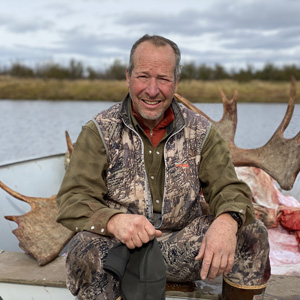
Editors Note: As ptarmigan season starts to open up in various game management units across the Alaskan landscape, we thought this piece by Don Thomas – originally published in Pointing Dog Journal and adapted for digital use by Strung Sporting Journal – would be timely, not only as a source of reference, but also as entertainment and sheer good reading, for which Don Thomas is renowned. Note that the season on Ptarmigan is by game management unit – be sure to look up specifics before venturing out (as a reference, here are the 2024-2025 regulations).
In Alaska, getting there is half the fun… at least in theory. As the fog burned slowly from the surface of the Naknek River, my wife Lori and I helped our old friend Dan Michels top off the fuel tanks in the Beaver and coax Max, his German wirehair, up the steps and into the back of the airplane. By the time we’d finished all our pre-flight chores, the last of the fog had dissipated. A few minutes later we were lifting off the river and heading south into the heart of more wilderness than most residents of the Lower-48 could ever imagine.
Indeed, wilderness isolation and gorgeous tundra terrain form an integral part of ptarmigan hunting’s appeal. In the era of locked gates and trespass fees “Outside”, roadless Alaska’s all but infinite horizons still promise ambitious hunters more cover than they can walk in a day, a week, or a lifetime, all free of fences and offering no one to object to your presence but the bears.
Thirty minutes later Dan had the flaps down in preparation for landing on a nameless pond in the middle of nowhere. I liked what I saw from the right seat: long miles of low tundra ridges that promised dry footing and held just enough willows to provide birds with cover without obligating us to bust through any brush. Factor in clear skies overhead and tundra foliage aglow with the blush of autumn and I couldn’t imagine a more promising beginning to a hard day of bird hunting, Alaska style.
After securing the Beaver, we climbed the first low ridge and fanned out behind Max in a pitch-perfect rendition of what our British counterparts would call rough shooting. Bristol Bay ptarmigan are funny, unpredictable birds. Sometimes I’ve found them so thickly concentrated that I didn’t have to go more than a few hundred yards from the airplane before I’d killed as many as I wanted or ran out of shells. Then there were days when I had to gird up my loins and cover some serious country just to watch a few flush out of range. When no warning clucks greeted us as we topped the first rise, we set out to earn our ptarmigan the old fashioned way: by walking.
A Digression about Caribou Habitat…
Fortunately, despite the countless time I’ve spent out in the Bush I’ve never lost my fascination with tundra habitat. As we hiked, I pondered a mystery that had long left me perplexed: the near total disappearance of the Upper Peninsula caribou herd. When I lived in Alaska fulltime during the 1980’s I hunted this country hard for caribou. Even though I limited myself to a traditional longbow I seldom came home without a good bull, often after glassing thousands. Then a decade or so ago, they simply vanished. As I walked along behind the wide-ranging dog, I studied the “reindeer moss” (it’s actually a lichen) that appeared as irregular yellow patches against the green and crimson ground cover. Although vital to the caribou, the stuff underfoot all looked sparse and skimpy compared to its exuberant, leafy appearance as I remembered it from years ago. Therein, I concluded, lay the explanation for the caribou’s sudden disappearance, and I found myself agreeing with the biologists who felt that the once rapidly expanding herd had simply eaten itself out of house and home.
But leave it to bird dogs to interrupt my deepest thoughts… “Point!” Dan cried suddenly, and when I looked up I spotted Max locked up tight as a tetanus victim beside a low clump of willows a hundred yards away. Ptarmigan destined to flush wild—more on this subject later—usually do so at once, and since we’d neither seen nor heard any birds in the air I guessed that whatever Max was pointing would hold tight while we approached. And indeed it did.
By the time the three of us reached him, the dog still stood motionless and quivering as if the willow clump had hypnotized him. When I finally waded into the brush in front of him, the deep, reedy chuckle of unhappy ptarmigan spilled across the tundra and then white wings were flashing everywhere. Gentleman that I am, I conceded the nearest bird to Lori while another 20-gauge barked off to my left. The little flock left me with an easy double, by which time we had enough birds down that I didn’t bother to reload for stragglers.
By the time Max finished cleaning the birds off the tundra I felt rejuvenated and ready to start walking again. And why not? We could walk all week without running out of bird cover.
Alaska Ptarmigan
Shortly after Alaska stopped being a territory, its schoolchildren conducted a poll to determine their new state bird. The choice they made—Lagopus lagopus, the willow ptarmigan–stands as a testimonial to the wisdom of the young.
There are actually three ptarmigan species native to the state, of which the willow—the same bird that adorns the Scotch label and the subject of all the Glorious Twelfth excitement in the British Isles–is by far the most widely distributed. The range of the white-tailed ptarmigan is largely confined to alpine regions of the Southeastern panhandle, and I’ve killed some there, mostly with bow and arrow while hunting big game in the backcountry. The rock ptarmigan’s range overlaps the willow’s in South-Central Alaska, but its preference for barren, rocky habitat at high elevations makes it a more difficult quarry to pursue. For regulatory purposes the state treats them all the same, which is fortunate since it can be difficult to identify individual specimens by species when the bird is resting in your hand, let lone on the wing at shotgun ranges.
In the Bush, hunting pressure has virtually no impact on ptarmigan numbers, and the state recognizes this fact with generous seasons and limits—as high as 40 birds per day in some remote northern Game Management Units. In occasional Lord Ripon moments I’ve killed 20-bird limits farther south, only to be reminded that carrying out a backpack full of dead ptarmigan isn’t a whole lot easier than carrying out a backpack full of dead moose.
From the wing-shooter’s perspective ptarmigan demonstrate a wide range of behavior throughout the course of the season, in many ways similar to that of the sharptail grouse, a close biological relative. When hunting season opens in early August, birds are still organized in family groups and dressed in their summer plumage, which provides some of the best natural camouflage imaginable. When approached they’ll often hide rather than flush, and even in sparse open tundra it’s often possible to step right over them absent a canine nose to locate birds. Close, controlled shots are the rule as long as you can find the ptarmigan, which often first betray their presence with a characteristic alarm cluck.
By late August and early September—my favorite time to hunt them—birds may still be in family groups of 6 to 10, but some will have started to congregate in the large flocks that will see them through the winter. Their tolerance for dogs and people becomes unpredictable, with some groups continuing to hold tight while others flush far beyond shotgun range. By this time ptarmigan have started to transition into their snowy winter plumage, and the sight of dozens of white wings flashing across the tundra is one of the most compelling in the world of upland hunting.
For obvious reasons few readers will choose to visit Alaska to hunt ptarmigan once the snow has started to fly, but winter hunting is still worth mentioning just because it can be so interesting. Back when I lived on the Kenai Peninsula my standard mid-winter cabin fever antidote was to load the dog into the Super Cub, fly across Cook Inlet, and land on skis once I’d located a concentration of ptarmigan—or their tracks, which were often easier to spot from the air than the birds themselves. The resulting hunt, often conducted on snowshoes, could produce anything from furious shooting to maddening frustration as hundreds if not thousands of pure white birds erupted from the willows beyond shotgun range.
Pointers – The Elegant Way to Hunt Ptarmigan
The dogs I used to load into my Super Cub back in the day were all Labrador retrievers, simply because that’s what occupied my kennel back when I lived in Alaska. And they were useful, locating tight-sitting early season birds and nosing them into the air, diving into the brush to bust out reluctant stragglers, and practically guaranteeing that I could hunt all season without losing a bird. Nonetheless, I always had the feeling that I was missing something, and I was right.
A few years back I finally accepted an invitation from friends to hunt ptarmigan over their English pointers, and that experience altered my whole approach to ptarmigan hunting. Open tundra terrain provides an ideal venue to watch pointing dogs at work. Birds that hold as well as early season ptarmigan deserve to be hunted with pointing dogs, whose mere presence in the field can turn long miles of hiking into an opportunity to participate in a classical, elegant drama. And after you’ve put a few miles of tundra behind you on foot, there’s nothing like letting the dog run up the next ridge to look for birds rather than running up it yourself.
I’ve hunted ptarmigan with several pointing breeds, and if the logistics of transporting a dog through the airline system weren’t so frustrating we certainly would have had Maggie, our own young wirehair, with us during our most recent visit to ptarmigan country. While I have no basis for recommending one breed over any other, I can describe the traits an ideal ptarmigan dog should demonstrate.
Ideal Traits of a Ptarmigan Dog
Pick a wide-ranging dog. Ptarmigan country is huge, often with few terrain or habitat features that reliably concentrate birds. The more ground your dog covers, the more shooting you’ll do. The dog will also need the stamina to hunt for several days in a row. The logistics of transporting bird dogs in the Bush often don’t allow the luxury of frequent rotations. Of course a good nose always helps, but this feature isn’t as critical as in some forms of hunting. Dogs seem to smell ptarmigan easily, and Alaska’s cool, damp hunting season climate usually produces ideal scenting conditions.
Above all, the dog must be staunch on point. If the dog is covering enough ground to find birds, it may be hundreds of yards away when it goes on point… and that distance my contain hills to climb, creeks to cross, and brush to bust. More often than not the birds will hold, if the dog gives them the opportunity.
Finally, the dog should come equipped with common sense. It’s one thing to run off and get lost in a South Dakota cornfield and quite another to run off and get lost on the Alaska Peninsula or Kodiak Island. Hunt ptarmigan country long enough and every dog will eventually run into a bear several sizes larger than anything it’s ever faced before. It’s difficult to predict how any dog will respond to a run-in with a bear, but if the dog is an aggressive scrapper, the first such encounter could well be the last.
Ptarmigan and Pointers on the Emerald Isle
On rare sunny days Kodiak Island can be a spectacularly beautiful place, alive with the lush, green foliage only constant weeks of warm rain can produce. That’s when its residents lovingly refer to their home as the Emerald Isle. The other 95% of the time, they call it the Rock. While I’ve endured my share of storm-lashed nights on Kodiak, luck was with us when Lori and I arrived that September. A high pressure system had cleared the skies, and as we landed in the little fishing town of Larsen Bay the Emerald Isle itself lay spread out before us.
We were traveling with another old friend, Lori Egge, a woman as remarkable as the setting. After years in the Alaska Bush aviation business during which she acquired a wide reputation for her piloting skills, she decided to meld her flying background with her passion for bird hunting and dog training. The result was Wingshooting the Wild, a customized hunting program that begins with Alaska ptarmigan in August and September, moves to Idaho for pheasants, quail, chukar, and Huns in October, and concludes with Georgia quail over the winter. She felt that Kodiak might provide a good September alternative to her August ptarmigan program in the Bristol Bay area and had asked us to accompany her on an exploratory trip to the area. (And yes the presence of two Loris together proved an endless source of confusion!)
The afternoon of our arrival, we loaded up Parker and Elvis, two of her best pointers, and set out to explore some possibilities close to our home base at Kodiak Lodge in Larsen Bay. Early afternoon found us hiking across a broad plateau overlooking the Karluk River, one of the most famous salmon and steelhead waters in the state. But just as I began to long for my fly rod, Elvis went on point and Parker moved in stylishly to honor him.
The birds held so well that I had to kick the grass to flush them while the two Loris did the shooting. With all due respect to the pointers that made it possible, the birds flapping on the tundra moments later made me long briefly for one of my Labs. But we quickly sorted out the confusion, and by the time we’d snapped a few photos and stored the birds in our game vests, Parker was on point again up the hill.
The daily ptarmigan limit on Kodiak is 20 birds, but none of us felt like shooting that many, let alone packing them home and cleaning them. We aimed instead for a more modest eight apiece—plenty to feed our friends waiting back at the lodge—and we had no trouble reaching that goal. We didn’t even bother shooting at the occasional bird that flushed spontaneously without a point from Elvis or Parker… we didn’t have to, and watching the dogs work was even more fun than the shooting.
We spent the next two days exploring new bird cover on Kodiak’s remote western end, by airplane and on foot. All of it held some birds, and most of it held a lot. Hooligan, Lori’s young female pointer, completed a three-dog rotation so that each of the dogs enjoyed a day of rest, which they needed even if they didn’t know it. We shot well, the lodge ate well, and everyone was happy. I even got to break out my fly rod during occasional breaks in the action.
And by the time we finally headed back home to Huns, sharptails, and Maggie, I was already thinking about ways to get my own pointing dog up north the following year.
A Few High Yield Notes About Hunting Ptarmigan in Alaska
Destination: Alaska
Season – In the productive Bristol Bay and Kodiak areas, ptarmigan season opens in August and runs longer than you want to be there. Alaska hunting regulations are complex and subject to change. Always consult current details (Alaska Department of Fish and Game) prior to hunting.
Delicious – Ptarmigan taken in August and September are delicious on the table, where they resemble early season sharptail grouse.
Ideal Gun & Shot – Ptarmigan are not hard to kill, and 20-gauge shotguns are perfectly adequate. I usually shoot 71/2 shot during the early season, although 6’s make a better choice once the birds grow spooky.
DIY enthusiasts certainly can find reasonable ptarmigan hunting from Alaska’s limited road system if they’re willing to do some hiking. However, in Alaska the hunting gets qualitatively better once you leave the roads behind no matter what the quarry. Furthermore, having your own aircraft on standby greatly increases your chances of finding birds in good numbers.
Don Thomas, Strung’s managing editor, grew up in an outdoor family and has been hunting and fishing for nearly 70 years. He has spent his adult life in Montana and Alaska working as a rural physician, and has also been a pilot, commercial fisherman, and bear hunting guide. He has hunted and fished on five continents, written over 20 books on the outdoors, and continues to write for multiple magazines. His latest book, “On The Wing” is a reflection upon his 60 year experience hunting upland game birds and waterfowl. The text includes insightful observations on wildlife biology and habitat. It includes a lot of informative stories and information about hunting dogs, especially Labrador retrievers and various pointing breeds. While much of the material focuses on his current home state of Montana, settings also include Alaska, the desert Southwest, and Texas as well as international destinations such as New Zealand and multiple locations in Southern Africa. The text is supplemented by 45 high quality color photographs. Find out more and purchase his books at https://www.donthomasbooks.com/
Voluntary wing deposits help shape the future of upland birds and waterfowl
We had stopped momentarily, as I had observed the red barrel far off in the distance as we drove down from the sage flats. I exited the truck and went towards the back. I could see the spiny tail feathers protruding from my orange bird vest as they swayed gently in the wind. I reached for the vest and immediately felt its heft. The sage grouse is North America’s largest grouse. The bird derives its name, food, and shelter from the sagebrush on which it depends for its very life. The wavering smell of sage encompassed my surroundings and clung to my clothes.
Its physical appearance was striking. It had a mottled, brownish-gray body with white chest feathers. Its specialized head feathers and long black tail feathers with white tips distinguished it from a female. I had shot a big male. Later, while at a Wyoming Game and Fish Department Sage Grouse Checkpoint, I would learn the bird was approximately a two-year-old “bomber” based on the measurements of the wings and other identifying male features. I raised the gray bird and set it on the tailgate. From my pack I retrieved a pair of sharpened game shears. The wings were spread out. The primary feathers were brown in color, and the undersides were white. The right wing was removed by cutting it off at the joint as close to the body as possible.
I returned the sage grouse to its resting place in my bird vest. I walked to the barrel with the stenciled words “GROUSE WINGS” spray-painted in white on both sides. Below the barrel a sign with specific instructions for hunters to follow. Wyoming Game and Fish biologists have placed marked barrels at convenient locations in the field and near major access roads to popular hunting areas along highways. I placed the sole wing into the dark opening of the red container and walked away. What sort of information would be obtained from my sage grouse?
The number of sage grouse wings submitted depends mainly on the cooperation of hunters.Bird hunters who voluntarily deposit wings help biologists obtain valuable information. Personnel specifically look at the ninth and tenth primary feathers on each wing to determine gender. Shorter feathers would show that the sage grouse was a juvenile, born in the spring. The number of juvenile and female birds in the wing count give an idea of the sage grouse reproductive success. Hen feathers tell if there was success in raising a brood. Female sage hens that show signs of finished molting when killed are a good indication the brood was lost, which freed up energy to go into molting. On the other hand, wings that show a slower molting pattern indicate the hen spent the summer raising her brood. Wing data from harvested sage grouse are especially valuable in wet years, where the birds are spread out more across the landscape, making it harder to get a good sample on brood sizes. Researchers know that brood success combined with lek-count data from specific areas, such as places with recent prescribed burns, has led to areas closed to hunting to help sage grouse populations recover.
THE IMPORTANCE OF WING COLLECTION: SURVEY SAYS…
The importance of wing collection is vital towards the continued understanding of both upland birds and waterfowl, especially those birds that benefit from such retrieved information (sage grouse and lesser prairie chicken). Unlike pheasants, which are easily counted during roadside surveys, determining the reproduction of grouse and other game birds and providing a fall forecast to hunters is not as easy. State and federal agencies each do their part in conducting surveys through wing collection to better determine populations and set and evaluate hunting seasons and limits. Population gauge aside, the wing count also acts as an informal report card for agencies.
Greater Prairie Chicken Wing
The US Fish and Wildlife Service conducts the largest part of wing collection (dove, waterfowl, and woodcock) known as the Migratory Bird Parts Collection Survey. Wing surveys or wing-bees, as they are known, provide detailed information about the harvest. If participating in the federal survey, postage-paid wing envelopes are sent to randomly chosen hunters to send in their wings and parts to one of four collection points, one in each flyway. When the wings/parts arrive, they are sorted by species and stored in a freezer. The wings are then carefully reviewed for color, size, and shape of the feathers. Collected data are then entered into the national database for use in harvest management considerations.
Across the country in different regions, wing collection boxes or barrels are set up by various agencies and organizations (Ruffed Grouse Society, for example) for deposits from band-tailed pigeons, dove, grouse (blue, dusky, prairie chickens, ruffed, sage, sharp-tail), ptarmigan, snipe, and woodcock. Typically, hunters are asked to provide one wing from each bird taken.
An example would be the US Forest Service’s request of hunters in the Fort Pierre National Grasslands to provide a wing of each greater prairie chicken or sharp-tailed grouse shot. Collected wings help form a general idea of population conditions for upland birds in the grasslands. These chicken and sharp-tail wing counts are crucial, as they are umbrella or indicator species, along with prairie dogs. Their health and population numbers are suggestive of how animals who share similar habitats are faring. If these prairie grouse are doing well, it can be assumed other species are, too.
MORE THAN WINGS
Some states conduct wing surveys and othermiscellaneous parts collections to gain a better understanding in upland bird populations. The state of Washington requests that forest grouse hunters help by voluntarily depositing wings andtails of shot birds into collection barrels. This helps with species that are remote and difficult to study.
Alaska launched a wing collection program in 2013 to gain insights into the state’s four species of grouse and three ptarmigan species. Hunters are asked to provide one grouse wing and tail, and one ptarmigan head and wing. The additional parts are yet another component and tool in identifying specific data such as sex, age, and also help evaluate populations. Biologists know that most grouse are harvested between the first part of the season (early to mid-August) and Thanksgiving. After that bird hunters tend to switch to hunting ptarmigan in the winter. This data helps determine harvest compositions to which biologists use to better understand distribution and how harvest changes over areas and time, informing management decisions such as seasons and limits.
Sharp-tailed Grouse
Oklahoma researchers go as far as requesting hunters voluntarily donate one wing, preferably the right wing and the crop or crop contents of harvested quail (bobwhite and scaled quail). This helps in identifying WMA-specific (wildlife management area) fall and winter food sources and provides a broader picture of how quail use WMAs.
And of course, a wing survey wouldn’t be complete without a state requesting hunters to donate ruffed grouse wings. Cooperation between the New Hampshire Fish and Game and the New Hampshire Ruffed Grouse Society Chapter allows for an annual grouse wing and tail survey to be conducted throughout the state.
Samples provided by hunters allow biologists to determine age and sex composition, distribution data, and juvenile-to-adult female ratios. This information is critical about ruffed grouse and helps in determining populations and cyclic trends.
OTHER GAME BIRDS THAT WOULD BENEFIT FROM WING SURVEYS
Wilson’s snipe, sora rail, clapper rail, king rail, and Virginia rail–these five species are difficult to monitor because of their secretive habits, cryptic coloration, infrequent vocalizations, and use of difficult-to-access dense wetland habitats. Population sizes, and trends in abundance, are essentially unknown for snipe and rails at the flyway and national levels.
Harvest estimates are available for snipe and rails through the Migratory Game Bird Harvest Information Program (HIP), but annual harvest management decisions are made with considerable lack of information. At the moment, the Parts Collection Survey (PCS) for rails and snipe enables estimation of the species composition of the rail harvest and the age ratio of the snipe harvest. Wings collected as part of the PCS could be used for additional purposes to better inform management of these species.
Other uses for the wings include: (1) developing methods to age rail wings, (2) determining the spatial origin of the harvested rails and snipe, and (3) further assessing the species composition in the harvest. Surveys do not exist for rails and snipe. Surveys or wing-bees such as those for other species (i.e., doves, waterfowl, and woodcock), do not exist for rail and snipe. One possible solution would be to hold a rail and snipe wing-bee/survey in conjunction with the annual woodcock wing-bee.
THE REASON TO “WING IT” – PRESERVING THE OPPORTUNITY FOR FUTURE GENERATIONS
Data from the collection of wings can be used by biologists to better understand the distribution and the timing of game bird harvests in specific areas, the relative proportions of harvested birds, and the sex and age structure of game bird populations. Distribution and timing of harvest has relevance to obtaining information pertaining to game bird populations and trends, season structure, and to hunter participation for coordinating law enforcement activities.
Collections of game bird wings from volunteering hunters is a reasonably low-cost method in obtaining valuable information such as demographic profiles of game bird populations, overall health of species, and correlating habitat in specific areas. Consistency in wing collections is important in comparing harvest and hatch dates, and age and sex ratios between areas and years.
That is why there is a need to continue education efforts to increase hunter awareness and participation in returning wings, tails, and other requested parts. These efforts should emphasize the need for hunters to voluntarily drop wings off in identifiable boxes and barrels.
So if you’re a bird hunter and want to do your part, I recommend volunteering a wing or two (or tails) from harvested birds in the name of science. This is especially true when hunting those birds that are on a fine line of being accessible to hunt, e.g. the sage grouse. By committing a wing, hunters are in a sense preserving future hunters’ opportunity to hunt upland birds and waterfowl. Hunters going into an area can contact DNR offices and obtain information as to whether or not the area is participating in wing collection. Some agencies provide wing box locations via their website to better help hunters locate drop-off boxes. Once the decision is made to drop a wing off at a collection site, after that it’s relatively easy. Hunters just need a good sharp knife or pair of game shears.
WHY COLD AND MISERABLE CONDITIONS MAKE FOR BETTER DUCK HUNTING
By Don Thomas
THE SCIENCE BEHIND COLD WEATHER AND SOUND TRANSMISSION
The thing I notice first when the thermometer descends past 10-below here on the high plains isn’t the cold; it’s the acoustics. The physics are straightforward. Cold air is dense air, and molecules of nitrogen and oxygen transmit sound waves more efficiently when they’re packed tightly together. But to the observant outdoorsman, the complexity of the results defies the simplicity of their explanation. This morning, the sound of the spring creek babbling past the front of our makeshift blind offers an orchestral range of tone and timbre. Dry snow squeaks beneath the dog’s paws. The tinkle of frozen willow branches yielding to a browsing whitetail’s teeth sounds positively intimate even though the deer is over a hundred yards away. And when the first wave of mallards rises from the stubble fields two miles to the south, I can hear contented feeding chuckles long before I ever see the birds.
I have been told by responsible adults that hunting waterfowl in these conditions is a lunatic passion and they no doubt have a point. But they don’t know the local game the way I do. We live in an arid county on the cusp of the Pacific and Central Flyways. Absent abundant wetlands and a position in the middle of the great autumn flight paths, the first two months of duck season here are largely unproductive. That’s not to say I don’t hunt ducks then; I just don’t expect to kill a lot of them. Come December though, several thousand mallards will be wintering in the valley, feeding in grain fields and living on whatever open water they can find. When the mercury plummets and ice grips the rivers and reservoirs, they flock to spring fed creeks and ponds where the hunting can be spectacular. The Catch-22? If it’s warm enough to be comfortable in a blind, you’re not going to shoot any ducks.
Since the converse is true as well, Lori and I are bundled head to toe in an assortment of low, medium, and high-tech clothing adequate to stock a sporting good store. Canine companionship this morning comes from Rocky, the seasoned half of our kennel’s current yellow Lab duo. The temperature means nothing to him. Muzzle framed in a halo of icy whiskers, he’s busy scanning the sky for birds. We’ve loaded our guns – the chink of brass on steel still seems to be echoing from the hills – but there’s nothing to do but wait, providing an opportunity to reflect upon years of experience with the correlation between great wing-shooting and miserable weather.
WHY WATERFOWL HUNTING IN MISERABLE WEATHER WORKS
Even as a kid, I quickly realized that bluebird days are anathema to waterfowling. I still remember a long hike through the sagebrush to a large Columbia Basin pothole one clear, still October morning. Sunrise revealed a huge raft of puddle ducks and divers in the middle of the glassy lake, none closer than 200 yards from shore. Lifeless as decoys, they stayed there all morning. The few new arrivals all bypassed our spread to join the pajama party far out in the water. Down to shirtsleeves by mid-morning, my hunting partner and I finally circled the shore shouting and waving in a futile attempt to get some ducks airborne. The only shot we fired all morning came in a pointless attempt to flush the flock. Damn, but that was a gorgeous day.
The value of rain, snow, wind, and other forms of climactic misery is old news to seasoned waterfowl hunters, but bad weather has its place in upland cover too. Hot, dry scenting conditions can render even the best flushing dogs helpless. Weather concentrates upland game as well as waterfowl in predictable ways and there’s nothing like a foot of fresh snow to slow down running pheasants and chukar. Here in Montana, I’ve long been partial to the waning weeks of pheasant season, for reasons that have nothing to do with easy limits. I’m hunting educated survivors then, and a few cagey December roosters mean more to me than game vests full of naïve birds during the opening week. The dogs can run all day without overheating and so can I. Only a few fellow madmen are foolish enough to hunt pheasants in blizzards and they’re the folks I’m happy to run into out in the field anyway. Indian summer days early on make for nice pictures, but angry winter weather often makes for better bird hunting.
CLOTHING CHOICES FOR WATERFOWL HUNTING IN BAD WEATHER
Today’s new generation of outdoor clothing has made it easier to hunt birds in nasty weather and I certainly take advantage of modern synthetics and rain gear when I’m heading out into the worst of it. But as an incurable romantic, I’m not ready to forsake all of the old ways. I like the smell of wet wool; like a good whiff of pronghorn or moose, that aroma instantly evokes countless subliminal memories, most of them pleasant (at least after the fact). No matter how comfortable a good arsenal of modern outdoor wear can make you during the thick of the fray, I sometimes think we should chuck it all and go back to cotton long-johns, plaid wool shirts, and no-camo slickers just for old time’s sake. Granted, that kind of sentiment usually goes best at the end of the day when you’re dressed in fresh, dry clothing and sitting in front of a crackling fire with a glass in your hand.
No matter how you’re dressed, nasty wing-shooting weather can eventually cross the line from inconvenience to serious discomfort. One day years ago I was hunting the Cook Inlet tide flats in mid-October with my old Lab, Skykomish. The weather was beautiful when I took off from the dirt strip beside my house, with nothing serious ahead on the weather map. That’s a dicey time of year up north though and winter can arrive in a hurry… as it did a little after nine o’clock the following morning.
I was bundled up beside the decoys shooting nothing when I saw a wall of weather start to spill over the top of the Alaska Range behind me. I would have packed up and run for cover, but all the ducks that had been riding out the Indian summer deep in the Alaska Interior arrived right along with the storm. By the time I’d shot a limit of puddle ducks and Sky had retrieved them, ice was already forming on the decoys and I had gale winds and sleet in my face all the way back to the duck shack. But that was a gorgeous day too, at least once I’d reached the comfort of the oil stove.
HOW TO STAY WARM HUNTING IN COLD WEATHER
Before we progress to the dogs and their responses to cold weather, let me offer a brief review of proper protection from the elements based on years of experience in the field of wilderness medicine. Dressing properly to prevent hypothermia involves three layers of clothing. The inner wicking layer conducts heat-robbing moisture away from the body. Polypropylene or silk long underwear serves this purpose well. The middle insulating layer creates a thermal barrier to prevent loss of body heat to the environment. While newer synthetics accomplish this adequately, it’s still hard to beat wool, or even down as long as you’re sure you can keep it dry. The outer barrier layer protects everything inside from both wind and rain. Gore-Tex is an excellent choice if you’ll be exerting enough to work up a sweat, since it allows both inner layers to breathe. If you’re sitting still in a duck blind, an impervious fabric such as oilskin or rubberized cloth may keep you even more comfortable on rainy, windy days.
HUNTING DOGS IN COLD WEATHER
A retriever’s ability to thrive in such conditions – while plunging in and out of icy water, no less — seems utterly amazing, especially to non-hunters who sometimes wonder aloud how we can make our dogs do such things. There’s an easy answer to that question. We can’t make them hunt in cold weather; they’re too busy volunteering. Thanks to centuries of selective breeding back when our dogs’ ancestors were retrieving codfish from the North Atlantic, today’s retrievers come dressed naturally in water repellant, insulating coats that no human technology can rival. The problem isn’t making them go out on frigid mornings to fetch ducks; it’s making them come back home with you once you’ve shot your limit… or given up because you can’t stand the cold anymore.
Friends from lower latitudes sometimes wonder why I don’t dress my dogs in Neoprene vests on such cold weather outings, and I appreciate their concern. I also have experienced friends who do use vests on their dogs, but I’ve always taken the position that it’s hard to improve upon nature. Left alone, a Lab’s coat will shed water, fluff out, and begin to trap insulating pockets of air moments after a single shake at the end of a water retrieve. (Note how well a retriever’s coat, with its combination of guard hairs, under fur, and body oils, mimics the function of wicking, insulating, and barrier layers of clothing as described above.) And of course my dogs are conditioned to cold by habit as well as genetics. If I were taking a retriever from Mississippi to northern Alberta to hunt ducks over water, I would argue for some supplemental insulation. The same applies if I were asking a short haired breed like a GSP to handle the duck blind chores.
The only time I’ve ever seen any of my Labs act uncomfortably cold while hunting was when they were puppies. While still a youngster, Rocky whined so hard when we threatened to leave him behind one day that we relented and took him along despite the cold temperature. He spent the morning curled up on Lori’s lap while old Sonny handled all the retrieving chores. Young dogs have a high ratio of surface area to body mass, which promotes the loss of heat to the environment. Moral: if a pup objects to being left behind when you head out the door on a bitter day, leave the dog behind anyway.
Back down at the creek, Lori, Rocky, and I are shivering and waiting for Godot. Fully adapted to the cold and clad in the best insulation nature can provide, the dog looks happy as a pig in slop. He knows why we’re here and instinctively recognizes the mission as his raison d’etre. Lori seems less certain. She makes no bones about the fact that she’d rather shoot one shoveler on a nice day than a limit of sub-zero greenheads, but she’s too proud and stubborn to show the white feather. If anyone’s going to decide we’ve had enough and start picking up the decoys, it’s going to be me.
WHY SUBZERO TEMPERATURES ARE RELATIVELY SAFE TO HUNT IN
One important technical consideration amidst all this story-telling: 20-below may be damn cold but this isn’t the kind of weather that gets hunters in real trouble. Frigid temperatures like this are almost always the result of stable high pressure systems, which means little wind or moisture. You’re much more susceptible to hypothermia on a wet, windy day with temperatures in the 30’s than on a calm, clear one like this, no matter what the thermometer says. And that’s my rationalization for hanging on a little bit longer. I know we’ll survive; I just hope my marriage does too.
The face, feet, and hands always go first on days like this. Wool ski masks have the first concern covered, although frozen condensation from my breath has turned my beard into a bib of ice. Cold fingers have long been Lori’s downfall, but she’s learned to stuff her pockets with chemical hand-warmers and I can feel their heat against my side as we huddle together on the fallen log. Insulated waders and heavy socks notwithstanding, there isn’t much to do when your toes start to go numb except stamp your feet and hope the birds arrive before common sense prevails.
We’ve just reached that stage when Rocky glances sharply back over my shoulder. He’s too well trained to break, but the rules don’t say anything about excited whining. The noise of setting wings sounds like a jet engine spooling up for takeoff. Then the birds are circling the blocks and it’s time to start mentally isolating drakes from hens.
By pass-shooting standards, there isn’t much to the gunning here in the late season, when most birds fall at ranges I could reach comfortably with my fly rod. But the show is all mallards, and the goal is to kill five birds with green heads while leaving the ladies untouched. The epic part of the morning will belong to the dog soon enough.
“Take ‘em!” I whisper on the next pass and seconds later three drakes are tumbling as the rest of the flock claws its way back into the sky. Two of the fallen birds leave neat little entrance wounds in the snow bank across the creek while the third tumbles away on the dancing current. After handing my empty gun to Lori, I line Rocky up on the troublesome retrieve and he’s off in a spectacular geyser of spray.
Suddenly the cold just doesn’t feel cold anymore, and it’s another gorgeous day after all.
It was a gloomy, overcast day. There was a bit of chill in the air, enough where I had to zip up my jacket even further to keep the chilly breeze out. My boots trudged along the worn path without purpose as we walked past tangled messes of saplings. Patches of red sumac swayed gently in the wind, as Mallards could be heard in the distant background, and crows overhead squawked at our uninvited presence. It was late February, and they were all but subtle reminders of a bird season that had ended roughly four weeks prior. I was glad to be back out and excited for the possibility of coming across spring woodcock migrating through Kansas.
My friend Rich and I were following up on a tip that woodcock were making a layover in The Sunflower State as they returned north. They are known scientifically as Scolopax minor, but colloquially referred to as timberdoodle, bog sucker, swamp & night partridge, Labrador twister, mud snipe, timber rockets, and “dood’s” or doodles. No matter what they are called, our goal was to pinpoint their specific habitat, so we could hunt them in the fall on their reverse migration south. For years there had been rumors of the little pudgy bird with oversized black eyes and elongated bill living in the damp shadows as it stopped between flights in Kansas. There was no hard evidence, only chance encounters by a very few quail hunters. And even less eyewitness of the mythic bird during the spring. Until now.
An amped up, small, tricolored blur bounded about like an excited child at a playground. The mostly black, little French dog was excited to have returned to the field to do what it was bred and trained for…to find birds. Stormy zipped by us, almost causing me to trip when she abruptly stopped in mid stride. Suddenly, a trilling fluttering of wings launched from the ground. My brain immediately processed the twittering sound and sent a message to my mouth, where I loudly exclaimed, “Woodcock!” I had not heard the familiar sound since hunting Southern Missouri last October, and certainly, never in Kansas!
Optimal Woodcock Habitat & the Woodcock Dance
As woodcock journey home, they make stopovers in the central states in early spring. The birds key in on specific habitat such as moist, young forests or shrubby old fields and thickets, which are concentrated along edges and riparian areas. These specific sites provide ample cover and food resources as they probe for earthworms. This makes their distribution in Kansas limited to the eastern side of the state.
These plats also become a place for males to court females by establishing “singing” grounds. At dawn and dusk, males perform ground displays by making their trademark nasaly “peent” call, then spiraling upward to fly over the singing ground. As males execute their aerial “sky dance,” air passes through the wings, creating a unique twittering sound. While zigzagging downwards in flight, melodic chirps are sung. Once mates are chosen, nesting is typically from early March into June. Nests are created in slight depressions on the ground amongst dead leaves in young upland woods. Females lay one egg a day until completing a normal clutch of four.
The area we were in met all the requirements needed by the birds. Walking, we found woodcock splash or chalk scattered about – vital indicators of prime habitat. The various island thickets and edges of tangled groves we passed were met by flushing birds.
More often than not, woodcock sensing pressure would take flight just as Stormy would pick up their scent. On a few occasions the wind played favor to Stormy, leading to statuesque points that resulted in photo captures. Sometimes, the woodcock would run along the ground before bursting through twisted brambles. Each time we watched the overly plump birds whisk away effortlessly, only to set back down a short distance away.
I have always described the underside of the woodcock’s wings as “pinkish,” highlighted with an orange-buff belly. The whistling-like chirp produced when flushed is similar to the takeoff sound of mourning doves. Its rhythmic whistling notes are a delight to hear as they depart post haste almost bat-like, twisting and banking, flying a short distance to land in another thicket.
For three hours we explored a large area focusing on very distinctive habitat. A slight change in the landscape would be met with no woodcock. We in turn would abruptly turn around and within a fleeting period of time find woodcock again. This cat and mouse game resulted in a dozen birds being located. With their cryptic camouflage pattern, they morphed into the littered ground debris, while being pointed by Stormy.
With a renewed enthusiasm of finally finding the diminutive, little shorebirds in Kansas, we returned repeatedly. Each time, we took note of the weather patterns and focal points of habitat where we had previously located birds. Over a period of three weeks with fluctuating temperatures, we returned four more times, cataloguing counts of 25, 27, 18, and 8 on my flush counter, not including re-flushes.
In the end, the month of March had me walking thickets with an energetic French Brit in search of woodcock. We pieced together pieces of a vegetive puzzle that we hope proves its worth when the season begins. Dare I say that come October, if their migration south can be dialed in…ohhh, what a wonderful time it will be to chase ‘doodles in Kansas.
“I want there to be woodcock forever flying over in October, and solitude…”
– George Bird Evans
“The woodcock is a living refutation of the theory that the utility of a game bird is to serve as a target, or to pose gracefully on a slice of toast…Since learning of the sky dance, I find myself calling one or two birds enough. I must be sure that, come April, there will be no dearth of dancers in the sunset sky….”
Saguaro cactuses are silently poised with outstretched limbs as the Arizona sun climbs higher. The few shadows that are left are quickly vanishing. Sunlight has brought another day into the desert, bringing forth a wide array of warm colors. Jagged mountain peaks can be seen in the distance. As if on cue a rhythmic sound emits from across the landscape. “Chi-qui-ta” or “Chi-ca-go” depending on how it is interpreted. I know this familiar sound. If you’ve ever watched an old western, then you know the call. It can be heard in the background of almost every cowboy movie of yonder.
The three-note musical call is made by the Gambel’s quail (Callipepla gambelii), named after American naturalist and ornithologist William Gambel (1823-1849) after discovering the gamebird in the mid-1800s. Gambel’s are easily recognized by their black droopy feathery tufts atop their heads and pale bluish-gray plumage on much of their bodies. The males’ heads are adorned with copper feathers, dark sable faces with a white stripe above the eyes, resembling a sort of bandido-type appearance. They inhabit the desert regions of various southwest states to include, Arizona, New Mexico, and parts of California, Texas, and Colorado, and of course Old Mexico. They certainly personify the image of bands of outlaws chased by bird hunters for their villainous looks, behavior, and the desolate places they call home.
A second, and third hale is heard not far. Across the dried rocky wash, I see a small plump bird scurrying across the sand behind a cadre of its companions. It suddenly stops. Its greyish and cream-colored plumage is visible on its puffed-out chest. Atop the bird’s brick colored crest is a black exclamation point topknot emphasizing its presence. This adversary resembles the quintessential outlaw with its coal black mask. Suddenly the bird leans back… “CHI-QUI-TA! CHI-QUI-TA!” pierces the air. It means, “Where is everyone?” or “I’m right here.” I translate it to be the latter and take it as an invitation for a confrontation between hunter and bird.
The quail nervously looks around as if to see if a posse had found him and his cohorts. For a split second, our eyes meet. Instantly our roles are determined. Predator vs prey. I squint as sun rays hit my face, and I adjust my blaze orange hat. The little quail nervously darts around, stopping and then moving quickly. His little feet are almost invisible as they move very fast as he scurries about. The quail bobbles up and down checking to see if the coast is clear. He stops again and lets out another call…” CHI-QUI-TA!” Farther down the dried-up wash, a series of similar responses are heard.
“There’s more.” I silently whisper to myself.
I load two shells into the shotgun and snap it shut gently. My boots shift slowly creating a soft crunching sound in the granular dirt. I move slowly and silently towards the cocky bird. Only a few feet are gained before my intentions are immediately uncovered. He retreats into the prickly brush. I noisily follow, busting through while getting entangled by sharp appendages. The whir of a single pair of wingbeats flushes from underfoot. “BANG!” A cloud of feathers fills the air. I mark the bird where it falls. The lifeless body is found amidst white-washed cattle bones and coyote tracks. A fitting scene for the recently departed. I hoist the desperado into the blue sky. Nearby the telltale cries of “CHI-QUI-TA” ride the desert’s air current. I quickly reload my shotgun and ready myself for more flushes as I continue to walk. What I encounter are blurs of quail zigzagging their way across my path ahead of me. Gambel’s begin peeling off one by one and disperse across the desert foliage.
My shot had garnered the attention of my own “posse” of bird hunters. We had been spread out walking our own paths when I came across the lone bandit. Sporadic cracks begin to erupt. Each gunslinger facing their own encounters with quail. Looking around I see a white statuesque dog with its hind-end poised up in the air.
“Point!” I yell.
Moving forward, I carefully scoot around clumps of cacti. My leather gloves creak as I tighten my grip on the shotgun. A sudden cloud of birds startles me, and my attention is drawn away from the motionless pointer. A quick succession of shots turns out only to be a desperate attempt to bring down a bird, but none find their mark. Unscathed, the covey of quail flies a hundred yards before settling down.
Feeling like a fool, I pay no attention to the still motionless bird dog. Seeing my error, I hastily move towards the dog reloading on the move. Cautiously, I maneuver around large flat, oval plate-sized cactus. Jumping Cholla cacti dot the area and I suddenly feel a sharp poke.
“Ouch!”
A ball of spiny appendages had become an unwelcome hitchhiker. In front of me a dozen quail are running and immediately disappear into the landscape. Kicking up dirt as I skid to an abrupt stop, I pull my quail call from my shirt pocket.
“CHI-QUI-TA. CHI-QUI-TA”
I wait for a moment.
“CHI-QUI-TA” is heard off to my left! The quail are not far. Maybe fifty yards. Moving through I pick up another cholla. Damn those things hurt! Suddenly, a whir of wingbeats explodes from underfoot near a large gnarly bush. The shotgun barrel follows through a blurry target and erupts. The bird folds instantly. Grey feathers float down like confetti. More birds begin to flush, and my bottom tube finds another target. More feathers begin to drift with the air current. I’m enveloped in a delicate cloud. Both birds are found. A male and female. While admiring their plumage and colors, the moment is suddenly interrupted by multiple calls.
“CHI-QUI-TA! CHI-QUI-TA!”
The over-under is broken open and two empty hulls eject like rockets. They are quickly replaced with a duo of crimson shells. I turn and see the rest of the guys all scattered about. Shots are sporadic. Each is engaged in their own skirmishes. Movement catches my eye. A lone male scampers across my path and stops. He rears back and with all his energy, bellows out a loud…
“CHI-QUI-TA!”
And, just like that I am once again confronted with yet another outlaw quail and thrust back into another showdown. My ears catch the familiar response by nearby desperados answering the call…
“CHI-QUI-TA! CHI-QUI-TA!”
If you are interested into adding a desert quail call to your gear, then checkout AZQUAILCALLS on Instagram and Etsy. Calls emit and mimic Gambel’s and California/Valley Quail. They are reasonably priced and are available in two types of wood: hardwood and exotic.
Chukar Stuck: A lesson in the judicious application of poor judgment
Thomas Reed
Does one enjoy getting continually lashed in the face by willow switches in the grouse woods? Perhaps. Is it fun to log countless blistering and fruitless steps on wild prairie dodging rattlesnakes and straddling barbed wire in search of Huns and sharptails? Or slopping through cattail stench and olive thorn to flush a cursing rooster pheasant into a cold west wind that exfoliates your tear-streaked face with the ruthlessness of an unfeeling planet?
Passion drives the human soul and our undaunted canine companions into the strangest situations and the most far-flung places. The apex oddity is the lost terrain that the Spanish, on their quests for golden idols and shining cities in the clouds, called the Northern Mystery: the great dry, sagebrush-swept basin that stretches from eastern Washington and Oregon east across southern Idaho and northern Nevada all the way into western Utah.
This is chukar country.
In chukar country I have performed some of my most foolish acts of zeal. Like the time an old companion and I hiked up a canyon of broken shale into a west wind promising snow and delivering it by the time we got to the top in a can’t-see-shit blizzard to find our setters hard as frozen glass, pointing at the base of an ice-coated juniper. A covey of chukar went up into the brutal wind, throats no doubt full of the driving snow, and we each slapped down two. But that wasn’t the story; the story was the long, bitter march down the mountain with the wind-driven snow pounding at our backs and arriving at the camper frozen stiff and needing at least a half-dozen hot buttered rums until we felt half-thawed.
Or the time I marched alone into yet another blizzard while pals cooked Thanksgiving dinner back at camp. I got into birds that day, but they came at me so quickly from uphill where my unseen white dogs worked in a white landscape that they were over my head and gone before I could swing a gun. Occasionally I barked out a shot but scratched nary a bird, and when it was all over I followed my nose—the scent of a sagebrush campfire mingled with snowflakes—into camp, empty-bagged but ready for turkey and fixings.
Or another occasion I slogged out into a thick fog covered basin, again following a good setter who was following her nose and not really in need of many other senses. Like sight. There were birds out there in the fog, and they flew over my head as they had in the blizzard. I fired a few shots, but remembered my buddy who was also marching in the fog somewhere and thought, “You know, I better only shoot straight up in the air, because I could easily be shooting at him or one of the dogs.” Fortunately, he was thinking the same thing. Then we popped out of the fog as one might climb on a ladder out of a steaming swimming pool and found ourselves in a glorious wash of sunshine above a surreal sea of cloud that stretched as far as we could see. We’d timed our ascent by accident, and we were both there, above the clouds with our dogs. The gods had given us the why of things: why a couple of simpletons with shotguns would set out from a warm camp into a fog that would scare even the bravest long-haul trucker, carrying shotguns and following bird dogs they couldn’t see. On that spit of golden, sun- and sage-scented land jutting out into an ocean of cloud, there was no need to ask or answer the question.
Yet in a lifetime of hunting these little creatures of high crag, pucker cliff, and tall sage, one incident stands out for which we were awarded the all-time dolt prize for displaying what we will charitably call extremely poor judgment. This was the time three of us decided that a washed-out bridge was blocking us from some of the finest chukar hunting on the planet. There are times, such as now, when I pay attention to weather forecasts and try to time the travel for windows of good weather. Not then. Snow at home didn’t deter travel on slick roads east out of the Rockies and down to the sagebrush sea of chukar country. Snow turned to rain over the desert, and the rain had begun days earlier. Exactly when the bridge washed out—days, weeks, or months earlier—was unknown. Here we stood, with our three four-wheel drives, looking at the hand-painted “Bridge Out” sign and cursing our luck, without assessing our risk. A lazy desert stream, usually little more than the volume of a couple of garden hoses, now ran about a dozen feet wide and an unknown depth.
“I looked on the map, and there’s a two-track a ways back that looks like it crosses this damned thing,” said Floyd.
“Let’s do it,” I said.
The two-track was sloppy, but it did indeed cross the desert mini-river. We had chains, we had tow ropes, and we had tough pickup trucks and a vintage Bronco. There were chukar on yonder slope; we just knew it. So we plunged across the river and clawed up the other side without much incident. By dark, we had the wall tent set up and were cooking dinner, eager to get out into the desert the next day, just a short drive away from camp.
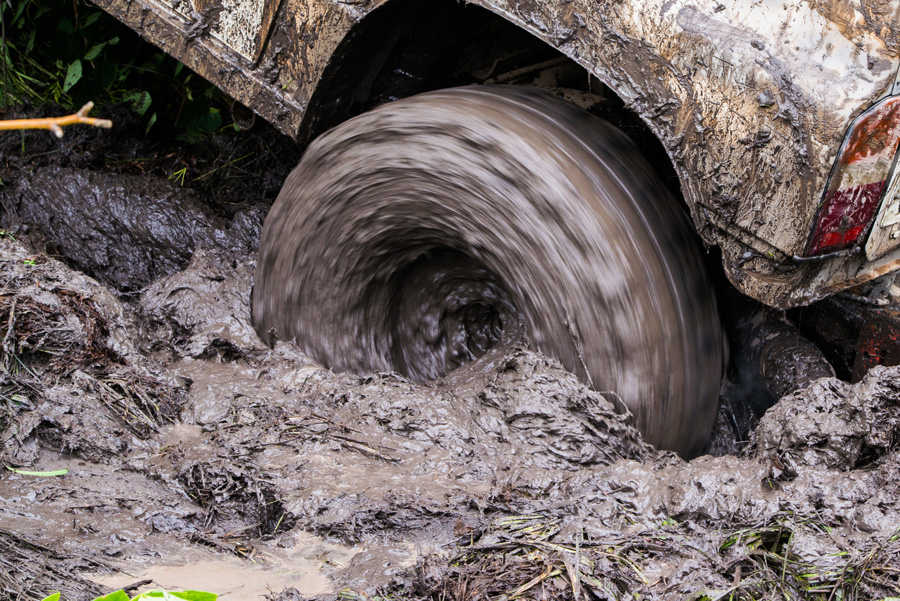
It had been cold that day, and the mud we’d driven in on had been somewhat solid. But that night while we were sleeping it warmed up, and the mud got softer. After breakfast we all hopped into one diesel pickup and discovered just how soft it was. We made it about 10 feet before the heavy truck sank to its axles in mud. Not to worry: We had two more four-wheel drives. I fired up my early-‘90s Dodge diesel and maneuvered so I could pull out the first truck. But that heavy old truck of mine suddenly felt as if it were dropping into the center of the earth. Stuck solid.
We still had the Bronco. But no surprise: That vehicle, though much lighter, went right into its axles as well. All three burly four-wheel drives to the axles about 15 feet from camp. Going nowhere in the middle of nowhere, well beyond a washed-out bridge.
There began two days of digging. We broke two high-lift jacks. We took old timbers from an abandoned mine and lugged them back to put under spinning tires. We crawled beneath differentials with small shovels and passed buckets up as if we were pioneers digging a well by hand.
Not all was lost. We had a good warm wall tent with a supply of firewood, we had beer, and we had a radio for a playoff football game or two. Or three or four. Two full days went by, and late on the afternoon of the second day, all the digging paid off. Or maybe it was just the weather getting cooler again and the mud getting stiffer. First we got Fred’s Bronco out, then my truck, and finally Floyd’s.
And yet.
The next day we decided to get smart and pile into the most off-road-capable of the vehicles, the Bronco. So we left a couple of the dogs in crates in camp and piled into the little Ford and lit out across the desert, following an old Jeep trail toward a chukar cliff. Finally, we were going hunting.
Then we came to another desert wash. It was running full. Fred looked at the river and said, “You know, I think I can do it.” Floyd and I looked at each other. “Sure. Let’s do it. The chukar are on the other side.”
We probed with sticks. It didn’t seem too deep, so we piled in. Halfway across, the Bronco went in over the running boards, and water started pouring in. The current then lifted the truck and washed it downstream 10 feet, where it lodged against a sandbar. We bailed out, trembling. We scurried to take out dogs, shotguns, and everything else of value. We looked at each other, blood drained, the bold attack mode needed for chukar hunting forgotten. We felt truly beaten.
The truck was not going anywhere. It was about 10 miles back to camp, where I could get one of the unstuck diesels and come out and perhaps pull out the Bronco.
“I’ll start walking. Come on, Ike.”
My tricolor setter Ike and I began a trudge. We walked and walked. And walked some more. Meanwhile Floyd and Fred pulled more gear out of the sinking Bronco and wondered if there would be anything left to salvage. I walked some more.
About five miles into it, I heard an engine. A plane? We had not seen a human for days. Four, maybe even five. Even jet contrails are scarce in this country. But then around the bend, here came—of all things—a big yellow backhoe. Here was the perfect machine for the moment, and the moment was damned near spiritual—as if the gods had finally decided that their joke could be over and given us the only gift that would save us.
I waved my arms, and the operator stopped.
The guy was a miner driving his backhoe in to work on the road to his claim.
“Climb on.”
I held on tight while Ike loped along, probably wondering just what in the hell kind of chukar hunt this was.
Miles later, I rode the backhoe into the foundered Bronco like a conquering hero returning to the scene of a great battle. In seconds, the Bronco was out of the stream; it fired right up, shooting water and rocks out of the tailpipe. The miner slapped us on the backs, wished us good luck, then went about his business. We promised a bottle in the mail.
The cliff was still on the other side of the river, and we had most of the day left to hunt, but reason at last took over. The Bronco was operating, we were all fine and safe, and nothing had been lost to the current. So we decided to park the truck right where it was. We grabbed guns and shells and vests and bird dogs and waded into the river to our waists, shotguns held high, bird dogs swimming.
The chukar hunting was phenomenal.
Thomas Reed lives with his family on their farm outside Pony, Montana. He is the author of four nonfiction books, most recently Give Me Mountains For My Horses, a memoir of a lifetime riding horseback in the Rockies. His column “Backcountry Dispatch” has been a regular feature in Wyoming Wildlife for two decades and his column “Blue Lines” has appeared nearly that long in TROUT magazine. He and his family operate a solar-powered organic farm that feeds nearly four dozen people in season, goodmamafarm.com. He is a passionate sportsman and conservationist who co-founded the bird dog hunting blog, mouthfuloffeathers.com, which has a wide following in upland hunting circles. Although he fancies himself the anti-elitist—he often shoots auto-loading shotguns and enjoys ice fishing—he is a setter man to the core.