Voluntary wing deposits help shape the future of upland birds and waterfowl
We had stopped momentarily, as I had observed the red barrel far off in the distance as we drove down from the sage flats. I exited the truck and went towards the back. I could see the spiny tail feathers protruding from my orange bird vest as they swayed gently in the wind. I reached for the vest and immediately felt its heft. The sage grouse is North America’s largest grouse. The bird derives its name, food, and shelter from the sagebrush on which it depends for its very life. The wavering smell of sage encompassed my surroundings and clung to my clothes.
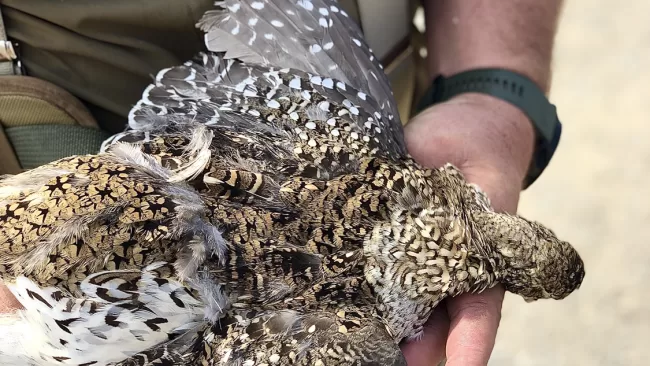
Its physical appearance was striking. It had a mottled, brownish-gray body with white chest feathers. Its specialized head feathers and long black tail feathers with white tips distinguished it from a female. I had shot a big male. Later, while at a Wyoming Game and Fish Department Sage Grouse Checkpoint, I would learn the bird was approximately a two-year-old “bomber” based on the measurements of the wings and other identifying male features. I raised the gray bird and set it on the tailgate. From my pack I retrieved a pair of sharpened game shears. The wings were spread out. The primary feathers were brown in color, and the undersides were white. The right wing was removed by cutting it off at the joint as close to the body as possible.
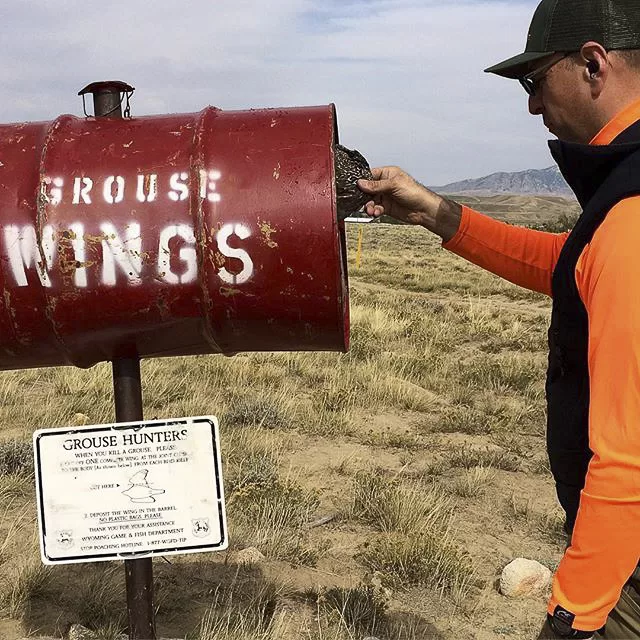
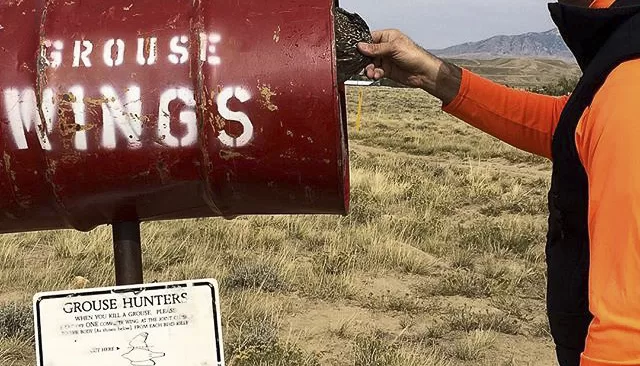
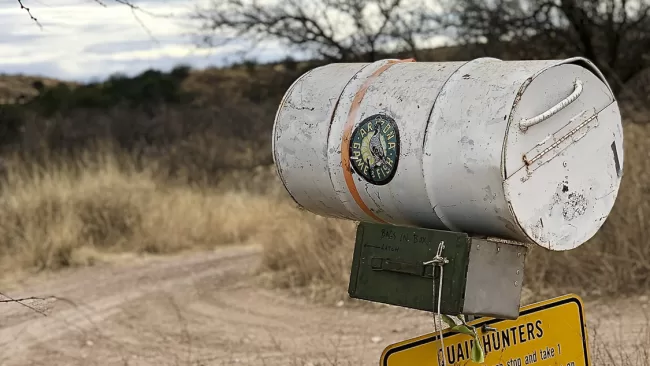
I returned the sage grouse to its resting place in my bird vest. I walked to the barrel with the stenciled words “GROUSE WINGS” spray-painted in white on both sides. Below the barrel a sign with specific instructions for hunters to follow. Wyoming Game and Fish biologists have placed marked barrels at convenient locations in the field and near major access roads to popular hunting areas along highways. I placed the sole wing into the dark opening of the red container and walked away. What sort of information would be obtained from my sage grouse?
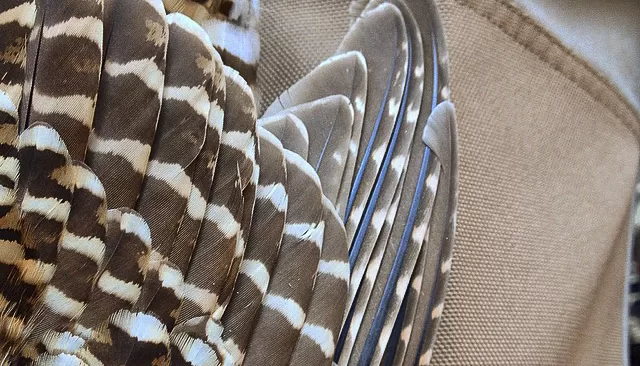
The number of sage grouse wings submitted depends mainly on the cooperation of hunters.Bird hunters who voluntarily deposit wings help biologists obtain valuable information. Personnel specifically look at the ninth and tenth primary feathers on each wing to determine gender. Shorter feathers would show that the sage grouse was a juvenile, born in the spring. The number of juvenile and female birds in the wing count give an idea of the sage grouse reproductive success. Hen feathers tell if there was success in raising a brood. Female sage hens that show signs of finished molting when killed are a good indication the brood was lost, which freed up energy to go into molting. On the other hand, wings that show a slower molting pattern indicate the hen spent the summer raising her brood. Wing data from harvested sage grouse are especially valuable in wet years, where the birds are spread out more across the landscape, making it harder to get a good sample on brood sizes. Researchers know that brood success combined with lek-count data from specific areas, such as places with recent prescribed burns, has led to areas closed to hunting to help sage grouse populations recover.
THE IMPORTANCE OF WING COLLECTION: SURVEY SAYS…
The importance of wing collection is vital towards the continued understanding of both upland birds and waterfowl, especially those birds that benefit from such retrieved information (sage grouse and lesser prairie chicken). Unlike pheasants, which are easily counted during roadside surveys, determining the reproduction of grouse and other game birds and providing a fall forecast to hunters is not as easy. State and federal agencies each do their part in conducting surveys through wing collection to better determine populations and set and evaluate hunting seasons and limits. Population gauge aside, the wing count also acts as an informal report card for agencies.
Greater Prairie Chicken Wing
The US Fish and Wildlife Service conducts the largest part of wing collection (dove, waterfowl, and woodcock) known as the Migratory Bird Parts Collection Survey. Wing surveys or wing-bees, as they are known, provide detailed information about the harvest. If participating in the federal survey, postage-paid wing envelopes are sent to randomly chosen hunters to send in their wings and parts to one of four collection points, one in each flyway. When the wings/parts arrive, they are sorted by species and stored in a freezer. The wings are then carefully reviewed for color, size, and shape of the feathers. Collected data are then entered into the national database for use in harvest management considerations.
Across the country in different regions, wing collection boxes or barrels are set up by various agencies and organizations (Ruffed Grouse Society, for example) for deposits from band-tailed pigeons, dove, grouse (blue, dusky, prairie chickens, ruffed, sage, sharp-tail), ptarmigan, snipe, and woodcock. Typically, hunters are asked to provide one wing from each bird taken.
An example would be the US Forest Service’s request of hunters in the Fort Pierre National Grasslands to provide a wing of each greater prairie chicken or sharp-tailed grouse shot. Collected wings help form a general idea of population conditions for upland birds in the grasslands. These chicken and sharp-tail wing counts are crucial, as they are umbrella or indicator species, along with prairie dogs. Their health and population numbers are suggestive of how animals who share similar habitats are faring. If these prairie grouse are doing well, it can be assumed other species are, too.
MORE THAN WINGS
Some states conduct wing surveys and othermiscellaneous parts collections to gain a better understanding in upland bird populations. The state of Washington requests that forest grouse hunters help by voluntarily depositing wings andtails of shot birds into collection barrels. This helps with species that are remote and difficult to study.
Alaska launched a wing collection program in 2013 to gain insights into the state’s four species of grouse and three ptarmigan species. Hunters are asked to provide one grouse wing and tail, and one ptarmigan head and wing. The additional parts are yet another component and tool in identifying specific data such as sex, age, and also help evaluate populations. Biologists know that most grouse are harvested between the first part of the season (early to mid-August) and Thanksgiving. After that bird hunters tend to switch to hunting ptarmigan in the winter. This data helps determine harvest compositions to which biologists use to better understand distribution and how harvest changes over areas and time, informing management decisions such as seasons and limits.
Sharp-tailed Grouse
Oklahoma researchers go as far as requesting hunters voluntarily donate one wing, preferably the right wing and the crop or crop contents of harvested quail (bobwhite and scaled quail). This helps in identifying WMA-specific (wildlife management area) fall and winter food sources and provides a broader picture of how quail use WMAs.
And of course, a wing survey wouldn’t be complete without a state requesting hunters to donate ruffed grouse wings. Cooperation between the New Hampshire Fish and Game and the New Hampshire Ruffed Grouse Society Chapter allows for an annual grouse wing and tail survey to be conducted throughout the state.
Samples provided by hunters allow biologists to determine age and sex composition, distribution data, and juvenile-to-adult female ratios. This information is critical about ruffed grouse and helps in determining populations and cyclic trends.
OTHER GAME BIRDS THAT WOULD BENEFIT FROM WING SURVEYS
Wilson’s snipe, sora rail, clapper rail, king rail, and Virginia rail–these five species are difficult to monitor because of their secretive habits, cryptic coloration, infrequent vocalizations, and use of difficult-to-access dense wetland habitats. Population sizes, and trends in abundance, are essentially unknown for snipe and rails at the flyway and national levels.
Harvest estimates are available for snipe and rails through the Migratory Game Bird Harvest Information Program (HIP), but annual harvest management decisions are made with considerable lack of information. At the moment, the Parts Collection Survey (PCS) for rails and snipe enables estimation of the species composition of the rail harvest and the age ratio of the snipe harvest. Wings collected as part of the PCS could be used for additional purposes to better inform management of these species.
Other uses for the wings include: (1) developing methods to age rail wings, (2) determining the spatial origin of the harvested rails and snipe, and (3) further assessing the species composition in the harvest. Surveys do not exist for rails and snipe. Surveys or wing-bees such as those for other species (i.e., doves, waterfowl, and woodcock), do not exist for rail and snipe. One possible solution would be to hold a rail and snipe wing-bee/survey in conjunction with the annual woodcock wing-bee.
THE REASON TO “WING IT” – PRESERVING THE OPPORTUNITY FOR FUTURE GENERATIONS
Data from the collection of wings can be used by biologists to better understand the distribution and the timing of game bird harvests in specific areas, the relative proportions of harvested birds, and the sex and age structure of game bird populations. Distribution and timing of harvest has relevance to obtaining information pertaining to game bird populations and trends, season structure, and to hunter participation for coordinating law enforcement activities.
Collections of game bird wings from volunteering hunters is a reasonably low-cost method in obtaining valuable information such as demographic profiles of game bird populations, overall health of species, and correlating habitat in specific areas. Consistency in wing collections is important in comparing harvest and hatch dates, and age and sex ratios between areas and years.
That is why there is a need to continue education efforts to increase hunter awareness and participation in returning wings, tails, and other requested parts. These efforts should emphasize the need for hunters to voluntarily drop wings off in identifiable boxes and barrels.
So if you’re a bird hunter and want to do your part, I recommend volunteering a wing or two (or tails) from harvested birds in the name of science. This is especially true when hunting those birds that are on a fine line of being accessible to hunt, e.g. the sage grouse. By committing a wing, hunters are in a sense preserving future hunters’ opportunity to hunt upland birds and waterfowl. Hunters going into an area can contact DNR offices and obtain information as to whether or not the area is participating in wing collection. Some agencies provide wing box locations via their website to better help hunters locate drop-off boxes. Once the decision is made to drop a wing off at a collection site, after that it’s relatively easy. Hunters just need a good sharp knife or pair of game shears.
WHY COLD AND MISERABLE CONDITIONS MAKE FOR BETTER DUCK HUNTING
By Don Thomas
THE SCIENCE BEHIND COLD WEATHER AND SOUND TRANSMISSION
The thing I notice first when the thermometer descends past 10-below here on the high plains isn’t the cold; it’s the acoustics. The physics are straightforward. Cold air is dense air, and molecules of nitrogen and oxygen transmit sound waves more efficiently when they’re packed tightly together. But to the observant outdoorsman, the complexity of the results defies the simplicity of their explanation. This morning, the sound of the spring creek babbling past the front of our makeshift blind offers an orchestral range of tone and timbre. Dry snow squeaks beneath the dog’s paws. The tinkle of frozen willow branches yielding to a browsing whitetail’s teeth sounds positively intimate even though the deer is over a hundred yards away. And when the first wave of mallards rises from the stubble fields two miles to the south, I can hear contented feeding chuckles long before I ever see the birds.
I have been told by responsible adults that hunting waterfowl in these conditions is a lunatic passion and they no doubt have a point. But they don’t know the local game the way I do. We live in an arid county on the cusp of the Pacific and Central Flyways. Absent abundant wetlands and a position in the middle of the great autumn flight paths, the first two months of duck season here are largely unproductive. That’s not to say I don’t hunt ducks then; I just don’t expect to kill a lot of them. Come December though, several thousand mallards will be wintering in the valley, feeding in grain fields and living on whatever open water they can find. When the mercury plummets and ice grips the rivers and reservoirs, they flock to spring fed creeks and ponds where the hunting can be spectacular. The Catch-22? If it’s warm enough to be comfortable in a blind, you’re not going to shoot any ducks.
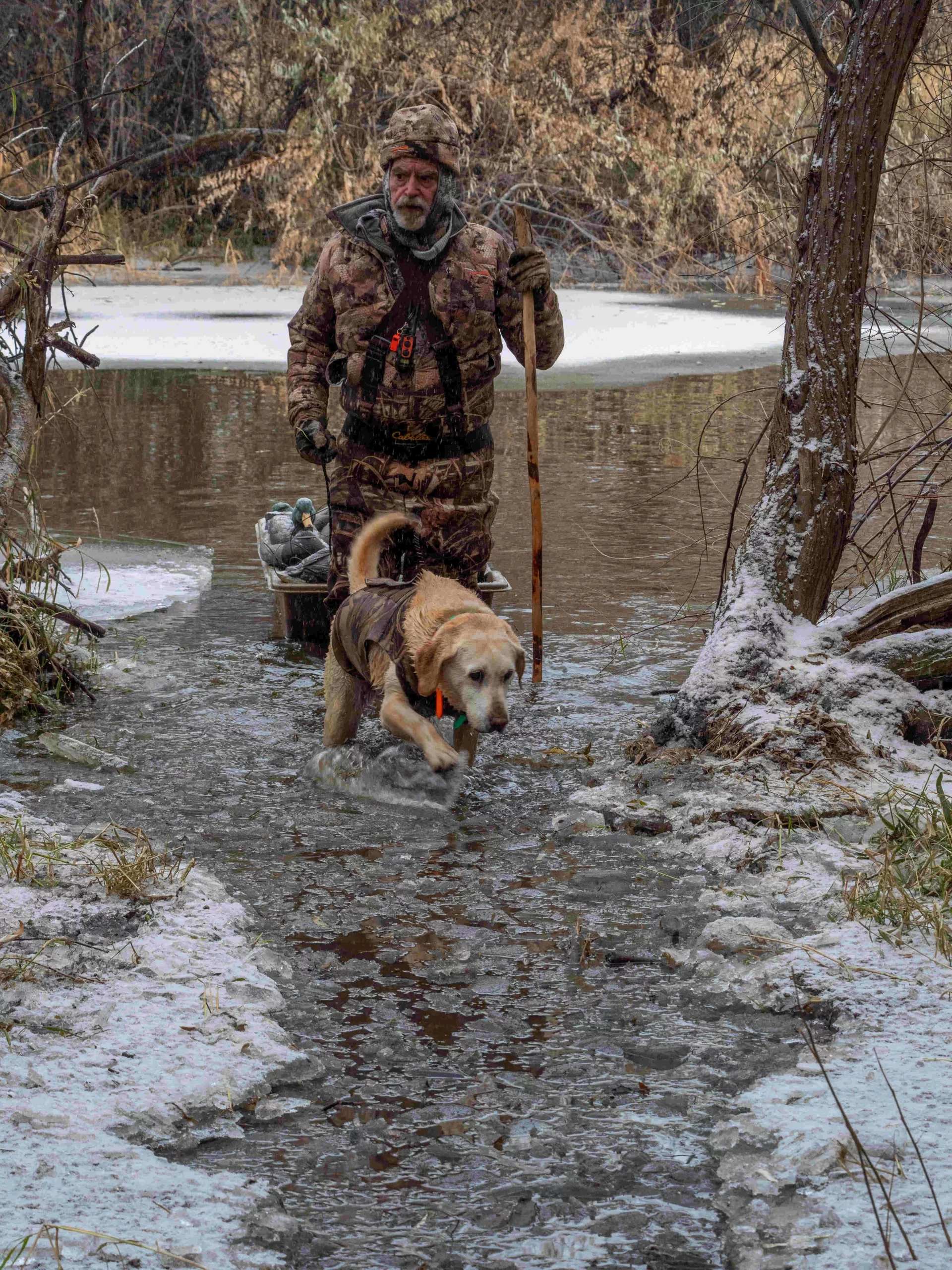
Since the converse is true as well, Lori and I are bundled head to toe in an assortment of low, medium, and high-tech clothing adequate to stock a sporting good store. Canine companionship this morning comes from Rocky, the seasoned half of our kennel’s current yellow Lab duo. The temperature means nothing to him. Muzzle framed in a halo of icy whiskers, he’s busy scanning the sky for birds. We’ve loaded our guns – the chink of brass on steel still seems to be echoing from the hills – but there’s nothing to do but wait, providing an opportunity to reflect upon years of experience with the correlation between great wing-shooting and miserable weather.
WHY WATERFOWL HUNTING IN MISERABLE WEATHER WORKS
Even as a kid, I quickly realized that bluebird days are anathema to waterfowling. I still remember a long hike through the sagebrush to a large Columbia Basin pothole one clear, still October morning. Sunrise revealed a huge raft of puddle ducks and divers in the middle of the glassy lake, none closer than 200 yards from shore. Lifeless as decoys, they stayed there all morning. The few new arrivals all bypassed our spread to join the pajama party far out in the water. Down to shirtsleeves by mid-morning, my hunting partner and I finally circled the shore shouting and waving in a futile attempt to get some ducks airborne. The only shot we fired all morning came in a pointless attempt to flush the flock. Damn, but that was a gorgeous day.
The value of rain, snow, wind, and other forms of climactic misery is old news to seasoned waterfowl hunters, but bad weather has its place in upland cover too. Hot, dry scenting conditions can render even the best flushing dogs helpless. Weather concentrates upland game as well as waterfowl in predictable ways and there’s nothing like a foot of fresh snow to slow down running pheasants and chukar. Here in Montana, I’ve long been partial to the waning weeks of pheasant season, for reasons that have nothing to do with easy limits. I’m hunting educated survivors then, and a few cagey December roosters mean more to me than game vests full of naïve birds during the opening week. The dogs can run all day without overheating and so can I. Only a few fellow madmen are foolish enough to hunt pheasants in blizzards and they’re the folks I’m happy to run into out in the field anyway. Indian summer days early on make for nice pictures, but angry winter weather often makes for better bird hunting.
CLOTHING CHOICES FOR WATERFOWL HUNTING IN BAD WEATHER
Today’s new generation of outdoor clothing has made it easier to hunt birds in nasty weather and I certainly take advantage of modern synthetics and rain gear when I’m heading out into the worst of it. But as an incurable romantic, I’m not ready to forsake all of the old ways. I like the smell of wet wool; like a good whiff of pronghorn or moose, that aroma instantly evokes countless subliminal memories, most of them pleasant (at least after the fact). No matter how comfortable a good arsenal of modern outdoor wear can make you during the thick of the fray, I sometimes think we should chuck it all and go back to cotton long-johns, plaid wool shirts, and no-camo slickers just for old time’s sake. Granted, that kind of sentiment usually goes best at the end of the day when you’re dressed in fresh, dry clothing and sitting in front of a crackling fire with a glass in your hand.
No matter how you’re dressed, nasty wing-shooting weather can eventually cross the line from inconvenience to serious discomfort. One day years ago I was hunting the Cook Inlet tide flats in mid-October with my old Lab, Skykomish. The weather was beautiful when I took off from the dirt strip beside my house, with nothing serious ahead on the weather map. That’s a dicey time of year up north though and winter can arrive in a hurry… as it did a little after nine o’clock the following morning.
I was bundled up beside the decoys shooting nothing when I saw a wall of weather start to spill over the top of the Alaska Range behind me. I would have packed up and run for cover, but all the ducks that had been riding out the Indian summer deep in the Alaska Interior arrived right along with the storm. By the time I’d shot a limit of puddle ducks and Sky had retrieved them, ice was already forming on the decoys and I had gale winds and sleet in my face all the way back to the duck shack. But that was a gorgeous day too, at least once I’d reached the comfort of the oil stove.
HOW TO STAY WARM HUNTING IN COLD WEATHER
Before we progress to the dogs and their responses to cold weather, let me offer a brief review of proper protection from the elements based on years of experience in the field of wilderness medicine. Dressing properly to prevent hypothermia involves three layers of clothing. The inner wicking layer conducts heat-robbing moisture away from the body. Polypropylene or silk long underwear serves this purpose well. The middle insulating layer creates a thermal barrier to prevent loss of body heat to the environment. While newer synthetics accomplish this adequately, it’s still hard to beat wool, or even down as long as you’re sure you can keep it dry. The outer barrier layer protects everything inside from both wind and rain. Gore-Tex is an excellent choice if you’ll be exerting enough to work up a sweat, since it allows both inner layers to breathe. If you’re sitting still in a duck blind, an impervious fabric such as oilskin or rubberized cloth may keep you even more comfortable on rainy, windy days.
HUNTING DOGS IN COLD WEATHER
A retriever’s ability to thrive in such conditions – while plunging in and out of icy water, no less — seems utterly amazing, especially to non-hunters who sometimes wonder aloud how we can make our dogs do such things. There’s an easy answer to that question. We can’t make them hunt in cold weather; they’re too busy volunteering. Thanks to centuries of selective breeding back when our dogs’ ancestors were retrieving codfish from the North Atlantic, today’s retrievers come dressed naturally in water repellant, insulating coats that no human technology can rival. The problem isn’t making them go out on frigid mornings to fetch ducks; it’s making them come back home with you once you’ve shot your limit… or given up because you can’t stand the cold anymore.
Friends from lower latitudes sometimes wonder why I don’t dress my dogs in Neoprene vests on such cold weather outings, and I appreciate their concern. I also have experienced friends who do use vests on their dogs, but I’ve always taken the position that it’s hard to improve upon nature. Left alone, a Lab’s coat will shed water, fluff out, and begin to trap insulating pockets of air moments after a single shake at the end of a water retrieve. (Note how well a retriever’s coat, with its combination of guard hairs, under fur, and body oils, mimics the function of wicking, insulating, and barrier layers of clothing as described above.) And of course my dogs are conditioned to cold by habit as well as genetics. If I were taking a retriever from Mississippi to northern Alberta to hunt ducks over water, I would argue for some supplemental insulation. The same applies if I were asking a short haired breed like a GSP to handle the duck blind chores.
The only time I’ve ever seen any of my Labs act uncomfortably cold while hunting was when they were puppies. While still a youngster, Rocky whined so hard when we threatened to leave him behind one day that we relented and took him along despite the cold temperature. He spent the morning curled up on Lori’s lap while old Sonny handled all the retrieving chores. Young dogs have a high ratio of surface area to body mass, which promotes the loss of heat to the environment. Moral: if a pup objects to being left behind when you head out the door on a bitter day, leave the dog behind anyway.
Back down at the creek, Lori, Rocky, and I are shivering and waiting for Godot. Fully adapted to the cold and clad in the best insulation nature can provide, the dog looks happy as a pig in slop. He knows why we’re here and instinctively recognizes the mission as his raison d’etre. Lori seems less certain. She makes no bones about the fact that she’d rather shoot one shoveler on a nice day than a limit of sub-zero greenheads, but she’s too proud and stubborn to show the white feather. If anyone’s going to decide we’ve had enough and start picking up the decoys, it’s going to be me.
WHY SUBZERO TEMPERATURES ARE RELATIVELY SAFE TO HUNT IN
One important technical consideration amidst all this story-telling: 20-below may be damn cold but this isn’t the kind of weather that gets hunters in real trouble. Frigid temperatures like this are almost always the result of stable high pressure systems, which means little wind or moisture. You’re much more susceptible to hypothermia on a wet, windy day with temperatures in the 30’s than on a calm, clear one like this, no matter what the thermometer says. And that’s my rationalization for hanging on a little bit longer. I know we’ll survive; I just hope my marriage does too.
The face, feet, and hands always go first on days like this. Wool ski masks have the first concern covered, although frozen condensation from my breath has turned my beard into a bib of ice. Cold fingers have long been Lori’s downfall, but she’s learned to stuff her pockets with chemical hand-warmers and I can feel their heat against my side as we huddle together on the fallen log. Insulated waders and heavy socks notwithstanding, there isn’t much to do when your toes start to go numb except stamp your feet and hope the birds arrive before common sense prevails.
We’ve just reached that stage when Rocky glances sharply back over my shoulder. He’s too well trained to break, but the rules don’t say anything about excited whining. The noise of setting wings sounds like a jet engine spooling up for takeoff. Then the birds are circling the blocks and it’s time to start mentally isolating drakes from hens.
By pass-shooting standards, there isn’t much to the gunning here in the late season, when most birds fall at ranges I could reach comfortably with my fly rod. But the show is all mallards, and the goal is to kill five birds with green heads while leaving the ladies untouched. The epic part of the morning will belong to the dog soon enough.
“Take ‘em!” I whisper on the next pass and seconds later three drakes are tumbling as the rest of the flock claws its way back into the sky. Two of the fallen birds leave neat little entrance wounds in the snow bank across the creek while the third tumbles away on the dancing current. After handing my empty gun to Lori, I line Rocky up on the troublesome retrieve and he’s off in a spectacular geyser of spray.
Suddenly the cold just doesn’t feel cold anymore, and it’s another gorgeous day after all.
There are a number of culprits that can stress a dog out, such as separation, unfamiliar visitors, a change in weather, loud noises or novel sounds. Sporting dogs, in particular, could demonstrate anxious behaviors over a disruption in routine or location, whether it be due to travel or going to a new trainer.
“One of the biggest stressors for bird dogs especially is inactivity,” says pro trainer Ike Todd of Todd Kennels in Somerville, Tennessee. “A dog’s anxious behavior is best controlled by regular physical and mental stimulation. Anything you can do to keep your bird dog active, such as running, roading or providing a more spacious kennel or outdoor enclosure, will help promote calmer behavior.”
“What’s more, a dog showing anxiety about training situations, in particular, even after he or she has been adequately exercised, will sometimes respond better when worked with more well-adjusted dogs,” Todd says. “A dog learns by association and being around other willing participants can help boost his or her confidence.”
Anxious behaviors in a dog typically are signaled by pacing, reluctance to accept treats, and excessive barking or panting. An anxious dog living in a state of chronic physiological stress may be prone to chronic health issues.
“It’s important to talk to your veterinarian if your dog is displaying undesirable behaviors,” says Purina Director of Veterinary Technical Communications Jason Gagne, DVM, DACVN. “What might be perceived as just a characteristic of a particular breed or part of a dog’s personality could really be an anxious behavior that needs attention.”
Follow these tips to help manage your dog’s anxious behaviors caused by external stressors.
1. Expose ‘Em Early
First things first. Learning to cope with stressful situations begins during puppyhood. Puppy gyms, or boxes made of PVC frame with various dog toys suspended from ropes or plastic chains, can promote early socialization and sensory stimulation, the foundation for a well-rounded, adaptable dog.
“Anything that involves physical and mental activity for young pups is good,” says Todd. “The more a pup is exposed to, whether it’s a puppy gym or true field-like conditions, the better he or she will be prepared for life as an adult.”
Do your homework before buying a pup and check with prospective breeders on their socialization philosophy.
2. Don’t Set an Expiration Date
A pup should be introduced to the world outside the whelping box, and socialization doesn’t expire once a dog enters adulthood. Continue exposing your dog to new people, places and experiences throughout his or her life, ensuring positive interactions by using common sense and safety considerations.
“Socialization throughout a bird dog’s life is best accomplished through time spent in the field,” Todd explains. “Dogs love it and thrive on it.”
3. Make Noise
A dog should be exposed early and regularly to household noises such as the vacuum cleaner, blow dryer, blender, washing machine and clothes dryer, as well as outdoor noises such as the tractor, lawnmower, weed eater, blower and all-terrain vehicles. Furthermore, a sporting dog should have an early gradual introduction to especially loud sounds to reduce fear of noise.
“Early exposure to loud noises is ideal for a bird dog, provided it’s in a controlled environment,” Todd advises. “Any loud noises should be introduced from a safe distance away initially and be associated with something enjoyable, such as eating or playing, so that whatever is being introduced is associated with a positive experience.”
4. Practice Makes Perfect
Ensure your dog is well-accustomed to travel before leaving on any trip. Start by putting your dog in a crate and taking him or her on short errands, increasing the length of time each trip, to gradually condition the dog for riding in a vehicle. The more comfortable your dog is in the car, the longer he or she can ride.
To further desensitize a dog to travel, give him or her plenty of exercise prior to traveling. “Just like a tired child travels better, so too will a bird dog,” says Todd.
5. Calm During the Storm
“A dog with storm anxiety should be given a safe, confined and comfortable space for the duration of a storm,” says Todd. “Anything you can do to help put your dog at ease can help alleviate his or her fear of storms.”
Keep your dog distracted during a storm by offering his or favorite toys and treats and playing light music to drown out rumbling thunder. Products such as the Thundershirt can also help ease storm anxiety.
6. Relax Together
A dog depends on his or her owner for security, so patience and persistence on your part is key to helping your dog be stress-free. Always keep desensitization sessions short and fun, offering praise or a treat for positive interactions.
Purina Pro Plan Veterinary Supplements Launches Probiotic Breakthrough for Helping Dogs Maintain Calm Behavior
What if you could help support your dog with a probiotic to help him or her stay calm? Purina Pro Plan Veterinary Supplements Calming Care is a canine probiotic supplement available through veterinarians, online retailers, and select pet specialty stores containing Bifidobacterium longum (BL999), a probiotic strain shown to help dogs maintain calm behavior.
“The gut is sometimes referred to as a ‘second brain’ because of the bi-directional communication between the gut and the brain,” explains Purina Director of Veterinary Technical Communications Jason Gagne, DVM, DACVN. “There is scientific evidence that manipulating the gut bacteria can also have a positive influence on dogs displaying anxious behavior. For example, Bifidobacterium longum (BL999), the probiotic found in Calming Care, has been shown to help dogs maintain calm behavior.”
“Different strains of probiotics have different effects on the body,” Purina Research Scientist Ragen T.S. McGowan, PhD, says. “In a 15-week blinded crossover design study, we evaluated the effects of administering BL999 to 24 Labrador Retrievers that demonstrated anxious behaviors. By the end of the study, 90 percent of dogs showed an improvement in displaying anxious behaviors, such as excessive vocalization, jumping, pacing and spinning. Dogs in the study also showed improvement in physiological factors, including positive cardiac activity during stressful events1.”
Calming Care helps support dogs with anxious behaviors such as excessive vocalization, jumping, pacing and spinning, and helps them cope with external stressors such as separation, unfamiliar visitors, novel sounds or changes in routine and location. It also helps dogs maintain positive cardiac activity during stressful events, promoting a positive emotional state, and supports a healthy immune system.
Available through veterinarians, Calming Care should be given under your veterinarian’s supervision. If you have concerns about your dog’s behavior, talk to your veterinarian.
1McGowan, R.T.S. (2016). “Oiling the brain” or “Cultivating the gut”: Impact of diet on anxious behaviors in dogs. Proceedings of the Nestlé Purina Companion Animal Nutrition Summit, March 31-April 2, Florida, 91-97.
Henry Big Boy All-Weather Side Gate Rifle – $1,141 (henryusa.com)
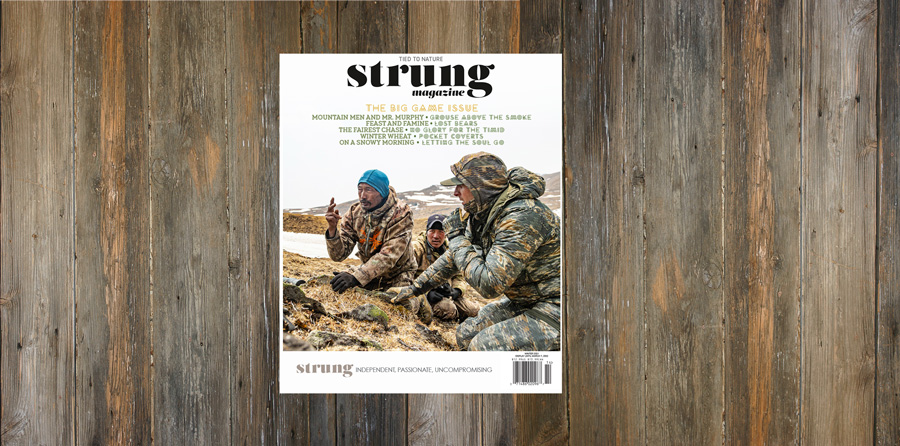
The theme of this year’s Big Game Gear Guide is versatility, and this rifle from classic American firearms manufacturer Henry certainly fits the bill. We tested it in .44 Mag and found it useful in a wide variety of situations. The all-weather version (chrome plated steel and industrial-grade coated hardwood stock) means you don’t have to baby it in the rain or snow. It sports a 10+1 tube magazine capacity and shorter lever throws thanks to the shorter cases of “revolver” calibers. For longer range shooting, it’s drilled and tapped for mounting optics. The Big Boy is a tough rifle that is at home in the deer woods, riding along as a truck gun, or slung across your back in bear country. The Big Boy adds to Henry’s reputation for American-made quality.
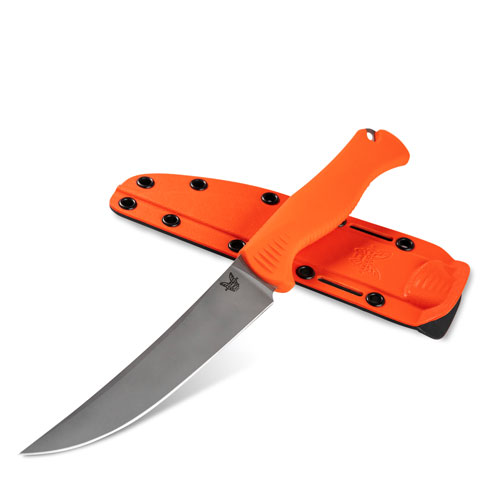
Strung’s Editor-in-Chief, Ryan Sparks, worked as a butcher when he was younger. He wishes he had this knife back then. We won’t go into the science behind it, but the SelectEdge technology Benchmade brought to the Meatcrafter results in a perfect edge from the factory. Being in such excellent condition out of the box means minimal and simple maintenance down the road. With a trailing point and semi-flexing blade, this is truly a field-to-table knife. If we could only have one knife for everything we do—from skinning, field dressing, and deboning big game animals to filleting bluegills—this would be it.
Danner Recurve Moc Toe Boots – $200 (danner.com)
Danner calls their new Recurve Moc Toe a “performance heritage boot,” which is to say they took a classic hunting boot design and infused it with modern technology. A waterproof upper keeps your feet dry while the breathable mesh lining prevents sweating, giving you versatile boots that you can wear from August antelope through rifle elk. The 7-inch ankle height provides plenty of support without becoming heavy, and a nylon shank takes the place of traditional steel, further cutting down on weight. Outside of their functionality, we also like their classic look.
MEAT! makes commercial-grade meat-processing equipment like grinders, sausage stuffers, meat slicers, and vacuum sealers designed to exceed expectations. Even better, their direct-to-consumer approach means they can offer products of the highest quality without an added retail markup. We used a variety of their meat-processing equipment, from their 10-tray dehydrator to their vertical sausage stuffer to their 440-pound digital meat scale, and were impressed by the quality and thoughtfulness of design.
Stone Glacier Sky 5900 – $659 (stoneglacier.com)
Stone Glacier is a Montana-based company that builds American-made packs for everything from day hunts to multi-week expeditions. We used their Sky 5900 for an 8-day elk hunt and can say that it is hands-down the best pack we’ve ever used. The pack’s construction, including the Xcurve frame that contours to the shape of the back, allows for infinite adjustability. After a few minutes of fine tuning, it fit like it was tailor-made. An integrated load-shelf lets the bag pull away from the frame, creating a platform where you can lash meat between the frame and the pack. This prevents blood from seeping into your pack and keeps the heaviest weight near your back during a pack-out. Expanding the load-shelf ups the Sky 5900’s carrying capacity from 5,900 cubic inches to 8,000—perfect for hauling elk quarters or an entire boned-out deer, pronghorn, or sheep. The frame is compatible with all of Stone Glacier’s bags, so you can swap out bags depending on the nature of your hunt.
Leupold Pro Guide Tripod Kit – $599 (leupold.com)
With their new Pro Guide Carbon Fiber Tripod, Leupold has a tripod worthy of its optics. Weighing just under 4 pounds, the tripod extends to nearly 5½ feet with the addition of a removable center post, and has the strength and rigidity to handle full-size spotting scopes and large cameras. Four-section legs nest to make a pack size of about 22 inches, and the unit ships with a ball head and Arca-Swiss mounting hardware to handle most optics bases. The stout legs deploy with precision and ease and lock in place with quarter-turn twist controls that have oversized rubber grips that make operation a cinch, even with gloves. The Pro Guide is the “just right” middle of a trio of new carbon tripods from Leupold; the 2-pound Alpine model ($399) is suited for backcountry hunts, and the 5.3-pound Mark V ($999) is a beast that will stabilize even massive optics in heavy wind.
When it comes to foot care, hunters far too often focus on boots and overlook their socks. Buffalo Wool Co. makes bison-fiber socks in a variety of weights so your feet will stay comfortable no matter the conditions. What makes them so great is the inherent qualities of bison down. Bison wool is warmer than sheep wool and as soft as cashmere. Short and crimpy fibers create small air pockets that insulate by trapping air while simultaneously wicking moisture away from the skin. Bison down is also naturally soft, comfortable, and antimicrobial (think scent control), and doesn’t lose its loft after a day of hiking. We tested their Trekker Boot Socks as well as their Pro-Gear Boot Socks, and we wouldn’t think of hunting in any other socks from now on.
onX Hunt App – $14.99–$99.99 (onxmaps.com)
Over the last several years the onX Hunt app has become so integral to our hunting that we can’t imagine hunting without it. Covering over 985 million acres of public land and more than 121 million private properties in all 50 states, OnX Hunt gives you access to land ownership data, GPS tracking, topographic maps, and more. Using the onX Hunt app allows you to scout terrain before upcoming hunts, find lesser-known access points, share hunting locations with friends and family, measure distances, and find your way home if you get turned around. You can purchase maps for a single state or get the Elite 50-State Membership. Both last a year and are worth every penny.
Montana’s winter waterfowl season doesn’t truly arrive until the temperature drops well below zero…
…freezing up all the water in the state except for spring creeks and tailwaters. Although not for the faint of heart, if you can find open water this time of the year, chances are you’ll also find some amazing hunting.
Waterfowl hunter with black Lab setting decoys.
Mallard Ducks/Flock
Late season in Montana is mostly a mallard game.
These mallard drakes are big, tough birds that often weigh between three and four pounds. They’re happy to stay “up north” if they have access to food and open water. Toss a few decoys into a spring creek, find a place to hunker down (ideally in a blind with a heater), and try to stay warm while you wait for the birds to arrive. Given the liberal bag limit of seven mallard in the Pacific Flyway, the action often goes a long way toward staving off frostbitten toes.
Bagged ducks and waterfowl hunter calling birds.
Waterfowl hunter taking duck from black Lab.
There’s an intimacy about hunting these small spring creeks. Boots are more important than boats. Birds tend to decoy fairly close.
Black Labrador Retriever
Dogs do more running than swimming to retrieve ducks from the clear, shallow water.
Hunter-killed mallard ducks.
Extreme cold and hoarfrost also make for some interesting adornment on both hunters and dogs—think icicle beards and pearly coats. Throw in a sunrise illuminating snow-blanketed mountains in the distance, and you can’t help but step back and marvel at the beauty of it all.
Keeping the Dogs Focused is the Key to a Successful Day
You’ve done your training all spring and summer, and first season went according to plan. But then a consistent cold front moved in, and the duck and goose migration kicked into high gear. That fired up the ordinarily calm dogs to the point that they whined and broke and ruined the morning’s hunt. All dogs get excited and make mistakes, so here’s how to get them focused without having to return to the training fields.
Robert Milner, the owner of Duckhill Kennels says “the excitement in a blind causes dogs to produce adrenalin, endorphins and other neurochemicals. Those hormones put them in a state of excitement. Fortunately, hormones dissipate faster than they are created. It takes three minutes for these neurochemicals to reduce and for the dog to relax. Behavior improves when they are calm, and that’s when they should be rewarded with a retrieve.
“To get an over-excited dog back on track I make him wait for three minutes before sending him on a retrieve. If he hasn’t calmed down and regained his focus then I’ll give the work to an obedient dog. I’ll repeat that method as often as necessary until the excited dog is calm. It might take five or more repetitions for young dogs and maybe only one or two corrections for experienced dogs. The point is to repeat as many times as necessary.
“I’ll also send dogs that are wound up on long retrieves. The same rush of adrenaline that excited the dog in the first place now motivates him to run and swim hard. Vigorous work on a long retrieve burns off some of those hormones, so when he returns to the blind he’s more calm than when he left. For the next retrieve I’ll build on that foundation. I make him wait for three minutes before sending him to fetch. Rewarding calmness is the foundation of good blind manners, and by pausing before sending a dog on a retrieve you’ll get your dogs back on track very quickly.”
Jeremy Criscoe, the Head Trainer at Whistling Wings Kennels, slightly changes his schedule to accommodate training and drills. “Post-hunt work is a great time to get rowdy dogs back on track. I always have some bumpers in the truck, so if I a dog was difficult in the morning I’ll put him to work when we’re done. I’ll stand outside of the pit or blind, throw some marks outside of the decoys, and run some retrieves.
“A lot of times dogs get worked up and break because of the perceived competition coming from other dogs. Honoring drills help them relax and focus. I’ll run some drills with a buddy and his dog. I’ll get my dogs under control, send his to fetch bumpers, and release mine when he’s calm and well mannered, and steady. I’ll switch up the order of which dog gets to retrieve. I might send his dog three or four times in a row to test my dog’s patience. When my dog behaves properly I’ll send him for the reward of the retrieve. Then I’ll give my dog several retrieves while my buddy waits with his dog.
“I always try to identify issues before they become problems. I know my dogs will be excited when we hunt a new area, so I’ll familiarize them with the spot before the hunt. I’ll arrive at the new location a little early on the day before the hunt. Then, I’ll introduce the dog to the new blinds and terrain. We’ll walk around, get in and out of the blind, and check things out. Throwing some bumpers for retrieves lets the dog get acquainted with running routes. It might only take an hour or two, but that pre-hunt exposure helps dogs get familiar with the new environment. They’re less likely to get ramped up in the morning.”
We’ve worked all year to get to hunting season. Don’t let a few mistakes derail your plan. Midseason corrections get dogs back on track so they can go hard for the rest of the year.
Tom Keer is Stung Magazine’s Upland Editor and an upland enthusiast. He has written literally thousands of features for outdoor publications over the last 30 years earning himself over 50 outdoor writing awards as well a golden reputation among upland hunters, dog trainers, and fly fisherman across the country.